Dog Training Nation

In Dogs We Trust

  • Home
  • Training
    • Dogs
    • Puppies
    • Clients
  • Behavior
    • Breeds
  • Health
  • Safety
  • Resources
    • Equipment
    • Books
  • Dog Training Videos
  • About
You are here: Home / Archives for Fanna Easter

Crate Rest Games for Dogs

March 9, 2015 by Fanna Easter

Stretches for Crate Rest Games
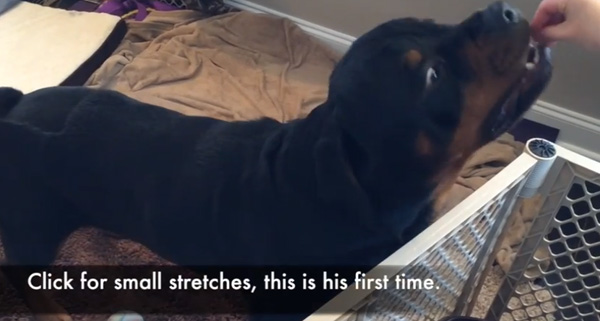
Dog Crate
Click and treat for small stretches.

I’ve researched crate rest games and there are some really good ones out there! So I created a list of a few since Sobek is the perfect candidate while recovering from cruciate ligament repair (torn ACL).

Depending on your dog’s injury, always consult your vet before performing any stretches. Be safe first!

Stretches are Good

Usually crate rest is prescribed after orthopedic surgery, meaning dogs should keep walking to a minimum during the first critical weeks. Sobek really enjoyed neck, shoulder and chest stretches. I noticed increased mobility during short potty walks. His neck and shoulders work harder, as he favors his repaired knee–poor baby boy!

Practice one stretching session in the a.m. and p.m.

Lure Dog’s Nose to Shoulder (Beginner Level)

With this stretch, your dog will stretch his neck and shoulder muscles. Move at your dog’s pace. His nose doesn’t need to touch his shoulder. You’re looking for tiny stretches in the beginning. Never force your dog’s head toward his shoulder, as this will make things worse. With continued practice sessions, your dog will become more flexible over time.

If your dog knows “touch,” replace the lure with your hand, then click and treat when your dog touches your hand.

You’ll need six yummy treats about the size of a penny and a clicker/marker word.

  • Hold lure in your right hand (or left, if you’re left-handed).
  • Place lure on your dog’s nose.
  • Slowly, lure your dog’s nose diagonally toward his left shoulder.
  • Click and give him the lure (treat).
  • Practice two more times.
  • Now, lure your dog’s nose toward his right shoulder. You may notice one side has more flexibility, which is normal.
  • Practice two more times.

VIDEO: Stretches for Crate Rest Games: Up and Down

Stretch Neck Up and Down

Picture a clock. You’ll lure your dog’s nose up into the 12 o’clock position. This will stretch your dog’s neck and chest. You’ll need several yummy treats about the size of a penny.

If your dog knows “touch,” replace the lure with your hand, then click and treat when your dog touches your hand.

Head Up

  • Holding a lure in your right hand, lure your dog’s head up. His nose should be pointing up in the air.
  • Refrain from lifting the lure up too high. You don’t want your dog to stand or sit up. You just want him to extend his neck and lift his head up.
  • Click and give him the treat (lure).
  • Practice two more times.

Head Down

  • Your dog can be sitting or lying down, whichever is most comfortable.
  • Place a lure on your dog’s nose and lure his nose toward the ground.
  • Click and give him the treat (lure).
  • Practice two more times.

Holding Stretches for One Second

After several practice sessions, hold the lure in position for one second, then click and treat.

Happy stretching!

You may also like: Teaching Your Dog the “Go to Place” Cue
Filed Under: Games, Health, Resources Tagged With: crate rest activities, crate rest game cruciate ligament surgery, crate rest games, crate rest games after acl surgery, dog neck stretch, shoulder stretches for dogs

Shaping Dog Behavior

March 5, 2015 by Fanna Easter

Shaping Dog Training

You’re Getting Closer

Dog BehaviorShaping dog behavior is another extremely powerful way to teach polite manners. A teacher uses basic learning fundamentals for humans, dogs, cats, fish and snails so let’s discuss how dog owners can use shaping in dog training.
What is Shaping Dog Behavior?

Shaping means rewarding small approximations, or small steps, toward a goal behavior. When teaching complex behaviors that don’t occur naturally, shaping works wonderfully.

Think of shaping as the “hot and cold” game. When a learner is “warm,” you click and treat. When she is “cold,” the learner is ignored. In shaping dog training, reward “warm” behaviors often because we all know how discouraging it is after hearing “cold, cold, cold.” You want to quit, and it’s no longer fun.

Shaping Happens Everyday

If you want to increase the chances of your husband emptying the dishwasher, reward him with control of the remote afterwards. You don’t need to say anything. Just push the remote toward him when he enters the living room after tidying up in the kitchen. 🙂

Works at the Office Too

You can totally shape better behavior at the office. For grumpy co-workers, ignore or limit chit-chat when they’re complaining. Reward smiles and positive comments by engaging in conversations. If he should become grumpy again, disengage. Over time, you’ll notice a happier co-worker even if it’s only with you. 🙂

Bosses are different. We sometimes need to engage when they’re grumpy. Instead of grimacing or blankly staring back at your boss, try nodding often and offering direct eye contact. This will lighten the mood, as your boss is being acknowledged. When you notice the mood lighten even if slightly, smile. You may notice your boss smiling back even just a little toward the end of your conversation. 🙂

Shaping Dog Training Technique

When teaching a complex behavior, such as walking on a loose leash, spend some time figuring out what polite leash walking looks like.

Polite loose leash walking components:

  1. Leash is loose.
  2. Dog looks back at you (checks in regularly).
  3. Dog walks around within three to four feet of your legs/body.
  4. Your dog can easily ignore approaching dogs.
  5. Dog ignores approaching people.
  6. Now, she can ignore movement (bicycles, cars passing by, joggers passing you on walking trails, etc.).

That’s a lot of components, and learning all of these at the same time is like learning to ski or dance in an hour. It’s not going to happen. 🙂

Pick one component and practice during training sessions. Once your dog learns to keep a loose leash after three or four practice sessions, move onto the next component and practice. Now you’re clicking for when your dog looks back at you while keeping the leash loose.

Once your dog can do both at the same time, move to component three. If, at any time, your dog begins pulling on the leash, take a step back and work on “keeping leash loose.” It’s hard doing two things at once. Remember balancing and then squatting down on skis? If you lose your balance, take a step back and refresh.

Slowly add one component at a time until your dog walks politely on leash. Again, take one or two steps back, isolate the component your dog is struggling with, and refresh. Once she’s ready, try adding back the final behavior.

Don’t Get Overwhelmed

Shaping actually prevents that dreaded overwhelming feeling. Keep it simple, split tasks into smaller chunks and refresh often. When working on a complex project at work, you probably wrote high-level tasks in an outline, captured and categorized each task in an Excel sheet, and completed items by category–that’s shaping!

You may also like: Teach Your Dog How to Use a Ramp

Filed Under: Behavior, Clients, Training Tagged With: dog trainer tips, Dog Training Tips, how to shape a behavior, how to shape behavior, puppy training shaping, shaping dog behavior

Teach Your Dog How to Use a Ramp

March 4, 2015 by Fanna Easter

Training a Dog to Use a Ramp

Dog RampsDog ramps are popular, as most dogs will benefit from using one during their lifetime. Ramps are extremely useful. They help small dogs on and off furniture, large dogs into and out of vehicles and prevent dogs from navigating steps after surgery.

The pet industry is filled with plastic, portable, wooden and decorative versions so choose the ramp that works best for the situation needed and your dog’s size.

Ramps are beneficial if your dog uses them. It’s important to teach your dog how to walk up and down a ramp. Dogs are smart and will likely jump over, off or go around a ramp because they haven’t learned how to navigate them yet.

How to Teach Your Dog to Use a Ramp

You’ll need lots of tiny yummy treats and a clicker. Treats should be the size of a pea, as you’ll be using plenty of them in the beginning.

Step One: Going Up

  • Sprinkle a thin trail of treats going up the ramp and take a few steps away from the ramp. Sometimes, our hovering is counterproductive and we, humans, usually feel the need to push or pull a dog closer to or up the ramp. Standing on the side of the ramp will prevent pushing forward.
  • Your dog will likely walk toward the ramp and sniff the treats or even eat a few. Praise her. She’s trying.
  • As she nibbles a few treats, praise her as she places a paw or two on the ramp.
  • If she’s still not sure, ask another member of the family to stand at the top of the ramp and praise her for touching the ramp.
  • After a few minutes, your dog will likely walk halfway up the ramp and look over the sides. Continue to encourage her to walk up the rest of the way.
  • Once she walks up the ramp, give her a handful of treats and lots of praise. I call it “have a party!”

Step Two: Coming Down

  • Using a trail of treats, sprinkle down the ramp. You’ll use the same techniques as teaching her to go up the ramp.
  • Some dogs are hesitant to walk up a ramp and others aren’t too sure about walking down a ramp. Dogs have different comfort levels just like people.

Step Three: Add a Cue

  • Once your dog willingly walks up and down a ramp, it’s time to add a cue.
  • Say “ramp.” As your dog begins to walk up or down the ramp, click and give a treat. Voila. There you go!

VIDEO: Teaching Your Dog How to Use a Ramp

READ ALSO: How to Choose a Dog Ramp

Filed Under: Dogs, Equipment, Resources, Training Tagged With: dog ramp, dog ramp video, dog ramps, dog ramps for car, dog ramps for chairs, dog ramps for furniture, indoor dog ramps, puppy ramp, teaching your dog who to use a ramp

Teaching Your Dog the “Go to Place” Cue

March 4, 2015 by Fanna Easter

Training a Dog “Place”

Training Dogs

When teaching dogs a “place” cue, you’re teaching them to place or target their bodies onto an object, such as a mat. There are so many uses for “place.” Here are just a couple of them:

  • Lying on a mat teaches young dogs how to settle down.
  • Great place for your dog to relax during family meals or when guests visit.

How to Teach a Dog “Place” Cue

You’ll need lots of tiny and yummy treats plus a clicker. If your dog is new to clicker training, I suggest attaching a six-foot leash to his collar. This keeps him with you until he learns the meaning of a clicker.

Choose a non-skid and comfy mat that hasn’t been used before as you’ll pick it up after each training session. The reason you pick up the mat after each training session is to ensure your dog is not practicing when you’re not around to reward his behavior. Good mats include yoga mats, bathroom rugs and small area rugs. About two-thirds of your dog’s body should fit on the mat.

Once “place” is on cue, meaning your dog will walk over and stand on the mat when given the cue, then you can transfer it to his bed.

Step 1: Teaching a Dog to Walk Over to Mat

Goals: 1) Dog walks toward the mat. 2) Dog places one foot on the mat.

  • Place mat in front of your feet and stand still. Look down at the mat and say nothing. Refrain from pointing at the mat. We want your dog or puppy to think here.
  • More than likely, your dog will either sit or stare at you, as he’s learned sitting usually works for treats. Don’t say anything. Just wait for your dog to touch the mat with one foot.
  • As his foot touches the mat, click and reset your dog.
  • After the training session, pick up the mat and store in a shelf.
  • Continue to click and treat for one foot touching the mat, and practice short sessions (five times in a row) for one to two days.

Goal: Dog places two feet on the mat.

    • Place mat on the ground in front of your feet.
    • Now wait for your dog to touch two feet on the mat. This means wait a second or two as your dog places both feet on the mat, then click and treat.
    • Reset and try again.
    • Practice short sessions (five times in a row) for one to two days.
    • Don’t forget to pick up the mat after each session.

Step Two: Keep Feet on Mat Longer

Goal: Dog keeps paws on mat longer (duration aka time).

  • Place mat down in front of your feet.
  • Once your dog touches the mat with his feet, wait one second before clicking and treating. To keep track of one second, say “one Mississippi” to yourself–that’s one second.
  • Reset and try again.
  • After five sessions, pick up the mat and practice again later. Continue to practice for a day or two.

Step Three: Add “Place” Cue

Goal: Dog walks over and puts feet on mat when given “place” cue.

  • As you drop mat down in front of your feet, say “place.”
  • Click and treat when he touches his one or two paws on the mat. Since you’re adding a cue, don’t worry about duration. This will come later.
  • The moment your dog turns back and looks at you, say “place.” You’re pairing the word “place” with “walk over and touch mat” behavior so make sure he’s looking at you and not distracted by looking for fallen treats. You want his full attention before saying the cue.
  • Keep practicing. You may notice after a few successful attempts, he may sit in front of the mat instead of touching it. He’s trying different things out. 🙂 Wait for him to touch the mat with his paw. It may take a one or two seconds, but it’s worth it. He’s thinking!
  • Pick up the mat.
  • Keep sessions short and practice for a few days.
  • Move to the last step once your dog will walk over and stand on mat when given “place” cue.

Last Step: Transfer “Place” Cue to Bed

  • As you’re placing your dog’s bed down in front of your feet, say “place.”
  • Practice several times using his bed in place of the mat.

READ ALSO: Keep Dog Training Sessions Short

Filed Under: Puppies, Training Tagged With: go to your place dog, go to your place puppy, teach dog to go to bed, teaching a dog a place cue, teaching your dog place, teaching your dog the place command

How to Choose a Dog Ramp

March 3, 2015 by Fanna Easter

Choosing a Dog Ramp

Dog RampsChoosing a dog ramp can be daunting. There are so many options out there. I’ll share some must-have ramps, and then it’s your decision going forward. 🙂
Ramp Features to Consider

Traction

Slick surfaces are scary for dogs so choose a ramp with a slip-proof walking surface and evenly spaced grippers for safety. Ramp grippers are very beneficial for older dogs. They can push against them when climbing up a ramp and they can control their speed coming down a ramp.

RELATED: 3 Reasons Why You Need Non Slip Socks for Dogs

For outdoor ramps, choose a non-skid surface appropriate for the weather conditions in your area. For an entire week, we were experiencing an unexpected ice storm in the deep South. I literally wanted to kiss the wide grippers and heavy duty carpet on our ramp. I couldn’t imagine having a plastic version during that weather. Thankfully, my husband is handy so he built our deck ramp for $60. 🙂

Width

In my opinion, wider is better, especially for medium to large dogs. Plus, senior dogs tend to widen their stance when walking down a ramp so provide plenty of room for movement.

Steepness

As we’re aware, walking up and down steep stairs strains knees and joints so choose a ramp with adjustable steepness. Not only is it more comfortable for senior dogs, it’s also easier to navigate post-surgery patients up and down for vet visits or potty walks. Personally, I’ve had to shimmy down a ramp for 10 weeks with Sobek, a 120-pound Rottweiler recovering from ACL surgery, and our lower sloped ramp saved my back!

Furniture Ramps

Non-skid walking surface, width and steepness are definitely factors when choosing a furniture ramp. I like the ramp style better than the stair version, as it’s easier for senior dogs to climb up and down. If you find a senior dog struggling, try lowering the slope (decreasing the steepness) and adding wider gripper bars across the walking surface.

You may also like: Teach Your Dog How to Use a Ramp

Filed Under: Equipment, Resources Tagged With: best dog ramp, best ramps for senior dogs, best stairs for dogs, choosing a dog ramp, dog ramps, furniture ramp for dogs, puppy ramp, ramps for older dogs, stairs for dogs

  • « Previous Page
  • 1
  • …
  • 98
  • 99
  • 100
  • 101
  • 102
  • …
  • 135
  • Next Page »

About

Dog Training Nation is a community of dog trainers, dog owners and dog lovers. Our mission is to provide trainers and owners valuable information to enrich dogs' lives. We cover a range of topics, from socializing puppies to dealing with aggressive dog behavior to selecting the best dog products. It is our hope you share our content to make the dog and owner world a better place.

​

Facebook

Video

Dog Training Nation is a dog training blog for pet owners and dog lovers. We cover a range of topics from puppy socialization tips to dog aggression to dog health. It is our hope you share our content to make the world a better place for dogs.

Dog Training Nation

Quick Links

Dog Training
Dog Behavior
Dog Training Videos
Become a Dog Trainer
About
Contact Us

Copyright © 2026 · Lifestyle Pro Theme on Genesis Framework · WordPress · Log in