Dog Training Nation

In Dogs We Trust

  • Home
  • Training
    • Dogs
    • Puppies
    • Clients
  • Behavior
    • Breeds
  • Health
  • Safety
  • Resources
    • Equipment
    • Books
  • Dog Training Videos
  • About
You are here: Home / Archives for Fanna Easter

Dog Shock Collars are Cruel and Unnecessary

July 20, 2016 by Fanna Easter

Dog Shock Collars: They Hurt and They Don’t Work

Dog Shock Collars
GalpinPhotos/iStock

A few days ago, I stumbled upon a news article in which a mother was accused of shocking her toddler with one of these dog shock collars. What? Is this article for real?

Unfortunately, it’s very real and the mother is being prosecuted for child abuse. She had witnessed a pet owner using a shock collar on his dog to change the dog’s behavior. She thought the collar would change her toddler’s behavior too, so she shocked her child whenever he wouldn’t swallow food or didn’t potty in the toilet. I’ll spare all the gory details because it’s truly disturbing. However, if you want to read the full article, click here.

The world and I were disgusted that a mother would shock her child, but don’t we use shock collars to train dogs every day? Is there a difference?

Why It’s Upsetting

As a positive reinforcement dog trainer, I don’t use shock collars for dogs and stay clear from people who use them. I guess it’s my way of ignoring the problem. However, when I read this news article pertaining to a mother shocking her child, my heart dropped and that angry fire started burning inside me again. I asked myself, “Why are we still using dog shock collars?”

Everyone has a right to do as he pleases unless he’s harming someone else. For the most part, adults have a voice and can defend themselves if someone hurts them. They’ll fight back or press charges, or even do both. I don’t pick sides and I try to stay out of other people’s business, but when a voiceless and defenseless child or animal is hurt, I get really angry.

Dog Shock Collars Cause Pain

There is no reason to shock an animal. I’ll never be convinced that shocking or physically hurting an animal will teach it quicker, faster, more efficiently or more humanely. I’ll never believe any and all other buzzwords that further defend the use of pain during training.


Dr. Karen Overall, MA, VMD, PhD, DACVB, believes everyone should understand that:
“The use of shock is not treatment for pets with behavioral concerns;
the use of shock is not a way forward;
the use of shock does not bring dogs back from the brink of euthanasia; instead, it may send them there, and;
such adversarial techniques have negative consequences that those promoting these techniques either dismiss or ignore.”


I Used to Train Dogs With Shock Collars

You’re probably thinking I’m that dog trainer with limited dog training experience who has only used positive reinforcement methods. That’s not true. More than 25 years ago, I trained dogs with electronic collars (or e-collars), pinch collars and choke chains because that’s all I had known.

As I became more experienced, I knew something was wrong. I felt icky shocking a dog if he made the wrong choice. The look in his eyes would say everything. After a decade of training this way, I learned that rewarding good behavior instead of correcting bad behavior was the best way to train dogs (or any living creature for that matter).

Not only did my dog training skills improve, but my group classes were much happier too. We celebrated wins instead of waiting for bad things to happen, so we could correct them.

Oh yes, I’m on my soap box! If everyone clasps their pearls when they hear a mother shocking a defenseless child, why don’t they react the same way when a pet owner shocks a defenseless dog? Dog shock collars hurt. I’ve tried them on my leg, arm and neck at the lowest settings possible. Even knowing the shock was coming, it would still hurt. Shock collars don’t deliver a tickle, vibration or a buzzing sound. They stinking hurt.

Research Proves Shock Collars for Dogs Hurt

If you don’t find dog shock collars painful, you’re fooling yourself. Research has finally caught up and proven that shock collars do cause dogs harm. If you’re interested, you can find the latest research here and here. There’s more than a dozen research findings by real experts in this article too. The results all point to the same painful conclusion.

You may also be interested in: The Real Reason Why Dog Trainers Dislike Cesar Milan

Shock Collars Aren’t the Last Resort

Dog shock collars aren’t the last resort for saving a troubled dog’s life. I highly doubt you would consciously choose shock therapy to save your life. However, you have a choice whereas a child or dog doesn’t. Positive reinforcement dog training works better and quicker and changes dog behavior.

All creatures should be treated humanely because it’s the right thing to do regardless of your beliefs. I’m stepping off my soap box now and I strongly hope this article will stop at least one pet owner or dog trainer from purchasing or using a shock collar on a dog. As for new dog trainers entering the pet industry, you don’t have to use these painful collars. You can find much better ways to train dogs.

Choose to be kind. It’s the right thing to do.

Filed Under: Dogs, Equipment, Resources, Safety, Training Tagged With: ask a dog trainer, dog behavior, dog trainer advice, dog trainer tips, dog training, Dog Training Tips, electronic collar dog, how to teach a dog, how to train a dog, how to train a puppy, shock collar dogs, should I use a shock collar on my dog, should I use a shock collar on my puppy, stop barking behavior, stop dog barking

Put an End to Dog Fence Fighting Aggression

July 18, 2016 by Fanna Easter

Dog Fence Fighting Solutions That Work

Dog Fence Fighting Solutions
woyzzeck/iStock

It seems my article on fence fighting dogs has generated a lot of activity lately. Fence fighting dogs is so complex and very frustrating, which is why I’m going to explain different dog fence fighting solutions to help you restore peace to your backyard.

I’ve had to deal with fence fighting dogs at home and with many dog training clients. The trick to stop fence fighting in dogs is to teach your dog to ignore the taunting neighbor’s dog that’s running along the fence line. I know that seems impossible, but teaching this dog behavior works!

Causes of Fence Aggression in Dogs

Some dogs fence fight out of frustration while others can’t resist the barking and rapid running of a neighbor’s dog taunting them on the other side of the fence. Fence fighting is a frustrating behavior that is usually learned, and, once your dog gets really good at it, the behavior is harder to extinguish. I could go on and on about the causes, but I’m pretty sure you would rather learn how to fix it instead. 🙂

Movement

Movement is so powerfully enticing, especially for dogs bred to herd, chase prey or work livestock. These dogs become mesmerized by movement. As a dog trainer, I find it fascinating that dogs fence fighting almost becomes a dance where both dogs run along the fence together, stop and then run a different way all while barking. A few times, I’ve watched dogs run along a fence together, yet not one sound was uttered from either dog. It was all about movement.

Sound

Sound is very stimulating for dogs too, especially rapid repeating barking, whining and growling while running along a fence. Interestingly, sound can become a cue to fence fight. For example, the neighbor’s dog may quickly run toward your side of the fence when he hears your back door opening, your dog’s nails tapping or even your dog’s ID tags jingling.

Dog Fence Fighting Solutions

Create a Visual Barrier

Creating a visual barrier is the first step to stopping fence fighting in its tracks, and it’s an easy fence fighting solution as well. Set up a visual barrier on the inside of your fence, so both dogs are unable to see each other. Believe it or not, privacy fences are not that private. Dogs can still view fleeting glimpses of the other dog running back and forth, and I know several dogs that will peep through a wood knot hole to see what’s happening on the other side.

Visual barrier materials can be dark-colored plastic tarps, outdoor carpet or even cement blocks. You can use any type of material that your dog cannot see through. To attach this material to your fence, you can zip strip it into chain fences or staple it in place for wooden privacy fences. Make sure to place the material high enough so your dog is unable to jump on the fence and see the other dog. It’s amazing how about 70% of fence fighting aggression cases end once a visual barrier is in place.

Train Your Dog to Stop Fence Fighting

If your dog continues to engage in fence fighting even after a visual barrier is in place, then it’s time to teach your dog to ignore the other dog. Before you begin, make sure your dog is unable to see the other dog. Walk the fence line and verify there aren’t any holes, gaps and tears and that your dog is unable to see anything through the visual barrier material.

For this step, you’ll need a 6-foot leash, your dog’s flat collar or harness, a clicker, and some super yummy treats. During this exercise, you’re rewarding your dog for ignoring the neighbor dog one step at a time—literally.

  • Before walking outdoors, shorten your dog’s leash to 4 feet. Take one step outdoors while giving your dog a yummy treat. 
  • Now, take a few more steps in the opposite direction of your neighbor’s dog and reward your dog for each step.
  • If your dog looks toward your neighbor’s barking dog, make a smoochie sound to distract your dog and reward her the moment she looks back at you. There’s no cue right now. You’re just teaching your dog that looking at you instead of the barking dog means treats rain from the sky.
  • Bring your dog to her potty spot, so she can relieve herself, and reward each and every time she looks at you instead of the barking dog next door.

Additional Dog Training Tips

Bring your dog outdoors on leash every time for the next two weeks. If you let her out to potty just one time off leash, and she engages in fence fighting, you’ve just undone all of your training.

After a week of training, bring her out on a retractable leash and practice this behavior—again without saying a word. Cues or commands aren’t needed for training your dog to stop fence fighting. They become a crutch in this type of situation. You want your dog to learn that ignoring another barking dog is normal behavior, so she doesn’t need a constant verbal reminder.

Soon, your dog will happily potty and play in the backyard while totally ignoring her rowdy neighbor. Now, you might notice your dog slip a little and approach the fence growling at your neighbor’s dog. If this happens, make a smoochie noise and reward her when she ignores the other dog. If she doesn’t ignore the dog, it’s time to bring your retractable leash back out and practice polite behavior again.

Finally, never leave your dog alone in the backyard. This is a recipe for disastrous dog fence fighting. If you work long hours (more than 5 hours), hire a pet sitter to walk your dogs in the neighborhood.

Speak With Your Neighbor

Speaking to your neighbor is the only permanent fence fighting solution, yet it’s only done as a last resort. Instead of speaking with neighbors first, pet owners focus on stopping the fence fighting behavior themselves, which takes weeks of dog training. It’s impossible to expect perfect behavior from your dog every time, but you can expect a permanent fence fighting solution by speaking with your neighbor.

I know you don’t want to talk to your neighbor, but you have to. Walk over there, ring the doorbell and have a polite conversation with your neighbor. Ask if you can both coordinate different times to bring your dogs outside. If your neighbor keeps his dog in the backyard all day, ask if he can bring her inside, so you can exercise your dog with no distractions.

In my 25+ years of working with fence fighting aggression clients and sharing my home with fence fighters, I’ve only had one neighbor tell me to “go fly a kite.” Well, I contacted our local animal control and took a video of my neighbor’s dog barking relentlessly and engaging in fence fighting. AC ended up leaving a notice on my neighbor’s front door. Magically, he kept his dog indoors and we could enjoy our yard again.

My neighbors never invited us over for pool parties after that, but I didn’t care. I enjoyed silence in the backyard. If you live in an HOA (Home Owner’s Association) neighborhood, file a complaint with your local HOA office.

Still Having Issues?

While this article provides dog fence fighting solutions and dog training tips, it can never replace having a professional dog trainer work directly with you and your dog. If installing a visual barrier, teaching your dog to ignore the other dog or chatting with your neighbor haven’t helped, please set up an appointment with a positive reinforcement dog trainer in your area. Nothing beats a one-on-one evaluation in your home; a dog trainer can make suggestions and troubleshoot with your dog.

Lastly, never punish your dog for fence fighting. It’s not fair. Fence fighting isn’t your dog’s fault. Your dog will do better once she learns better, so take the time to teach her polite behaviors. Be honest: it’s impossible to ignore a screaming neighbor. No one can ignore it all the time. 🙂

Filed Under: Behavior, Dogs, Training Tagged With: dog barks at fence, dog behavior, dog fence aggression, dog runs along fence, dog training, Dog Training Tips, dogs fence fighting, fix dog fence fighting, how to stop fence fighting, how to teach a dog, how to train a dog, stop dog fence fighting, stop dog from barking at fence line, stop dogs fence fighting, why dogs fence fight

4 Kong Stuffing Tips to Make Your Life Easier

July 14, 2016 by Fanna Easter

How to Stuff a Kong the Easy Way

How to Stuff a Kong
Learn how to stuff a Kong like a pro!

Food stuffed interactive toys, such as Kong dog toys, are frozen miracles of love wrapped with a sweetly exhausted dog! If you’ve never given your dog a food stuffed Kong, you’re missing a wonderful opportunity to provide mental enrichment, which wears your dog out.

For those who have used Kongs before, you know stuffing them can be a bit challenging. If you’ve ever tried stuffing peanut butter inside a Kong toy with a butter knife, you know the struggle is real. To make this process much easier and quicker for pet owners, I’ll share my four tips to teach you how to stuff a Kong within minutes.

RELATED: Summertime Dog Food Recipes for Kongs

1. Use a Muffin Pan

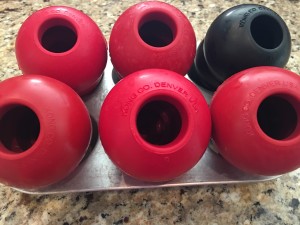
How to Stuff a KongOnce a week, I gather up all of my dogs’ Kongs and stuff them with food. Filling each dog toy individually is such a waste of time, and it gets so dang messy.

Giving credit where it’s due, my husband pulled out an old muffin pan and placed a toy in each hole. He literally made an instant Kong dog toy holder! Good job hubby! Click and treat! 😉

Once each toy is lined up in a muffin pan, I squeeze or stuff food with ease. The best part is there’s minimal mess! Aside from using it as a Kong holder, you can also use a muffin pan to freeze leaky food stuffed toys. Just carefully place the muffin pan on a flat surface with the food stuffed Kongs in your freezer and voila!

2. Glue With Peanut Butter

How to Stuff a KongLet’s chat about leaky food stuffed toys for a minute. Leaky food stuffed toys make a mess in your refrigerator, freezer and even your favorite rug. An easy way to prevent the food from leaking is to plug the holes with peanut butter.

Serving as an adhesive, peanut butter can prevent watery ingredients from leaking out. When stuffing a Kong with watermelon or broth, plug the hole with peanut butter and freeze for 2 hours. Then, stuff the moist foods into the toy. Freezing the Kong before stuffing it with moist food will allow the peanut butter to set, so all those lovely sticky ingredients remain inside the toy.

RELATED: What Human Foods are Bad for Dogs?

3. Make Your Own Pastry Bag

Stuffing Kong dog toys with pumpkin, mashed sweet potatoes, canned dog food, yogurt or soaked dehydrated dog food is difficult. It’s almost impossible to slowly spoon this wet stuff inside a toy. Save valuable assembly and cleanup time by making your own pastry bag.

To make a pastry bag:

  1. Place the food stuffing ingredients inside a plastic zip bag.
  2. Squeeze the mixture toward one corner of the bag.
  3. Snip off the tip.
  4. Squeeze food stuffing into the toy.

You can make large batches of stuffing and pipe these mixtures into 20 Kongs within 5 minutes—yes, I’ve timed it! 🙂

4. Soak and Wash Kongs

In my opinion, the worst part of giving food stuffed toys to my dogs is cleaning them. Cleaning Kongs can take forever. Instead of scraping out leftover food residue with a butter knife, I throw all toys into a sink filled with hot water and dishwashing detergent, and let them soak overnight. The next morning, I place each toy on the top rack of my dishwasher and wash with my dishes.

Afterwards, each Kong is clean as a whistle, disinfected and ready to be stuffed again. Now, I would only place rubber Kong toys in the dishwasher; I don’t believe plastic ones would fair so well.

Don’t wait. Give your dog a food stuffed Kong today! Your dog will love you for it!

Filed Under: Games, Resources Tagged With: food stuffed toys dogs, food stuffed toys puppies, how to add food to a dog toy, how to clean kong toys, how to clean rubber dog toys, kong toys, tips interactive toys for dogs, tips on filling kongs

Leaving Your Dog Home Alone? Try These Tips

July 13, 2016 by Fanna Easter

3 Ways to Keep Home Alone Dogs Entertained

Home Alone Dogs
adogslifephoto/iStock

As pet owners, we feel guilty when we leave our dogs home alone all day. Whenever I leave for work and I’m shutting the door behind me, my heart sinks to the floor because I hope my home alone dogs won’t be bored. Just to make sure they’re entertained while I’m away, I leave food stuffed toys and puzzles behind for them. I also enlist help from a pet sitter when my dogs are left alone for more than 4 hours. Check out these three tips that will keep your home alone dog busy while you’re away!

Provide Food Stuffed Toys

Food stuffed toys are a miracle; I can’t say this enough. I purchased rubber Kong toys online several years ago and ever since I’ve been filling them with food and storing them in the freezer every week. Before leaving for work, I toss a frozen food stuffed Kong in each dog’s crate. A frozen food stuffed dog toy will keep my home alone dogs busy for at least an hour. These durable rubber toys are pretty safe to leave with them unattended. Over time, my dogs have learned it’s a good thing when I leave for work because it means a frozen interactive toy.

When purchasing Kong toys, choose a black Extreme Kong for powerful chewers or a Classic Red Kong for normal chewers. As for size, check out Kong’s size recommendations, which lists sizes based on your dog’s breed and weight. When in doubt, choose one size larger, especially for powerful chewers.

Use a Kibble Dispensing Toy

This is another amazing dog toy and a must-have if your dog eats kibble (dry dog food). Your dog will need plenty of space when playing with a kibble dispensing toy because she needs to move the toy around to dispense food.

It’s always best to teach your dog how to use a kibble dispensing toy first before leaving her home alone with it. To do this, pour her evening meals inside the toy and encourage her as she bops it around. Once she confidently and happily pushes the toy around with her paws or nose, and hasn’t tried to chew it, you can leave your dog home alone with it. Pour your dog’s breakfast inside a kibble dispensing toy and place it on the ground before leaving for work.

I’ve had excellent results with Kong’s Wobbler (small or large) and Buster Cube kibble dispensing toys. These toys aren’t indestructible though. We’ve had to replace them several times due to gashes and cracks caused by my dogs tossing the toys across hard tile.

My dogs are very tough on toys, so a Wobbler will last about a year with everyday use and a Buster Cube will last a couple of years (this toy is super strong). Several of my clients swear their dogs absolutely love their Tug-A-Jug toy. With this toy, a dog must tug on the rope to dispense treats from inside the “jug.” It’s quite a challenging toy. We don’t use Tug-A-Jug toys in our home anymore because my dogs bashed a huge hole in our wall from slinging the toy in mid air and chewing the rope to pieces.

You may also be interested in: Indestructible Dog Toys (Well, Almost)

Hire a Mid Day Pet Sitter

If you’re gone for more than 4-6 hours at a time, I highly recommend paying a professional pet sitter to visit and potty your dogs mid day. During a typical visit, pet sitters will spend at least 30 minutes playing, walking and pottying your dog while you’re away. Honestly, I think asking a dog to hold it for longer than 4 hours is asking a lot. Your home alone dog needs to get out and stretch her legs, and of course potty. Plus, your pet sitter can refill your dog’s kibble dispensing toy or toss another frozen Kong in her crate for even more fun. I think all of that is easily worth $15-$20 per visit.

A Few Cautions for Your Home Alone Dogs

Never leave two or more home alone dogs with food stuffed toys because even the sweetest dogs will fight over food. If you choose to give two dogs food stuffed toys, you should toss them in your dogs’ crates, and then close and lock the crate doors. If you’re leaving two or more dogs home alone with kibble dispensing toys, which require room to make the toy work, then I recommend keeping each dog in a separate room with closed doors.  For dogs left loose in your home, you should separate them with super sturdy safety gates.

Lastly, please don’t leave dogs alone in your backyard because it’s not safe. Your neighbors could complain, your dogs could be stolen or your dogs could learn to escape your yard. It’s not worth it, so keep your dogs indoors when they’re home alone.

Filed Under: Games, Resources Tagged With: activities for dogs alone at home, bored puppy, dog alone home, dog alone while at work, keeping dogs home alone, leaving dog home alone, my dog is bored, tips for bored dogs, toys for dogs left alone

Do Dog Boarding and Training Programs Work?

July 12, 2016 by Fanna Easter

Think Twice About Dog Boarding and Training Programs

Dog Boarding and Training Programs
filrom/iStock

Pet owners want fast dog training results, so they choose to board their dog with a dog trainer (i.e. dog lives with dog trainer) and the dog trainer trains their dog to a certain level of training. Sounds quick and simple right? Even though this is an extremely fast growing segment of dog training, not all dog trainers agree with dog boarding and training philosophies. There are so many bad things that can happen when you choose this route, so know the facts first before dropping your dog off at someone’s house for weeks of boarding and training.

Typical Dog Boarding and Training Options

As mentioned above, pet owners drop their dog off at a dog trainer’s facility or home, and the dog trainer teaches their dog specific agreed upon behaviors. Length of stay with a dog trainer depends on the behaviors that will be taught to the dog, so it can vary between 2-6 weeks.

Learning takes times, especially when teaching challenging behaviors, such as walking on a loose leash in public and coming when called around tons of distractions. It’s important to understand dogs aren’t furry little computers; we can’t download information into their brains. If only it were that easy for dogs and humans! 🙂 Be prepared for sticker shock as well: boarding and training programs are extremely expensive. A two-week program can cost more than $500—that’s an insane amount of money.

How to Find a Good Dog Boarding and Training Program

Oh, this is where board and train programs can get really sticky. Finding the right dog trainer is key! There are several excellent board and train dog trainers out there and some rotten ones too. Learn how to stay clear of the rotten ones.

Research Good Dog Trainers

Choose a dog trainer who uses only positive reinforcement, meaning he doesn’t use punishment (physical or verbal), choke chains, pinch collars and/or electronic collars.

Look for dog trainers who will:

  • Reward good behavior
  • Redirect/ignore bad behavior
  • Only use flat buckle collars, Martingale collars, harnesses, head halters, clickers and yummy treats.

Check out my article on finding a good dog trainer. It lists websites that will help you in your search and point you in the right direction.

Don’t fall for the hype. Reward-based dog trainers can teach behaviors just as fast as punishment-based dog trainers. I know this personally, as I was a punishment-based dog trainer during the first 10 years of my dog training career. I switched to positive reinforcement because it was the humane thing to do for dogs, pet owners and myself. Also, it just works faster. Yes, I’ve been a positive reinforcement dog trainer for more than 15 years now and I’ve seen results from both sides of the dog training fence. Positive reinforcement is the clear winner by a landslide.

If a punishment-based dog trainer claims his methods work faster, ask for scientific research to back up those claims. Do know his personal experience is biased and wrong. Check out the multiple studies done on the effectiveness of positive reinforcement here.

Check Out the Facility

If a dog trainer offers a dog boarding and training program, ask to view where your dog will live while under his care. Ask how often your dog will be trained per day, if she’ll be crated and if she’ll go on daily walks. Ask if the dog trainer will follow your feeding instructions.

In addition, ask for contact information of previous clients and ask them for their reviews. You’re leaving a living and defenseless being in the care of this person. Interview the dog trainer ruthlessly and view the dog training facility thoroughly.

Dog Boarding and Training Program Horror Stories

Every day, I hear horror stories about dog boarding and training programs that will make you nauseous. I’m only sharing this information to inform you about the terrible possibilities that can happen to your dog. I’ve witnessed dogs starve during board and trains, as the dog trainer insisted dogs must earn all of their food or he simply forgot to feed them.

Some dogs would be left in their crates for 23 hours and forced to potty on themselves, which would cause large open sores. Other dogs were beaten and shocked with electronic collars so much so that the dogs would develop huge wounds. Others would be sent home with broken toes, legs and spines from physical abuse. I’ve also heard of dogs being left in extreme weather conditions that caused permanent damage; I could go on and on.

This stuff happens more than you think. I’ve witnessed these poor dogs being rushed into a veterinary clinic where I worked. Once you’re aware of the bad, you know what to look for during the interview phase and when visiting the dog training facility.

Don’t worry about offending a dog trainer either. An honest dog trainer actually admires and respects pet owners searching for the very best person to train their dog. We love it! If a dog trainer is rude, dismissive, unprofessional, lies or appears offended during your interview, end it and continue with your search.

Will Pet Owners Learn How to Train Their Dogs Too?

Professional board and train dog trainers will require pet owners to attend several dog training sessions with their dogs. While board and train dog trainers will teach your dog certain behaviors and put her on cue for you, you should still learn how to ask and reward cues, and know what to do if your dog becomes confused.

If a board and train facility doesn’t offer this option, or charges you more for it, this dog trainer and facility is not for you. Find someone else.

Final Thoughts

If you want a fast and effective way to train your dog, attend group training classes with your puppy or dog. Not only will you both learn together from a skilled dog trainer, but you will also build an unbreakable bond with your dog that will last a lifetime. If group class isn’t an option, choose private lessons in your home with a professional dog trainer. Working and learning together is key to success. Plus, you’ll save lots of money in your pocket. 🙂

Filed Under: Behavior, Clients, Dogs, Puppies, Resources, Training Tagged With: board and train costs, board and train dog trainers, board and train dogs, board and train prices, board and train puppies, board and train training, dog boarding for training, dog training, Dog Training Tips, how to teach a dog, how to train a dog, puppy training, should I board and train my dog, should I board my dog for training, should I board my puppy for training, teach a dog, train a dog

  • « Previous Page
  • 1
  • …
  • 45
  • 46
  • 47
  • 48
  • 49
  • …
  • 135
  • Next Page »

About

Dog Training Nation is a community of dog trainers, dog owners and dog lovers. Our mission is to provide trainers and owners valuable information to enrich dogs' lives. We cover a range of topics, from socializing puppies to dealing with aggressive dog behavior to selecting the best dog products. It is our hope you share our content to make the dog and owner world a better place.

​

Facebook

Video

Dog Training Nation is a dog training blog for pet owners and dog lovers. We cover a range of topics from puppy socialization tips to dog aggression to dog health. It is our hope you share our content to make the world a better place for dogs.

Dog Training Nation

Quick Links

Dog Training
Dog Behavior
Dog Training Videos
Become a Dog Trainer
About
Contact Us

Copyright © 2026 · Lifestyle Pro Theme on Genesis Framework · WordPress · Log in