Dog Training Nation

In Dogs We Trust

  • Home
  • Training
    • Dogs
    • Puppies
    • Clients
  • Behavior
    • Breeds
  • Health
  • Safety
  • Resources
    • Equipment
    • Books
  • Dog Training Videos
  • About
You are here: Home / Blog

Redirected Aggression in Dogs

January 9, 2015 by Fanna Easter

Dealing with Redirected Aggression in Dogs

Redirected Aggression
This can turn into redirected aggression within nanoseconds.

Redirected aggression is interesting and scary rolled up into one ball of madness.

And it’s common. Dogs, cats and humans will redirect their frustration onto the closest thing. Dogs can’t browse the self-help section of a bookstore so it’s up to their humans to understand why it happens before preventing it.

Examples of Redirected Aggression

An example of redirected aggression is when you’re walking two dogs at the same time in the park and one dog becomes really excited at seeing another dog in the distance. The excited dog becomes overly agitated. She is unable to get to the other dog. Then, she turns and attacks her walking mate, and they begin squabbling.

Road rage is a perfect human example of redirected aggression. A person becomes so frustrated by lack of control in a stressful situation so she lashes out at the nearest person. Lashing out ranges between horn blowing or snapping at the children in their car seats. This person is trying to deal with her frustration.

What is Redirected Aggression?

Redirected aggression is when a dog takes out his frustration on others when dealing with his frustration. Others can be dogs, pet parents and even objects. Once, when dealing with dog aggression in a client’s home, I witnessed a dog fighting with his neighbor dog along their fence line. Both dogs were separated by a chain link fence and you could tell they’ve practiced the game for a long time, as they would immediately lock eyes and their fence fighting began. This consult was during the fall and a large leaf had fluttered through the wind right next to the frustrated dog, and he attacked it. Wow, he was in a total frenzy.

Redirected aggression is not revenge seeking. I don’t think dogs plot revenge, at least I’ve not witnessed it yet. 🙂 But redirected aggression, in its mildest form, can turn into bullying behavior, which needs to be addressed quickly.

I’ve witnessed on numerous occasions dogs redirecting their frustration onto their pet parents. They become so overwhelmed, they’ll turn around and pinch or bite their owners in the leg or arm. Scary stuff!

Usually, dogs susceptible to redirected aggression have underlying anxiety struggles. These dogs can react quickly to perceived threats and have difficulty calming themselves during stressful situations. It’s the same for people too and I fit right into this category myself. I can get worked up in a matter of seconds!

By understanding the fact dogs prone to redirected aggression can react quickly, it’s important to:

  • Stop frustration before it starts.
  • Teach dogs how to deal with frustration without resorting to violence.

How to Deal with Redirected Aggression

Identify Frustration Triggers

It’s time to do a bit of homework. Find your dog’s frustration triggers. Now, list them in order of highest to lowest levels of frustration. For example, if your dog lunges and barks at other dogs, this will probably be first on the list followed by watching movement from a window and barking at a ringing doorbell. These are only examples so put on your detective hat and find your dog’s frustration triggers.

Stop Frustration Before it Starts
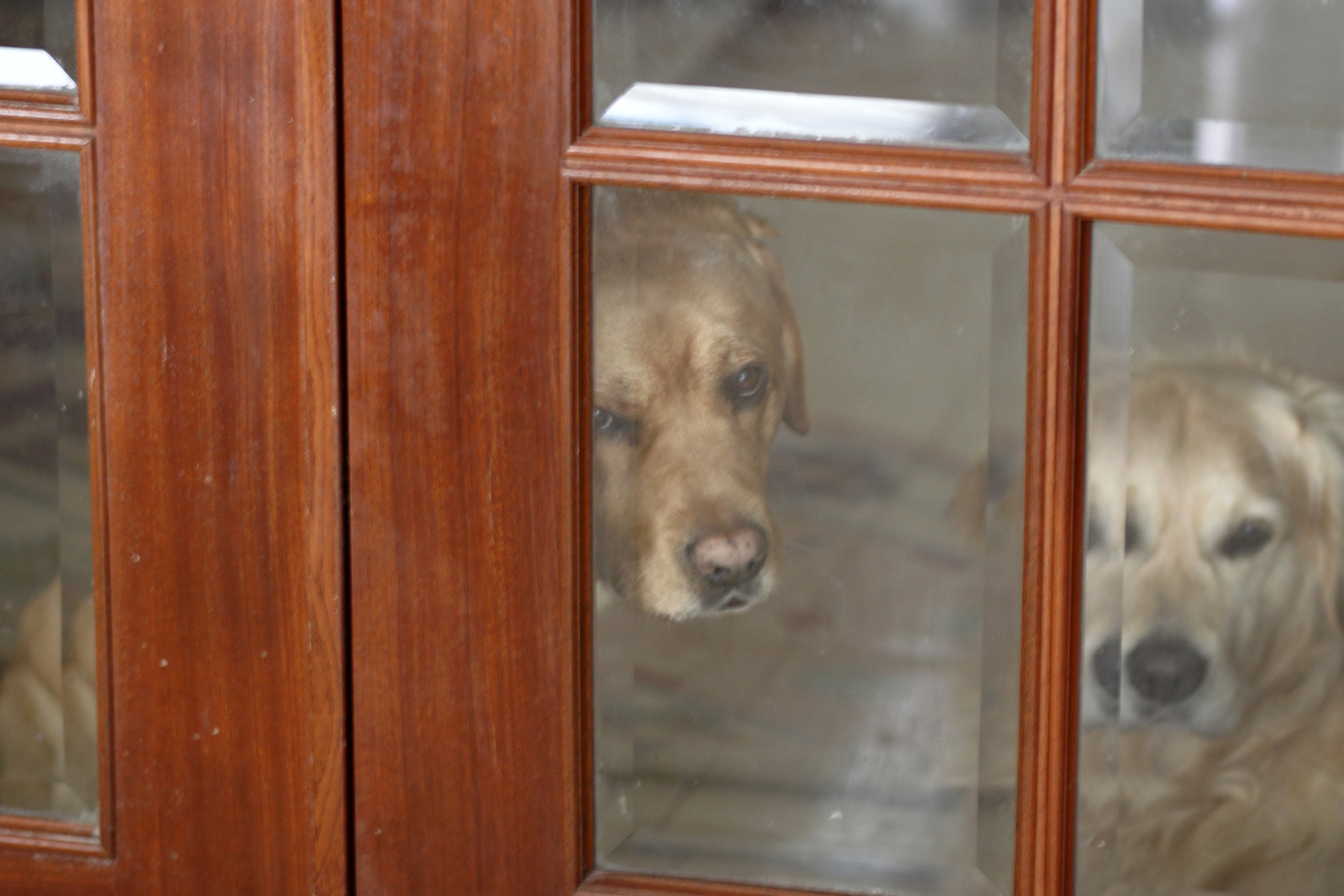
Redirected Aggression in Dogs
Prevent this from happening. This is redirected aggression waiting to happen!

This means avoid frustration triggers.

  • If you see another dog approaching, turn and walk the opposite direction.
  • Ask guests to knock instead of ringing the doorbell. Duct tape across the doorbell works great as a reminder (cue). 🙂
  • Close curtains or blinds. For “lookie loos,” block access to windows and move a chair or piece of furniture to block access.
  • Block visual access for fence fighting. I’ve successfully used rolls of felt about four feet wide and zip-stripped it along the inside of my fence. You can purchase felt at Home Depot or Lowe’s.
  • Walk one dog at a time. This prevents squabbling around triggers.

I promise you will not have to live with your sofa blocking a window or ugly felt-covered fences. These measures are to prevent a dog from practicing this behavior until you can teach him how to deal with frustration.

Dealing with Frustration

Ah, here’s the fun part! What do you want your dog to do instead of XYZ. It’s easy to say “don’t do that” but what do you want him to do instead? What if I told you to stop talking while driving? So, should you sing, hum, listen to music or read text messages instead? The devil is in the details!

  • Dog approaching: Your dog looks at you.
  • Fence fighting: Dog eats a food stuffed Kong.
  • Lay on mat when doorbell rings.
  • Heel when walking on a leash.

Seeking Professional Help

If anyone gets hurts (person, dog, cat, whatever), seek professional assistance. Having an experienced person advising you provides quicker results and prevents injuries. When in doubt, seek help.

Filed Under: Behavior Tagged With: aggressive dog behavior, aggressive puppy behavior, dealing with redirected aggression in dogs, dog aggression, dogs and redirected aggression, how to stop dog aggression, managing dog aggression, redirected aggression dogs, redirected aggression of dog to owner, stop redirected aggression in dogs, tips to avoid redirected aggression

Offensive Dog Aggression

January 9, 2015 by Fanna Easter

Dog Aggression

Offensive Aggression
This Spaniel warns not to proceed forward with a direct stare.

You reach for the dog nail trimmers. As you’re approaching your dog, he freezes, lowers his head and growls. His warning growl says, “Don’t do it.” You stop in your tracks, sigh and feel defeated so you put the nail trimmers back in the cabinet and watch TV instead. Sound familiar?

Learn how to identify and successfully manage offensive dog aggression. The solution is probably not what you’re thinking. 🙂

What is Offensive Dog Aggression?

Offensive means to stop something before it happens. Aggression means “hostile or violent behavior toward something.” When paired together, offensive aggression means to threaten violence toward someone before something bad happens. Usually, this is a learned behavior; a dog learns how to successfully stop a perceived threat before it happens.

Offensive aggression exists in the human world too. People usually stare threateningly at past enemies, freeze when an opponent walks into a room or verbally threaten attackers to prevent them from approaching.

When I say “learned,” it takes practice to figure out what aggressive displays work best to prevent a perceived attack. Direct eye contact may work, but what if it doesn’t? Offensive aggression is a fine line. Push too hard, then violent fights break out. Immediate physical attack can cause a fight, which dogs want to prevent. That’s why they’re learning to warn instead. 

Prevention

Prevention means listening to your dog. If he is uncomfortable, stop. Offensive aggression stems from past negative experiences. Dogs learn that “x” equals “y” so they better stop “x (dog, person, whatever)” from “y (hurting them again).”

Instead of forcing nails trims or body handling, teach dogs to allow it. As much as we want dogs to be “little humans,” they’re not. So instead of grabbing your dog’s toenail and trimming, touch his nail, click and give a treat. The same goes for body handling. Most dogs dislike restraint so teach them it’s fun and they will not be harmed.

Never force a dog or puppy to meet strange dogs. This can create a dog aggressive dog in seconds. Dogs, which are scared of other dogs, will display offensive aggressive body language when they see another dog. It’s almost like they’re saying, “I’ll get you before you get me!” Yikes!

RELATED: Introducing Dogs with Boundaries

Still don’t believe me? Remember when Great Aunt Emma would grab and hug you until your eyes popped out at Christmas dinner? Soon you learned to avoid her by hiding under the table. But what if Great Aunt Emma gave you candy, as she hugged you, it wouldn’t be so bad, huh?

What Does Not Work?

For some reason, we feel that forcing a dog to deal with negative things is part of life. Have you looked into your dog’s mouth? Do you see those big teeth? Yeah, they can and will use them. Dogs are not fuzzy humans. Force means threats in their world and dogs will learn to fend off threats. Would you force a silverback gorilla to trim his nails? You probably wouldn’t because they’re bigger and stronger, and can cause serious harm — same with dogs. Dogs will never enjoy nail trims, but they will learn to tolerate. They trust you to not harm them and you will stop when they need a break. Plus, they earn yummy treats (their paycheck).

Management

Dog Aggression
“I said no!”

If your dog already displays offensive aggression when her nails are being trimmed or when a strange dog approaches, then it’s time to teach her fun things happen instead.

To begin, you’ll need a clicker and yummy treats.

Nail Trims

Practice each step 5 times a day for 3 days. If your dog becomes confused, take a step back. I’ve found restraint of the paw usually causes a dog to become uncomfortable so practice often.

  1. Touch a front paw with your hand and click/treat.
  2. Touch a back paw with your hand and click/treat.
  3. Touch a front toenail with your finger.
  4. Now practice touching a back toenail with your finger.
  5. Show your dog the nail trimmer (dog does not need to touch nail trimmer). Just pair a click/treat with the presence of the nail trimmer.
  6. Touch nail trimmer to paw.
  7. Now, touch nail trimmer to front toenail (Don’t trim a nail yet. If you do, you’ll most likely have to start back at step 1).
  8. Touch trimmer to back toenail.
  9. Hold front foot in your hand for 1 second.
  10. Hold back foot in your hand for 1 second.
  11. Trim a tiny tip off one toenail and end session.
  12. Continue to practice until each toenail can be easily trimmed.

Body Handling

Take a peek at this video, which provides great tips on teaching body handling. Same principles apply when teaching your dog to allow nail trims too!

Coming Out of Crate

Move away from the crate opening. Better yet, stand next to the side of the crate. Toss a super yummy treat about 6 feet outside the crate opening. Bingo!

Strange Dog Approaching

This Dog Socialization Tips article covers prevention and management in detail.

Prevention is key!

Filed Under: Behavior Tagged With: dog aggression, dog growls during nail trims, dog hates nail trims, dog hates other dogs, my dog growls at me, offensive dog aggression, preventing dog aggression, puppy growls at me, stop dog aggression, stop dog from growling at you, what is offense dog aggression

Resource Guarding

January 9, 2015 by Fanna Easter

Resource Guarding in Dogs

Resource Guarding
belchonock/Deposit Photos

How do you feel when someone leans or sits on your new car? Mercy! You’ve worked hard to pay for that shiny new car. Folks need to show respect, right? Now, you understand why dogs guard their new toys.

What is Resource Guarding?

Every dog possesses the need to guard objects. Guarding resources is a primitive survival instinct. You can’t survive without shelter, food and water so it behooves you to protect valuable resources.

Aggression is a learned behavior. If you threaten someone, as he approaches your food, and he retreats, you’ve learned that aggression works. The dog world lists material, territorial, protective, possessive and sex-related aggression as different types of aggression, but when you peel back the layers, the cause is usually due to guarding babies, territory or mates. So I lump these terms into resource guarding.

What Does Resource Guarding Look Like?

Dogs will warn before biting. It’s up to us to notice the telltale signs. As another dog or person approaches, most dogs will:

  • Freeze or stiffen their bodies
  • Lower their heads over their prized object
  • Widen their eyes with the whites showing (whale eye)

If a threat continues approaching, dogs will increase their warning by:

  • Making direct eye contact (“Um, this is mine!”)
  • Growling
  • Showing teeth
  • Snapping
  • Lunging
  • Biting

VIDEO: Resource Guarding

Stella (Mini Bull Terrier) guards an antler. Sobek (Rottweiler) is asking for it, but Stella says “No.” Sobek takes the hint and relaxes. Sobek is dealing with his frustration and Stella never becomes aggressive. Her body language told the story.

Prevention

One ounce of prevention is worth its weight in gold and this is so true for resource guarding.

Play the Trade Game

Instead of taking away a prized chew toy, play the trade game. Offer your puppy or dog a piece of hot dog for his chew toy. As he drops the chew toy, pick it up and give him a piece of hot dog. Hey, if you try to take away my cheesecake because you think I’ve had enough, I just might growl at you too! But if you give me a $100 bill for my cheesecake, then we’re cool. 🙂

Good Things Happen

Approach your dog, as he’s eating, and toss something really yummy into his food bowl. Dogs will learn to back away from their bowl so you can toss delicious chunks of roast beef or a huge scoop of canned food into their bowls. Basically, they’re learning that “approaching” does not mean you’re taking away their food, but adding to it.

RELATED: Prevent Resource Guarding

Separation is Good

For multiple dog households, separate dogs to prevent resource guarding behavior. It never fails; one dog finds the nylabone that has not been chewed on in years. Suddenly, the forgotten nylabone becomes a hot commodity. Every dogs wants to chew it right this minute. Or, you hand each dog a bully stick. They don’t want their stick. They want the bully stick being chewed by the other dog, oi vay.

Ask dogs to go in their crates and reward with a bully stick or scheduled meal. It’s best to add visual barriers (see no evil :)), such as sheets or blankets, to prevent crate guarding opportunities. Once all dogs have finished their chews or dinner, open crate doors, pick up food bowls and release dogs from crates.

Management for Dogs Already Resource Guarding

Food Bowl, Chew Toys and Food Stuffed Kongs

Practice sharing games and teach the trade cue. I promise, it will get better! If not, seek professional help.

That’s My Spot

Some dogs will guard their favorite napping spots, usually the sofa or bed, from dogs and even people. My general rule: If you act rude, you lose privileges. If a dog is guarding a spot on the sofa (or bed), toss a treat on the ground while saying “off.” You are not rewarding your dog for guarding; you’re rewarding him for getting off the sofa. Don’t make this a standoff because then you’re reinforcing guarding behavior. They’re getting to practice it.

RELATED: Offensive Dog Aggression

If she jumps right back on the sofa, say “off” while tossing a piece of treat on the ground. Usually, by the second or third time, your dog takes the hint and finds another spot to rest.

Plus, play sharing games. Resource guarding dogs will usually protect other prized possessions too.

That’s My Human

If someone gave me free access to car rides, cheesecakes and donuts, I would totally guard him too! Most resource guarding dogs practice this behavior while sitting in your lap. The moment you notice the first sign of resource guarding, which is usually body stiffening or hard stare, I say “off” and toss a piece of food on the ground. The person being resource guarded should put the dog on the ground.

Secondly, change your dog’s perspective by playing sharing games.

Don’t Touch My Puppies

Maternal instincts are hardwired for a reason so listen to the momma dog. If she doesn’t want other dogs around her puppies, place barriers around the whelping box to prevent visitors from gawking at her puppies.

Get Off My Lawn

Knock knock. Who’s there? Why do dogs bark when the doorbell rings? Because it announces someone is there!

Your dog is not dominant. He’s saying , “Hey mom, someone is here.” So what do you want your dog to do instead? Lay on a mat? Run to you when they hear the doorbell ring? Sit quietly at the door?

Once you figured out polite guest announcement behavior, get busy teaching with yummy treats and a clicker. Start by attaching a leash to your dog.

  • Teach her to sit by the door (or lay on the mat). Practice 5 times a day for a week.
  • Ring doorbell (or knock), then lure your dog into “sit” or “lay on mat.” Continue to practice daily for a week.
  • Ring doorbell (or knock) and wait for dog to offer “sit” or “lay on mat” behavior.
  • Now the doorbell (or knock) is the cue to sit quietly or lay on a mat.

Get Your Own Girlfriend

Does your house resemble the nightclub on a Saturday night? This happens when dogs are intact (not spayed or neutered) and a female dog goes into season (heat cycle). It seems all the boys fall madly in love with her and will defend her honor. If altering a dog is not an option, separate using multiple barriers. Give the poor boy a break and have him sleep over at a friend’s house until your girl has completed her season (about 3 weeks from start to finish).

Resource guarding is normal, but you don’t have to live with it!

Filed Under: Behavior Tagged With: clicker training resource guarding, dog fighting over food, dog fighting over toys, dog growling over a toy, dog guarding a bone, dog guarding a person, dog guards owner, dogs resource guarding, food guarding, how to stop dog fighting over food, how to stop resource guarding, maternal aggression, my dog barks at other dogs from crate, my dog guards me, my dog protects me, my dogs are fighting over toys, prevent resource guarding, resource guarding, resource guarding against cat, resource guarding crate, resource guarding dogs video, resource guarding issues, resource guarding with other dogs, resource guarding with people, resource guarding youtube, territorial aggression, two dogs fighting over food, why dogs fight over food

Prevent Resource Guarding

January 9, 2015 by Fanna Easter

Use Sharing Exercises to Prevent Resource Guarding

Resource Guarding
Approaching means hot dogs. Hurray!

Does your dog guard his food, toy or you? This is normal dog behavior, but it can be corrected. Use these sharing exercises for preventing and managing resource guarding.

Note:

  • For multi-dog households, feed other dogs in their crates while practicing sharing exercises with your guarder. This keeps everyone safe and ensures success.
  • If you, a family member or other dogs have been bitten or resource guarding worsens, seek professional help.
  • Between meals, keep empty food bowl in a cabinet or behind a closed door. At times, some dogs will guard an empty food bowl.

Approach-Toss-Retreat Move

Before beginning the process, it’s vital to learn the move. This resembles a bowling move:

  • Step forward.
  • Crouch down as you toss the treats.
  • Step back.

Week One

  • While your dog is eating a meal (or chewing a high value treat), take one or two steps toward your dog while tossing hot dogs or cheese toward his bowl.
  • The yummy treat does not need to land in his bowl, just near the dog.
  • Back up one or two steps away from your dog, turn away and ignore him.
  • Repeat 2-4 times per meal at each meal time.

If your dog growls or freezes, you’ve moved too close to his food bowl. Next time, try taking only one step forward while tossing food. Or try tossing treats from across the room. Treats should land near your dog. If he scatters about, that’s okay too.

RELATED: How to Choose High Value Treats

Week Two

By now, you’ve practiced your bowling moves during your dog’s meals. Now, your dog will lift his head up and away from his food bowl as you approach. Some dogs will even take a few steps away, as they’ve learned your approach means treats. Good job!

  • As your dog is eating a meal or chewing on a bone, approach closer. Try to approach within 2-4 feet of your dog. Toss treats and retreat. Since you’re moving closer, try tossing treats in the food bowl or at a chew toy.
  • Practice twice per meal or during chewing session.

If your dog begins growling as you approach, increase distance. You’ve moved too far too fast.

Week Three

Resource Guarding
“Oh, you’ve got hot dogs? Toss away!”

Usually, this is the homestretch. Your dog has learned to step back from his bowl or move his head away from the chew toy. It’s time to add a cue.

  • As you approach, say “food” while tossing treats about two feet from his bowl. Try to toss treats toward the right of the dog bowl or chew toy. “Food” means “move away from your bowl.” For toys, say “give.”
  • Once your dog walks over to eat the treats, pick up his bowl (or toy).
  • After your dog eats the treats, ask him to “sit.” Once he’s sitting and there’s still food in the bowl, put the bowl down again. If all food has been eaten, pick up the bowl and place on a shelf.

Maintenance

Your dog understands that the “food” cue means you’re approaching and picking up his food bowl. To maintain this polite behavior, practice makes perfect!

  • Meals:
    • Once or twice a week, walk over and toss something super yummy in your dog’s food bowl like a spoon full of canned food or hot dogs.
    • Say the “food” cue while picking up his food bowl.

If, at anytime, your dog reverts back to guarding his bowl, start back at Week One. Setbacks happen, so don’t fret and get back to dog training. 🙂

Filed Under: Behavior Tagged With: dog fighting over food, dog fighting over toys, dog growling over a toy, dog guarding a bone, dog guarding a person, dog guards owner, dogs resource guarding, food guarding, how to stop dog fighting over food, how to stop resource guarding, maternal aggression, my dog barks at other dogs from crate, my dog guards me, my dog protects me, my dogs are fighting over toys, prevent resource guarding, resource guarding, resource guarding against cat, resource guarding crate, resource guarding issues, resource guarding with other dogs, resource guarding with people, territorial aggression, two dogs fighting over food, why dogs fight over food

Training Your Dog to Leave It

December 31, 2014 by Fanna Easter

How to Train Your Dog in Real Life Scenarios

Dog Training Tips
Good job!

Training your dog to leave it is vital so we’ll discuss how to train your dog during real life scenarios. It’s all good and well when your dog ignores treats in your hand, but will he ignore a chicken bone? If not, take a peek at these dog training tips.

Before Moving Forward:

  • Your dog will ignore your closed and open handed treats on cue.
  • If not, read this article before proceeding.
  • While it’s extremely tempting to push forward, the behavior will collapse and become unreliable. For “leave it,” start with foundation behaviors first, then move forward. Usually, a dog will reach the last step within a week. Steps 1-3 can easily be taught within a few days, practicing 1-2 minutes per day.

Peek-a-Boo Hand

Begin by sitting on the ground with your dog. While holding a treat in your left hand, say “leave it” as you place the treat on the ground. Keep your hand close by. If your dog moves forward, cover the treat with your hand. Once he moves back from the treat, click and say “take it.”

Dogs are extremely fast! Keep your hand close to the treat. If your dog takes the treat once or twice, then take a step back to closed and open handed games. This will teach your dog to ignore the treat instead. Never correct your dog by saying “no” or giving a leash correction, as this will only confuse your dog. Trust me, I’ve been training for a long time. It takes much longer to teach this way.

Practice 5 times, then end the training session. Keep training sessions short for maximum effectiveness. This keeps dogs from becoming bored. Practice twice a day so about 10 reps per day.

Chicken Wing on Floor

Oh, you know that feeling in your stomach when your dog spots a discarded chicken wing on the ground! Yikes, what should you do? When teaching “leave it,” it’s pretty important to scan your environment. It’s kind of hard to say “leave it” if you don’t spot the chicken wing first. Oh, and carry luscious treats. 🙂

Okay, back to the ant-covered chicken wing. Once you spot it, stop and say “leave it.” You should be standing 6 feet away, meaning your dog can not reach his object of desire. Say “leave it” once and wait. Your dog will strain against the leash. The moment he stops pulling, click and give him 3 pieces of hot dog! Once he’s done eating the last hot dog, say “let’s go” and move forward. As he follows you, click and give him 3 more pieces of hot dog. Your dog just learned to leave it alone and walk away. Good job!

Eventually, your dog will learn to ignore gross things discarded around the park, but every now and again, he may try rolling in deer poop or snack on cat feces so keep your “leave it” cue current. Hey, they’re dogs and expected to roll in grossness and try to steal stinky stuff. Have you ever watched hidden cameras of people chasing flying dollar bills around the park? Hilarious, but it’s what we do too!

Training Your Dog to Leave It – Real Life Scenarios

Filed Under: Dogs, Training Tagged With: clicker training leave it, clicker training videos, demo on teaching dog to leave it, doggy zen, how to teach a dog to leave it, how to teach a puppy to leave it, how to teach your dog leave it, how to teach your dog self control, how to teach your puppy to leave it, how to train a hyper dog, how to train your dog to leave it, teaching a bull terrier to leave it, teaching a miniature bull terrier how to leave it, teaching a rottweiler to leave it, teaching the leave it command, teaching your dog self control, teaching your dog to leave it, tips for training a hyper puppy, tips on training easily excited dogs, what is doggy zen

  • « Previous Page
  • 1
  • …
  • 106
  • 107
  • 108
  • 109
  • 110
  • …
  • 135
  • Next Page »

About

Dog Training Nation is a community of dog trainers, dog owners and dog lovers. Our mission is to provide trainers and owners valuable information to enrich dogs' lives. We cover a range of topics, from socializing puppies to dealing with aggressive dog behavior to selecting the best dog products. It is our hope you share our content to make the dog and owner world a better place.

​

Facebook

Video

Dog Training Nation is a dog training blog for pet owners and dog lovers. We cover a range of topics from puppy socialization tips to dog aggression to dog health. It is our hope you share our content to make the world a better place for dogs.

Dog Training Nation

Quick Links

Dog Training
Dog Behavior
Dog Training Videos
Become a Dog Trainer
About
Contact Us

Copyright © 2026 · Lifestyle Pro Theme on Genesis Framework · WordPress · Log in
