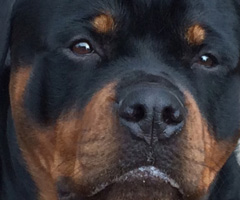
Rottweiler Training
“The Rottweiler breed is my favorite. I’ve shared, and still currently share my home with Rottweilers. As a dog trainer and dog lover, I enjoy every minute of it!” says Fanna Easter.
Certified dog trainers Fanna Easter fell in love with Rottweilers while living in Germany. She was lucky enough to visit the city Rottweil, which means “red roofed” in German.
Origin of the Rottweiler
The Rottweiler was named after the Imperial City, as the breed was the butcher’s dog in the region. Fanna and her husband attended the Rottweiler Specialty, a dog show for Rottweilers only held in Rottweil, Germany. They have both learned a ton about this breed of dog. Rottweilers are very good with families that have older children, as Rotties are big and can knock down small children accidentally.
Rottweilers (Rotties) were bred to herd livestock (the butchers’ dog). After herding the cattle to the market, the cattleman would tie his earnings in a pouch around his Rottie’s neck for the walk home. This would ensure that no one would steal his hard work earnings.
Not only do Rotties herd, but they also guard and draft (pull carts) very well. Think of Rottweilers as little draft horses. They are powerfully built with heavy bones and are extremely well muscled.
Rottweilers are the powerhouses of the working dog group.
RELATED: Rottweiler Training
3 Traits of the Rottweiler Breed
- A Rottweiler’s work ethic is intense (they will work all day).
- Rottweilers have a natural instinct to protect their families.
- Rotties are playful, gentle and fun loving.
Dog training tip: Always provide plenty of fresh water for your dog when he works or plays (inside or outside).
Rottweiler Grooming: Rottweilers shed throughout the year. Fanna recommends an undercoat rake to remove excessively grown undercoats. She also recommends weekly nail trims, ear cleanings and baths as needed. “It’s always a good idea to brush his teeth at least three times per week,” says Fanna. She also recommends a chicken-flavored toothpaste, which dogs tend to like. Please don’t use human toothpaste, as this can cause your dog harm.
Exercising Your Dog: Rottweilers are moderately active and need a 30-minute walk each day. Rottweilers are good at troubleshooting so feeding them using interactive toys are always fun. Interactive dog toys will dispense food as your Rottweiler moves, paws and tosses the toy around. This will ensure your Rottie receives plenty of mental stimulation.
Rough Play with Rottweilers: When watching Rottweilers play with other dogs, their play style is mostly like bully breeds. Rottweilers like to run full speed and body slam, hip check (bump their hips against other dogs) and shoulder check (slam their shoulders against other dog’s shoulders). Basically, they play roughly. Not all breeds think this is fun play so it’s vital to find dogs with similar play styles as a Rottweiler. Other bully breeds, like Rotties and Labs, usually play similarly.
Intense Fear Periods: Your Rottweiler may have fear periods just like any dog. However, herding and guarding breeds either have a longer or more intense fear period than most other dog breeds. Since Rottweilers are bred to observe constantly, they may see things a bit different than other dogs. With any fear period, it’s vital the dog can learn positive associations with anything that can cause barking or growling.
Training Rottweilers to Defeat a Fear
Fanna likes to play look at the monster game, which allows her to train Sobek to look at the scary object and be comfortable with it. This helps to reinforce positive associations with objects that her dog does not like. Fanna uses a dog training clicker and the click/treat method when training Sobek.
She suggests making sure that the person training the dog is at a safe distance away from the object that the dog fears. That way the Rottweiler will look at the trainer and will be able to take treats. Fanna says, “When in doubt move further away from the object.” This teaches the dog that the “monster” is not that bad because every time your Rottweiler looks at the object he feared, you will reward him with a training treat. Never force your Rottweiler to walk over or touch anything that causes him to be fearful. This can cause him to permanently be fearful of that object.
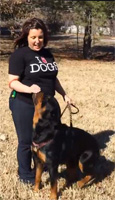
Pictured above is Fanna’s dog named Sobek. Fanna absolutely loves Sobek (aka Smoochie). She says, “He is the most kind and gentle Rottie soul, and he’s Momma’s honey bun.” 🙂
Fanna Easter is a volunteer Adoption Coordinator for this wonderful group: Southern States Rescued Rottweilers
Learn about Rottweiler rescue at National List of Rottweiler Rescue Groups.
Tell us about your Rottie on Facebook.com/DogTrainingNation.
You may also like: Bully Breeds


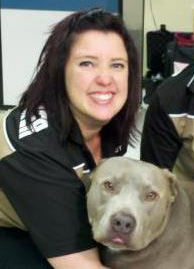 Many times, I’m asked if specific breeds like Pit Bulls are more difficult to train. When teaching dogs polite behaviors, about 90% is the same learning principles, which means all dogs are able to learn. So let’s discuss the differences between Pit Bull Terriers and other breeds of dogs.