Dog Training Nation

In Dogs We Trust

  • Home
  • Training
    • Dogs
    • Puppies
    • Clients
  • Behavior
    • Breeds
  • Health
  • Safety
  • Resources
    • Equipment
    • Books
  • Dog Training Videos
  • About
You are here: Home / Blog

Dog Training Classes

June 2, 2014 by Fanna Easter

Dog Obedience Training

Dog Obedience Training
Dog training class in session.

Ah, the magic question that I’m asked several times a day, from new and frustrated dog owners, is: Does your dog need obedience classes?

Let’s explore this question about dog obedience training.

As a dog trainer, I see things a bit differently, as over 80% of my clients are already frustrated with their dog’s behavior. The remaining 20% of dog owners who attend dog obedience classes want to prevent naughty behaviors before they happen. These pet parents usually have attended a dog obedience or puppy training class in the past.

Training Classes are a Must

Your dog needs positive opportunities to learn which dog behaviors are appropriate. Just like a small child, it’s our job to teach dogs how to behave around people and other dogs:

  • On a leash
  • At the dog park
  • At home
  • At a stranger’s house
  • In the car
  • In public places like restaurants

Dogs pull on a leash to move forward. They jump up to greet you, as they have not been taught how to appropriately greet you (or any humans). Your dog is not acting naughty out of spite, but he may not have been trained by you or a dog trainer as to what good behavior is.

3 Things You Will Learn in Dog Training Classes

Dog training classes are a fabulous resource to teach polite manners. These classes should be considered mandatory for all dogs and their owners. Before your hackles go up from the word “mandatory,” let me explain. Over 70% of dogs are in shelters due to naughty behaviors that can easily be fixed by taking dog training classes. It really is that simple. Help prevent a dog from potentially being put down in a shelter by training him good behavior skills.

Parking your dog is a great behavior every dog and his owner should know. It simply means that despite distractions, another animal barking at him or in any situation that you want your dog to remain poised, your dog will not act up but instead look to you for guidance.

Dog treats are the best motivators for training your pet. Some people love cheesecake while others love chocolate. Dogs are the same way. They all have things that they are excited about and love to be given whether it is:

  • Cheese sticks
  • Bones
  • Tennis balls
  • Chicken
  • Turkey
  • Snacks  and biscuits
  • Kongs
RELATED: Dog Training Treats

Finding out what motivates your dog and using this while training will produce better behavior results at a faster pace. Think of it from a human perspective. For example: If I were to ask you to take a seat in the chair and you do, but then I ask you to stand up. Next, I ask you to sit in the seat again. Eventually, you may get bored and give up. But, if I were to hand you a $20 bill every time that you sat back down in the seat, I’d bet you wouldn’t mind getting up and sitting down anymore. In fact, you would probably enjoy doing it, right?

Dog training requires the same techniques. The dog’s currencies and motivation are what you can use to train him into behaving in an acceptable or desired manner. What is your dog’s “$20 bill”?

During a group dog training class, your pet will learn foundation cues, such as:

  • Sit
  • Down
  • Stay
  • Come
  • Walk politely on a leash
  • How to politely behave around other dogs and people

Dog behavior amongst other dogs and humans is the most important behavior aspects that your dog should know. Most dogs perform cues like sit and down at home, but will your dog respond when a guest visits? Does he forget what you taught him when it counts out in the field or in a public place?

Are dogs ever too old to learn? Of course not!

As a professional dog trainer with over 20 years of experience, I can tell you for certain that you can teach an old dog new tricks. You can teach new behaviors, reteach foundational behaviors and how to remember dog tricks! If you adopt an older rescue dog, it’s great to bring him through a group dog training class. You are teaching foundation behavior and building a bond. It is never too late for consulting with a dog trainer!

RELATED: Best Dog Training Books

The Importance of Dog Behavior Training

Will your dog behave the way you want at the park or during walks down the street? Or in the backyard when a squirrel is teasing him from a tree? Most dogs that have not attended group classes usually have a tough time responding to cues with high distractions. These are just a few situations that dog training becomes beneficial in your pet’s life.

Basic Dog Training Classes

While most dog training classes are weekly, at the same time and day each week, classes can vary from 4-6 weeks. In a basic dog training class, you will learn to teach your dog the foundational behaviors. Your dog will learn what behaviors need to be used in place of the naughty unwanted behaviors.

For example: Training your dog to sit before he jumps on you. In my 20 years of training, I have yet to see a dog jump when sitting. Teach your dog to sit and then teach him to park so you know the difference and so will he.

Dog training classes offer a fun and safe learning environment that will set you and your dog up for success. Mistakes are ignored (and yes, us dog trainers make mistakes too) and appropriate behavior is rewarded even for humans.

Dog obedience training classes will teach you the pet owner how to train your dog. That means you will learn the skills that can prevent naughty behavior from your dog. Taking dog training classes can be addictive and it’s a lot of fun!

Have you ever taken your dog to dog training classes? Tell us about it in the comments below.
Filed Under: Dogs, Training Tagged With: dog training, dog training an older dog, Dog Training class, dog training classes

How to Train Your Dog to Park It

June 2, 2014 by Fanna Easter

Train Your Dog to Stay

One dog training cue that I strongly encourage every dog owner to train his dog to know would be to “park.” In a nutshell, this behavior means to stay with me while I’m doing something else. You can use these behaviors when:

  • Talking to someone at the park
  • Having guests over
  • Dining outdoors
  • Paying at the pet store or vet’s office
  • Listening to instructions

VIDEO: Train Your Dog to Park

You can use the dog park behavior when your dog becomes overwhelmed by another barking dog or excited in a new situation. You are teaching him to bring his arousal level down. It’s like taking a yoga breath for your dog. Having him know the ability to remain poised and look to the dog owner for approval before chasing or barking is key to a safe and calm interaction with other dogs, people or animals.

When teaching hyperactive dogs to be calm, many folks ask them to sit still. This is tough, as they are learning how to manage their extra energy and excitement. I want to set you and your dog up for success and asking for a rock solid stay or wait is not fair so let’s ask for something easier, such as park.

Let’s look at it from a human perspective. Have you been with a friend who meets up with another friend and you are not part of the conversation? It’s awkward, but it happens. Now, what if your friend asked you to sit on a bench and wait until their conversation is over? You can not check your Facebook page or text messages, you just watch them. Wow, I could not do it! Same thing for your dog. Let him walk around and occupy his mind by sniffing around and looking around if he wants to (as long as he is not pulling on the leash). Voila! You’ve parked your dog!

Don’t get this behavior confused with wait, as you’re not asking your dog to sit or down in one spot. I think of wait as a pause button. You stay in that position until released. Stay means you are asking the dog to sit or lay down until you pick him up or call (releasing him from the cue) to come.

Why are there so many words in dog training for similar things?

We need to clear up any confusion for our dogs. If I asked you to turn, you will ask which way (left or right), in a circle, just my head or my entire body. Let’s make sure we communicate clearly to our pooches. I think they will appreciate it. 🙂

Just by teaching this simple behavior, you are teaching your dog:

  • Self control (teaching your hyper dog to relax)
  • Polite greetings to people (not to jump on people)
  • Polite leash manners (not pull on the leash)
  • How to ignore other dogs
  • To stay
  • Not to bark

How to train a dog to park:

  1. Step on your leash about halfway up to your dog. He should have 3-4 feet of extra leash.
  2. Click and treat your dog the instant the leash becomes loose. Example: Your dog is pulling to visit another dog. Wait until the leash becomes loose and click/treat!
  3. Bingo. You are rewarding calm and quiet behavior!

This is very easy to teach. Just make sure you practice this behavior 1-2 minutes per day. Also, this is the first behavior you practice in the park before a walk and when guests come over.

Subscribe to our channel on YouTube for more dog training videos.

Have a comment? Tell us how the “parking your dog” behavior can be useful for you in the section below!

More on parking your dog:
Learn How to Park Your Dog
How to Park Your Dog

Filed Under: Dogs, Training Tagged With: dog, dog training, dog training advice, dog training tip, how to train a dog, how to train a puppy

German Shepherd Training

May 28, 2014 by Fanna Easter

How to Train a German Shepherd

German Shepherd Training
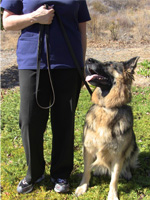
German Shepherd sitting down in the heel position.

Are German Shepherds more difficult to train than other dogs? The simple answer is no. Training German Shepherd dogs is easy. Start with teaching polite greeting manners, leash manners and body handling.

Anytime a dog trainer is training a German Shepherd to learn polite behaviors, the trainer will utilize about 90% of the same techniques to train any dog breed. All dog breeds learn in the same ways.

Top 3 Dog Training Behaviors

Let’s discuss the differences between German Shepherd dogs (GSDs) and other breeds of dogs.

German Shepherd dogs, as with all dogs, do not respond to authoritative or punishment-based training methods. GSDs understand consequences and will respond quickly when set up for success. Pushing, pulling or forcing a GSD to comply with a behavior will mostly likely result in a dog bite or your dog will become afraid of you.

Top 3 German Shepherd Behaviors

  • Polite Greetings: With any herding and guarding dog breed, it’s vital they learn how to greet other people and dogs politely. German Shepherd dogs are big so they should learn how to sit when approached by visitors. Also, they should learn to ignore other dogs. This is easily taught during a group dog training class.
  • Polite Leash Manners: German Shepherds need to learn not to pull on the leash. You can train your dog not to pull by holding still when he does. Once he learns to stop pulling, then walk forward. Front clip harnesses work great for GSDs, as they control pulling.
  • Body Handling: As with most large breed dogs, it’s important for GSDs to allow body handling. Start by touching your GSD’s ear, then click and treat. Next, touch his nails, then click and treat. Practice this everyday for one minute.

VIDEO: How to Train a Dog – Body Handling

Similar to all dog breeds, German Shepherd owners should socialize their dogs at an early age before they hit the 16-week mark. This means introducing your puppy to lots of new people and dogs. Want to bring a German Shepherd into your home? Learn more at National List of German Shepherd Dog Rescue Groups and German Shepherd Dog Club of America.

Tell us about your GSD and what polite behaviors you taught them in the comments below.

YOU MAY ALSO LIKE: German Shepherds

Filed Under: Breeds, Dogs, Training Tagged With: adopt german shepherd dogs, American German Shepherd Rescue Association, german shepherd, german shepherd dog, german shepherd training, german shepherd training tips

Housebreaking a Puppy

May 22, 2014 by Fanna Easter

How to Housebreak a Puppy

How to Potty Train a Puppy
Learn the seven tips to potty pad training your puppy.

What do you do when your puppy really needs to use the restroom. Take your puppy for a walk, right?

Sometimes it’s easier said than done. For many folks who live in high rise apartments, it’s challenging waiting for an elevator when your puppy needs to go now! Also, some people work long hours and would like their puppies to have immediate access to a potty spot. Potty pad training is a nice solution to fulfill these needs.

Benefits of Puppy Pad Training

If your dog is home for long hours, please invest in a pet sitter to provide mental and physical stimulation even if you are potty pad training. They need a walk to burn through their excessive energy just like people. Puppy training classes are a great way for them to learn while burning off some energy.

Before starting, read these tips on how to potty train your puppy. The difference is, instead of bringing your potty outside, you will bring your puppy to his potty pad. Also, instead of placing him in a crate, you will place him in his confined area.

Yes, your puppy will learn to potty on his pad and outside!

Train Your Puppy to Use a Potty Pad

  1. Most dogs will potty in the same spot so we can use this to our advantage. Dip the center of your potty pad in his urine (after the puppy potties outside or if he has an accident indoors). If he poops, you can place one small chunk in the center of the potty pad also. While there are some products that mimic urine smells, I recommend the real stuff. 🙂
  2. Add the scented reminder in the center of the pad so your puppy potties on the pad instead of the edge or slightly off the pad. Also, you can add two potty pads to provide additional potty area (cover one corner of the bathroom between the toilet and bathtub).
  3. Confine your puppy in a small room, such as a bathroom with a baby gate. Trust me, the baby gate will save your closed bathroom door from hideous paw scratches! Place the used potty pad in the far corner away from his food, water, bedding and baby gate.
  4. If you have difficulty confining your puppy to an area, read this crate training article for tips. Crate training has basically the same principle as potty pad training except your puppy is learning to potty in a specific spot of his area.
  5. Always add and rotate toys daily so your puppy plays with food stuffed toys instead of having a party with his puppy pad. 🙂
  6. If your puppy still plays with his pad, you can place it in a plastic potty pad holder.
  7. Once your puppy reliably uses his pad (100% of the time), I recommend placing it in the corner of a bathroom so you can scoop and flush chunks as needed.

As your puppy is learning potty training, always scent the new pad with his urine or poop. Once he understands the pad is the puppy potty spot, you can remove the scented reminder.

Tell us about your puppy potty pad training success stories in the comments section below!

YOU MAY ALSO LIKE: Top 10 Puppy Training Tips

Filed Under: Puppies, Training Tagged With: potty pad training, potty pad training a puppy, potty pad training a small dog, potty pad training an older dog, potty pad training tips

Puppy Biting

May 22, 2014 by Fanna Easter

How to Stop a Puppy From Biting

How to Stop a Puppy From Biting
Puppy nipping — ouch!

As my first puppy training class begins, I notice fresh scratch marks along pet parents’ hands and arms. Their puppies are nipping, mouthing, biting or whatever you want to call it. So we cover puppy nipping during first class. We want to save your skin. 🙂

Puppies teethe. It’s normal and all puppies go through it. Think of a puppy’s teeth as his fingers. He is “touching” everything now and learning how much pressure to use when “touching.” This is called bite inhibition. Also, he is losing his puppy teeth, which hurts!

The goal is to teach your puppy something else to do with his  mouth by giving him treats and rewards when needed.

Five Puppy Biting Tips

  1. Teach your puppy to target his nose to your hand. Your puppy learning to bring his nose to your hand instead of his teeth is rewarded.
  2. When a puppy puts too much pressure with his teeth, let him know by standing still and squealing. Once he stops mouthing, give him a toy he can mouth on instead of you.
  3. If your puppy continues to bite, walk away. If your puppy chases you and begins pulling on your pants, stand still and wait until your puppy lets go and reward him with a treat or toy.
  4. If your puppy is mouthing on your naked ankles, ask him to target your hand and reward. Then, give him a toy that your puppy can chew on. You can teach your puppy to target your ankle or foot for treats too!
  5. Teach the on/off game. Using a tug toy, wiggle it around so your puppy can pull and bite on a tug toy. Then hold the toy and your body still until the puppy releases the toy. Once he releases the toy, begin another game of tug. The tug game will not teach your puppy to be aggressive. It’s a self-control game of which the goal is for a puppy to learn when to play and when to give the toy back.

Always provide your puppy with plenty of chew toys so he can bite them instead of you.

RELATED: How to Stop a Puppy From Biting

Puppy Treats that Help Prevent Biting

I recommend bully sticks, food stuffed toys, tug toys and Jolly Balls. Never leave your puppy unattended when he is chewing on any toys unless it’s a food stuffed Kong.

When your puppy is teething, freeze his food stuffed toy to soothe his  inflamed gums, as teething hurts. I’ve gone as far as dipping a large towel in low sodium broth, freezing it and giving it to my puppy to chew on. Never leave him alone with the frozen towel. This is simply a tool to relieve the inflammation of his gums.

Puppy chewing deterrents can be useful. However, I’ve noticed a large population of dogs that enjoy the taste of bite deterrents. When polling my students, over half of their dogs will happily lick sprayed chewing deterrents—yuck.

If your puppy wants to chew something badly enough, he will endure the taste. 🙂

Filed Under: Puppies, Training Tagged With: puppy biting, puppy nipping at face, puppy nipping at feet, puppy nipping at hands, puppy nipping at pants, puppy nipping tips

  • « Previous Page
  • 1
  • …
  • 132
  • 133
  • 134
  • 135
  • Next Page »

About

Dog Training Nation is a community of dog trainers, dog owners and dog lovers. Our mission is to provide trainers and owners valuable information to enrich dogs' lives. We cover a range of topics, from socializing puppies to dealing with aggressive dog behavior to selecting the best dog products. It is our hope you share our content to make the dog and owner world a better place.

​

Facebook

Video

Dog Training Nation is a dog training blog for pet owners and dog lovers. We cover a range of topics from puppy socialization tips to dog aggression to dog health. It is our hope you share our content to make the world a better place for dogs.

Dog Training Nation

Quick Links

Dog Training
Dog Behavior
Dog Training Videos
Become a Dog Trainer
About
Contact Us

Copyright © 2026 · Lifestyle Pro Theme on Genesis Framework · WordPress · Log in