Dog Training Nation

In Dogs We Trust

  • Home
  • Training
    • Dogs
    • Puppies
    • Clients
  • Behavior
    • Breeds
  • Health
  • Safety
  • Resources
    • Equipment
    • Books
  • Dog Training Videos
  • About
You are here: Home / Archives for Behavior

Dog On Dog Aggression In The Home

October 4, 2017 by Fanna Easter

Dog Training: Dog Aggression Between Housemates

Dog On Dog Aggression In The Home
Jne Valokuvaus/Adobe Stock

When two dogs in the same home start fighting, it’s a frightening and extremely urgent situation. The tension between both dogs is pliable, and pet owners are often frustrated, yet hopeful. If your dogs are fighting, follow these steps today. Don’t hesitate because this situation will not get better on its own.

Why Are Your Dogs Fighting?

Many pet owners dwell on the exact cause for the fighting between their dogs. As a professional dog trainer, it’s extremely hard to pinpoint the exact cause for the dog on dog aggression in the home, but it’s evident that tension has been present long before their fighting began.

Dogs protect resources, such as food, toys, treats, beds, space and humans. Additionally, overly anxious dogs will redirect their frustration onto their housemate. Regardless of the reason, it’s important to understand this situation will only get worse until it’s addressed with a professional dog trainer or veterinary behaviorist.

[perfectpullquote align=”full” cite=”” link=”” color=”” class=”” size=””]Allowing dogs to fight only makes the situation much worse and is considered torture for both dogs.[/perfectpullquote]

What Should You Do First?

Prevent your dogs from meeting or seeing each other. Never allow dogs to fight it out or work it out for their spot in the pack because this never works. Allowing dogs to fight only makes the situation much worse and is considered torture for both dogs. Plus, it’s not fair to the dog being attacked over and over; his or her life is a living hell.

Separate both dogs to opposite sides of the house. Keep doors firmly closed and place gates to prevent fighting. Bring one dog out to potty at a time, and ensure each dog is securely confined in his or her area before letting the other dog out to potty. Preventing fights stops your dogs from practicing the behavior while keeping each dog safe.

Get Professional Help

Pet owners with squabbling dogs need professional help. It’s impossible to prevent housemates from fighting, even with management, without intense dog behavior modification. Contact a professional dog trainer or veterinary behaviorist immediately, and keep all dogs separated until a professional can help you implement behavior protocols.

While it’s tempting to seek advice online, it’ll be difficult to find specific answers for your case unless a professional has met each fighting dog and the environment. If someone does offer advice without meeting your dogs, that person is doing a disservice to your household.

Find a local professional immediately for best results. Plus, make sure the professional has extensive knowledge with dog aggression and uses positive reinforcement training only. Punishment will only make the problem worse.

Filed Under: Behavior, Training Tagged With: dog behavior, dog obedience, dog on dog aggression, dog on dog aggression in the home, dog to dog aggression, dog training, Dog Training Tips, dogs in same house fight, fighting dogs in same house, help for dogs fighting in same household, how to stop dogs from fighting, how to teach a dog, how to train your dog, stop dog fighting, stop dogs from fighting

Help! My Dog Eats Everything Outside

September 22, 2017 by Fanna Easter

How to Stop Your Dog From Eating Everything Outside

My Dog Eats Everything
otsphoto/Adobe Stock

With so many tempting things outside, it’s understandable why dogs would want to chew on sticks or crunch on acorns. As fun as it is for your dog to eat everything outside, it’s not healthy for him to consume indigestible foreign bodies. Next time your dog tries eating mulch, give these tips a try.

Keep an Eye on Your Dog First

To stop your dog from eating everything, it’s important to know when it happens, so you can redirect your dog. When your dog is outdoors, hang out and watch your dog at all times. During the time it takes to text your friend, your dog will have been able to swallow a whole acorn.

Keep your dog on a 4- to 6-foot leash to prevent pica behavior, which is the consumption of indigestible objects. Plus, keeping your dog close to you helps change your dog’s behavior quickly.

Play “Trade”

When your dog picks up a stick or rock to chew on, play the “trade” game. Say “trade” and offer your dog a super yummy treat. When your dog drops the stick, pick up the stick and then give your dog the yummy treat. Of course, throw away the stick to prevent your dog from picking it up again.

Trying to remove an object from your dog’s mouth will teach your dog to turn away from you or swallow the item faster, so always play the “trade” game. If your dog eats dog poop, picking up poop immediately is the best way to prevent this behavior.

Give Your Dog Fun Things to Do Outside

Leave fun toys outside to keep your dog occupied. Even better is to play tug or fetch with your dog after your dog potties. Once dogs learn to play with toys, they will quickly ignore sticks, stones and other indigestible objects outdoors.

Sometimes, dogs develop pica due to behavior and nutritional issues. If your dog continues to eat everything outdoors, contact your veterinarian. It may be due to a medical issue.

Filed Under: Behavior Tagged With: dog eats acorns, dog eats dirt, dog eats everything, dog eats everything outside, dog eats mulch, dog eats rocks, dog eats stuff outside, dog health, dog health tips, dog training, Dog Training Tips, stop dog eating everything, stop dog from eating rocks, stop dog from eating stuff outside

Help! My Neighbor Complains About My Barking Dog

September 20, 2017 by Fanna Easter

How to React When a Neighbor Complains

Neighbor Complains About My Barking Dog
mfotohaus/Adobe Stock

As you arrive home from work, you notice a note taped to your front door. It’s from your neighbors, and they’re complaining about your dog barking constantly while you’re away at work. What should you do?

Don’t Ignore the Situation

Many pet owners simply ignore neighbors’ complaints; they assume the complaint is not true. But is it? Neighbors don’t complain just to complain—unless they feel ignored. Regardless of your past feuds, it’s important to take your neighbor’s complaint seriously. Call, email or leave a note on your neighbor’s front door, and acknowledge his complaint politely. Apologize profusely, and let him know you’re putting a plan into action immediately.

How Bad is Your Dog’s Barking?

Pet owners are usually very aware that their dogs bark when they’re not home, but how bad is it? It’s important to know if your dog is bored or suffering from separation anxiety. Set up an old smartphone or tablet in your home, and Skype yourself from your current phone. Or purchase an interactive dog camera system to check in on your dog throughout the day. Many camera systems will automatically alert pet owners when their dogs start barking.

If possible, record some of this footage for future reference with a professional dog trainer or veterinary behaviorist. Knowing what’s going on while you’re away will help you address your dog’s barking problem and neighbor’s complaint quickly.

Change Your Dog’s Behavior

Incessant dog barking behavior will not resolve on its own, so it’s important to take time to change your dog’s behavior. One way to change your dog’s behavior is to keep her indoors when you’re unable to keep an eye on her. Never leave a dog alone outdoors. Depending on what you find during your daily video sessions, it’ll be better to start changing your dog’s behavior sooner than later.

For dogs with separation anxiety, partnering with a professional dog trainer is the only way to successfully manage this issue. For bored dogs, hire a pet sitter to walk your dog while you’re at work. While this may seem like an unneeded expense, a pet sitter’s fee of $20 per day is much cheaper than animal control fines and lawsuits. Check out additional tips on keeping a bored dog quiet while you’re away.

Electronic Collars Don’t Work

Unfortunately, an electronic collar or anti-dog barking device is the first item that pet owners purchase when neighbors complain about their barking dogs. After polling hundreds of pet owners, many claim their dogs continued to bark or became aggressive after using an electronic collar. Many dogs are so frightened by the pain, they hide under furniture, urinate or defecate.

There are so many other options that work quickly and won’t cause your dog pain. For example, a Manner’s Minder or Pet Tutor will keep your dog busy throughout the day and prevent barking behavior. These items cost the same or less than an electronic collar, and work much better. If your dog still barks, hire a positive reinforcement dog trainer for best results.

Never ignore a complaint, and start changing your dog’s behavior today.

Filed Under: Behavior, Training Tagged With: barking dog driving neighbors crazy, dog barking, dog barking angry neighbor, dog barks when left alone, dog behavior, dog training, Dog Training Tips, how to deal with neighbor angry my dog barks, how to stop a dog, how to train a dog, neighbor complained about my dog barking, neighbor complains about dog barking, stop dog barking

Dog Training Tips For Annoying Dog Behaviors

September 12, 2017 by Fanna Easter

How to Stop Annoying Dog Behaviors

Annoying Dog Behaviors
JaribFoto/Adobe Stock

Dogs do certain things because they’re fun! However, fun dog behaviors are super annoying to people, and it becomes a vicious cycle. Before freaking out and screaming “stop” to your dog, take a deep breath. Now, take 5 minutes to an hour and think about what you’d like your dog to do instead of (fill in the blank). This is the key to changing your dog’s annoying behaviors fast!

What Dog Behavior is Driving You Crazy?

Identifying a specific issue helps solve an issue quickly. What is your dog doing that drives you nuts? It could be anything. Instead of assuming that everything your dog does drives you crazy, try to narrow down the most frustrating one. Once you know the frustrating behavior, you can address it. If you don’t, it’s like bringing your car into a mechanic shop because something is wrong, but you can’t identify the issue.

If your dog has several annoying behaviors, pinpoint one that needs to be addressed immediately and work on that one first. Once the main issue is addressed, then move on to additional annoying behaviors. Trying to address all of your dog’s frustrating issues at once is like packing 10 pounds of sugar in a 5-lb sack; it’s not going to happen.

RELATED: Does Your Dog Have an Attitude?

Once the most frustrating issue has been positively resolved, something interesting happens. All other minor behaviors seem to decrease because your dog has learned to do something else instead. Your dog is learning how to positively respond in situations, and both you and your dog are building a bond of trust and communication. Great job!

Here’s a list of common annoying dog behaviors that are fun for dogs, but annoying to pet owners:

  • Barking
  • Digging
  • Jumping
  • Running away
  • Spazzing out
  • Pulling away
  • Chewing
  • Nipping

What Should Your Dog Do Instead?

Now that you’ve narrowed down a specific annoying dog behavior, it’s time to teach your dog an incompatible behavior. An incompatible behavior is the opposite of the annoying behavior. Basically, you’re telling your dog to do this instead of that. Examples of incompatible behaviors for common annoying dog behaviors are:

  • Being quiet instead of barking.
  • Digging in a sandpit instead of your rose garden.
  • Sitting instead of jumping on people.
  • Coming when called instead of running away.
  • Sitting still instead of spazzing out.
  • Walking on a loose leash instead of pulling on it.
  • Chewing dog toys instead of table legs.
  • Not putting teeth on your skin instead of nipping.

How to Teach an Incompatible Behavior

While this may seem like sunshine and rainbow wishes, it’s actually very simple to teach incompatible behaviors. Grab a handful of super yummy treats, and reward your dog when he does an incompatible behavior instead of an annoying one. Dogs eventually have to stop barking to take a breath, so click and reward even a nano-second of silence.

Redirect dogs to chew on their chew toys instead of expensive table legs, and crate dogs when you’re not home. Reward a dog when all four feet are on the floor instead of jumping. Think about it this way: If $100 bills rained from the sky when you sat down instead of standing, you would learn that sitting is super rewarding.

Identify the annoying behavior, then reward the incompatible behavior and the annoying behavior will disappear. Never punish annoying behaviors or they’ll hang around longer—just reward incompatible behaviors every time!

Filed Under: Behavior, Training Tagged With: annoying dog behavior, dog chews, dog digs, dog frustration behavior, dog jumps, dog nips, dog obedience tips, dog training, Dog Training Tips, frustrated with my dog, how to change dog behavior, losing patience with my dog, losing temper with my dog, my dog won't stop, stop dog from jumping

Help! My Dog Is Afraid Of Walking Through Doorways

August 30, 2017 by Fanna Easter

Dog Training Tips for Dogs Afraid of Doorways

Dog Afraid of Thresholds
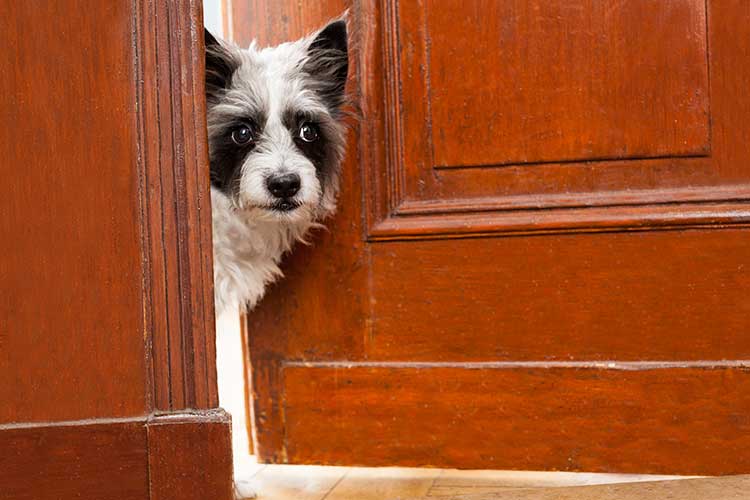
javier brosch/Adobe Stock

When approaching narrow spaces, some dogs will suddenly stop and refuse to walk forward while others will run through doorways quickly with their tails tucked and ears pinned back. Either way, both types of dogs are afraid to walk through doorways and it’s essential to positively change their behavior to increase their quality of life.

What Causes This Fear?

As humans, we assume hundreds of reasons why dogs behave a certain way, which is unfair to dogs. Let’s remove our anthropomorphic tendencies and try to understand the cause behind a dog’s fear of walking through thresholds.

Fearfulness is the main cause of your dog’s behavior. We can assume hallway echoes, loud noises, loudly slamming doors and many other reasons are the cause, but fearfulness is the real cause. When dogs are fearful, they may overreact to many things. When fearful dogs are exposed to scary doorways or entrance ways several times, they may develop anxiety. If a dog is punished when he’s scared of a scary situation, his anxiety deepens.

How to Teach Dogs to Love Walking Through Doorways

Regardless of why your dog became afraid of walking through doorways, it’s imperative to teach him to love walking through them. Grab super yummy treats, such as cheese cubes, deli lunch meat or hot dogs, and chop into pea-sized bites. Treats are a dog’s paycheck, so use the yummiest treats possible.

Start teaching your dog this behavior inside your home, using hall and doorways. Even though your dog may not be fearful of walking through indoor entrances, it’s a safe place to start changing your dog’s behavior.

Hold a treat in front of your dog’s nose, and lure him through the doorway. If your dog is too scared, click and treat your dog when he walks close to a doorway. Slowly shape this behavior until your dog will walk through the entrance.

Once your dog is comfortable walking through indoor entrances, leash your dog and practice outside. Walk out the back door and click as your dog walks through. Even if he slinks through the doorway, he’s being brave and choosing to walk through the doorway.

Pairing good things (yummy food) with scary things (entrances) will positively change your dog’s behavior. Think about it this way: If it rains $100 bills while you’re walking through a haunted house, you will learn that haunted houses are not scary. 🙂

What Doesn’t Work

Never force a dog through a doorway; your dog is scared. Back away from the door, regroup by grabbing treats and lure your dog inside. Ideally, you should practice this behavior before he has to walk through scary doorways, such as the vet clinic.

Take 1-2 minutes each day, and make doorways and entrances fun to walk through!

WATCH: Tips For Dogs Afraid To Walk Through Doorways

Filed Under: Behavior, Training Tagged With: anxiety in dogs, dog afraid of threshold, dog afraid to walk through doorways, dog anxiety, dog behavior, dog refuses to walk through threshold, dog scared of door, dog scared of entrances, dog training, dog who is afraid of doorways, dog won't walk through door, how to teach a dog, how to train a dog, how to train a dog to come, teach a dog, train a dog

  • « Previous Page
  • 1
  • 2
  • 3
  • 4
  • …
  • 33
  • Next Page »

About

Dog Training Nation is a community of dog trainers, dog owners and dog lovers. Our mission is to provide trainers and owners valuable information to enrich dogs' lives. We cover a range of topics, from socializing puppies to dealing with aggressive dog behavior to selecting the best dog products. It is our hope you share our content to make the dog and owner world a better place.

​

Facebook

Video

Dog Training Nation is a dog training blog for pet owners and dog lovers. We cover a range of topics from puppy socialization tips to dog aggression to dog health. It is our hope you share our content to make the world a better place for dogs.

Dog Training Nation

Quick Links

Dog Training
Dog Behavior
Dog Training Videos
Become a Dog Trainer
About
Contact Us

Copyright © 2026 · Lifestyle Pro Theme on Genesis Framework · WordPress · Log in