Dogs Growling

What should you do when your dog growls?
Dogs will growl. This is completely normal behavior. They may growl during play or when encountering something new or scary (like a plastic bag flapping wildly in the wind). Always look at your dog’s body language and environment to determine if your dog is having fun or your dog is growling out of fear.
Dog Growls When Playing
When dogs play, they usually growl. Some puppies may be more vocal than others. If your dog or puppy is playing with another dog and he begins growling, separate your dog from the other dog in a calm manner. Pay close attention to watch the other dog’s body language. If the other dog runs away, then your dog’s growling (or play style) may be too much for that dog. That is a safe time to end the play session.
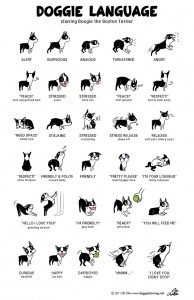
If the other dog continues to play with your dog, then allow them to continue playing.View the Chart of Calming Signals created by Doggie Drawings to understand your dog’s body language.
A special shout-out to Doggie Drawings by Lili Chin. This site has wonderful educational tools for everyone, including posters for educating children about dog bites.
RELATED: Dog Aggression
When Your Dog Growls, But it’s Not Playtime
Dogs will display signals that say to a dog behaviorist that the dog is uncomfortable in a situation before he growls. Think of it this way: How do you know a thunderstorm is approaching? The wind picks up, dark clouds roll in, you can smell an increase of moisture in the air, and it begins to rain, then you hear lightening strike. Think of growling as lightening strikes. We need to interrupt and acknowledge calming signals before the lightening strikes. In my 20+ years of dog training, I’ve never witnessed a dog growl or bite without warning signs. We must understand a dog’ s body language to be able to prevent dog bites.
Never punish a dog for growling! This is your dog’s warning system. A dog growl means that he is uncomfortable in the current situation. People react the same way when scared. We may say, “Leave me alone,” “Stop” or “You are scaring me” to the person who is causing discomfort. As pet parents, we must respect a dog’s growl.
To learn more about dog body language, visit “Learn to Speak Dog” by Dog Gone Safe and watch videos and free downloads. The “Learn to Speak Dog” series is highly educational and will help you better understand dog behavior and growling signals.
What should I do if my dog growls as a warning?
- Acknowledge and respect your dog’s calming signals (example: a growl).
- Scan the environment to locate what caused your dog to growl (flying plastic bag, another dog standing too close in his face, doorbell ringing, stranger approaching, touching his toenails, meeting new strangers, child is too close and in his face, fill in the blank).
- Calmly move the dog away from the trigger that caused the growl.
- Write down important facts about the trigger:
– Happened when…
– Trigger was…
– We were doing…
– Has happened X amount of times…
- Keep your dog away from these triggers. If he is exposed to his trigger over and over again, he rehearses his stressed behavior, which strengthens it and that means it will take much longer to teach him good behavior around the trigger. Anxiety is caused by repeated exposure to a stressor, and we don’t want your dog to become anxious. Not removing the dog from the situation that brought on a growl reinforces that the growling is the default.
Use desensitization and counter conditioning to overcome the trigger that caused your dog to growl fearfully.
Dictionary.com defines desensitization as:
1. The elimination or reduction of natural or acquired reactivity or sensitivity to an external stimulus, as an allergen.
2. A behavior modification technique, used especially in treating phobias, in which panic or other undesirable emotional response to a given stimulus is reduced or extinguished, especially by repeated exposure to that stimulus.
Both definitions apply to training your dog so he can overcome things that he may have first thought were threatening or scary.
To better illustrate the fear-based growl, here is a brief example:
If your dog is terribly scared of crickets and he growls because of the:
- Noise they make
- Unpredictable hops
- Scent they carry
This is generally a fear-based or warning growl.
The dog growl as the cricket is encroaching in his space is the dog’s trigger warning.
If the dog was taken out of the growl situation, but can still acknowledge that the cricket is in the room you can begin to reward the dog with his favorite treat while he can still see the cricket. Doing this will begin to teach your dog to associate that the cricket isn’t something to fear. Instead, he can begin to learn that a cricket present followed by yummy food and no growling is an acceptable behavior.
Overtime even if the cricket moves closer towards the dog (slowly) while feeding the dog treats. You will see improvement in the dog’s temperament. Your dog will become more comfortable with the cricket in the room.
You will want to feed the dog a treat as he continues looking at the cricket. If, at any time, it comes too close and the dog begins to growl or his body language shows he is getting uncomfortable, it is important to remove the dog from the situation and not treat during the uncomfortable moments. That will only reinforce the wrong feelings or behavior with getting a reward.
- Never force, pull a dog towards a trigger or repeatedly introduce a dog to a known trigger, which causes them to freak out. This will make your dog way worse, we call this “flooding.”
This does not work. You are teaching a dog to become helpless, which is cruel.
This example is no substitute for a professional behaviorist or dog trainer assessing the behavior problem that causes your dog to growl. There is no one size fits all scenario.
Please consult with a local professional to correct growling behavioral issues.
Locate a qualified animal behaviorist and dog trainer in your area to begin the desensitization process. We recommend having an expert physically involved to offer guidance and to be successful with these behavior modifications. Hiring a professional dog behaviorist and/or a professional dog trainer will quicken positive results.
If you have any concerns, find a qualified dog trainer and animal behaviorist. Most dog trainers will meet you and your dog, assess their behavior and answer your questions. Dog trainers have many resources at their fingers tips, such as qualified animal behaviorists. Qualified animal behaviorists (ABs) are extremely knowledgeable in dealing with complex behaviors. A certified animal behavior trainer or an animal behavioral expert will work with your local vet and dog trainer. I’ve consulted with pet parents and animal behaviorists in several cases to arrive at a point where the dog has overcome his fears and provide the animal’s owner with excellent results.
When does your dog display calming signals? Please share in the comment section below.
READ ALSO: Choosing an Animal Behaviorist
 Dealing with dog aggression, moderate to severe anxiety or fearfulness or obsessive compulsive behaviors (OCD) is extremely trying for pet owners. I’ve held these owners in my arms, as they sobbed. It’s a difficult situation for dogs and their owners.