Dog Training Nation

In Dogs We Trust

  • Home
  • Training
    • Dogs
    • Puppies
    • Clients
  • Behavior
    • Breeds
  • Health
  • Safety
  • Resources
    • Equipment
    • Books
  • Dog Training Videos
  • About
You are here: Home / Archives for Resources

Dogs vs. Sprinklers: Avoiding a Water Obsession

April 8, 2016 by Fanna Easter

Dog Training Tips for the Dog Obsessed With Water

Dog Obsessed With Water Hose
Joshua_Todd/iStock

What human or dog doesn’t love running through a water sprinkler on hot, humid days? Playing with water sprinklers can be exciting and exhausting fun for dogs, especially dogs that were bred to love water. To answer the question of whether or not dogs should play with water sprinklers: of course, dogs can play in water sprinklers, but add a couple of cues first! There are a few dogs that become obsessed with water. Let’s discuss how to prevent this behavior.

When Water Fun Turns Into Obsession

Some dogs become completely obsessed with water from a hose, lawn sprinkler or bathroom faucet. For the most part, these dogs will play endlessly for hours and never tire. But when dogs stand next to a hose, lawn sprinkler or faucet, waiting for it to be turned on, that may indicate an obsession. Some dogs take it a bit further; they become consumed with waiting for water to spray out of these devices. Some dogs refuse to eat or drink and, instead, they wait tirelessly next to a hose.

Many pet owners think it won’t happen to their dogs, but prevention is worth its weight in gold!

How to Prevent Dog Water Obsession

Before turning on spraying water, give your dog a cue that means it’s about to happen. Examples of cues are “water time,” “let’s play” or “sprinkler.” Usually, your dog will respond when you walk toward or touch the hose, which is a different type of cue than verbal, which is totally fine. Now, turn on the water and have a blast!

When it’s time to end the water session, give your dog a different cue, such as “all done” or “game is over” and turn the water off. If your dog sits next to the hose or sprinkler, just walk away and ignore your dog. The worst thing you could do is reward your dog’s cue for turning the water on. Yes, when your dog sits next to the water hose, he is basically asking you to turn it on. 🙂 If you reward this behavior, you’ll have a dog that sits next to the water hose waiting for someone to turn it back on. Yes, dogs teach us cues all the time, and we respond pretty darn quickly too. 😉

If your dog is still waiting by the hose in hopes it will turn on, call him inside for treats. Or better yet, grab a frozen food stuffed toy out of the freezer and show him the peanut butter stuffed treat. He will gladly follow you back indoors to enjoy his prize!

While this seems like a lot of work, it’s a safe way to prevent water obsession and still have loads of fun.

If It Doesn’t Get Better

If your dog refuses to eat, drink or move away from the water hose (lawn sprinkler, faucet, etc), then it’s time to get professional help. A professional dog trainer can watch your dog’s behavior and make additional suggestions. If your dog truly suffers from his obsession, which is called Obsessive Compulsive Disorder (OCD), a dog trainer will quickly refer you to a veterinarian board certified in animal behavior.

Have fun and stay cool this summer!

YOU MAY ALSO LIKE: Laser Pointer Games are Bad for Dogs

Filed Under: Behavior, Resources Tagged With: aggression towards water hose dog, dog attacks the water hose, dog obsessed water hose, dog obsessed with spraying water, dog obsessed with water, dog will not playing with water, how to stop dog from playing with water hose

Dog Teeth Cleaning: 3 Tips That Don’t Involve Brushing

April 6, 2016 by Fanna Easter

How to Clean Your Dog’s Teeth Without Brushing

Dog Teeth Cleaning
mykeyruna/iStock

Look, I totally understand. It’s difficult remembering to brush you and your children’s teeth daily–much less your dog’s teeth. With that said, oral hygiene is just as important for your dog as your family, so try these dog teeth cleaning tips that take less than one minute per day.

Wipe Your Dog’s Teeth

Wiping your dog’s teeth every day does a pretty good job at removing tartar buildup and it only takes 60 seconds. In our home, we wipe our dogs’ teeth daily and follow up with weekly teeth cleanings to remove any buildup between the teeth. It does take slightly longer to wipe my Rottweiler’s teeth. It takes a minute and a half because he’s huge, and there’s way more tooth surface to wipe than on my smaller dog.

How to Wipe Dog Teeth

Here’s how I wipe my dogs’ teeth daily. Please note I rotate between using paper towels and DentAcetic wipes (dog-specific tooth wipes), depending on how much time I have that day:

  • Using a dry paper towel sheet, wrap it around your index finger and wipe each tooth sideways, moving front to back of each tooth. Don’t forget to wipe the gum line also, as tartar loves to grow up there.
  • As you’re wiping a tooth sideways, move the paper towel downwards to deposit any tartar into the paper towel. This also ensures you’re not spreading tartar from tooth to tooth, but removing it.
  • Before moving to another tooth, move a clean section of the paper towel onto your finger and wipe the next tooth.
  • Wipe, swipe downwards and slip a clean paper towel over your finger until all teeth have been wiped.

Usually, it takes a whole paper towel sheet for my Rottie and half a sheet for my smaller dog (she’s 28 pounds). Don’t forget to recycle the paper towels. While you can use a thin washcloth to wipe your dog’s teeth, it might be a bit too thick and soft to really get in between each tooth.

If your dog is not comfortable having his mouth touched, check out tips on teaching your dog to say “ah.”

Add Safe Tooth Dissolving Solution to Your Dog’s Water

Adding a plaque-dissolving solution to your dog’s daily water can seem a bit scary at first. I felt the exact same way until a veterinary dentist recommended Dog::ESSENTIAL healthy mouth water additive after Stella’s (Miniature Bull Terrier) tooth capping procedure. This natural solution uses papain, which is a papaya enzyme that acts as a tooth cleaner, yet is mild enough for sensitive tummies. The ingredients are mostly plant-based with a sprinkle of added vitamins. I’m super picky, so I tried this product at a lower dissolution for the first several weeks. I was worried. I have to admit, my dogs’ teeth looked amazing and accumulated plaque was easy to wipe off after using the solution. Check out their videos on weekly teeth wipe results. This product makes our dog’s dental health much easier to manage.

Offer Daily Chews

Chewing removes tartar, so provide your dog with plenty of chew toys. Now, some long-lasting dog chews are made of hard plastic that will damage your dog’s teeth and gums, which is counterproductive to keeping your dog’s teeth healthy. By far, my favorite dog chews are bully sticks, Greenies and raw bones.

Why Wipe Daily? Is It Necessary?

Wiping your dog’s teeth daily prevents tartar from building up over time, and we all know built-up tartar must be scraped off. Plus, handling your dog’s mouth daily ensures positive learning experiences, which makes dog teeth cleaning easier. Additionally, wiping and cleaning your dog’s teeth daily keeps $150-$250 in your pocket because it prevents annual or bi-annual veterinary dentals.

Incorporate tooth wiping into your daily schedule. After your dog’s dinner, grab a paper towel or tooth wiping pad, and wipe his teeth clean. Voila, pearly white dog teeth and money in your pocket. Cha-ching!

Filed Under: Grooming, Health, Resources Tagged With: dog teeth cleaning products, dog teeth cleaning tips, how often should I clean my dog's teeth, how to clean dog teeth fast, make cleaning dog teeth easy

4 Tips for Taking Fabulous Dog Photos With Your Smartphone

April 4, 2016 by Fanna Easter

Taking Photos of Your Dog Doesn’t Have to Be Hard

Dog Photos
koufax73/iStock

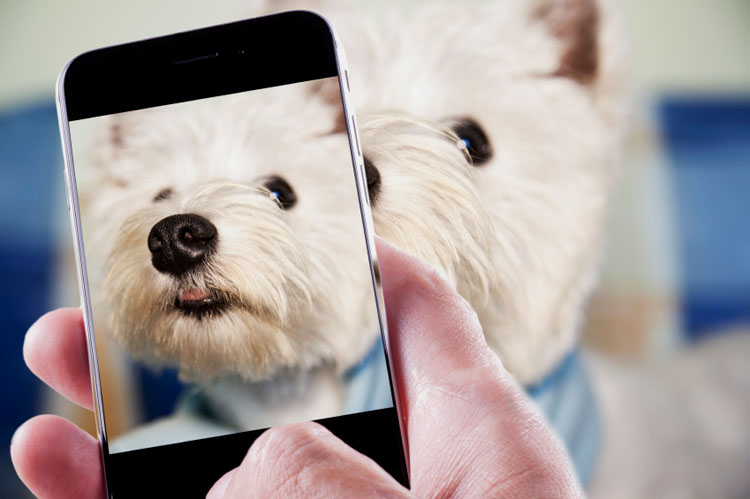
We are obsessed with taking pictures of our dogs. They’re our best friends and just darling to look at too! Professional photographers across the world will cringe as I type this, but you don’t need professional equipment or fancy lighting to capture perfect pictures. All you need is your voice, dog and smartphone; and, of course, sunlight will always help.

How to Take Photos of Your Dog

Make a High-Pitched Sound

Dogs love rapidly repeating high-pitched sounds. Use these sounds to your advantage when taking pictures of your dog. Honestly, these sounds work better than treats. Before using your high-pitched voice, get your camera ready and be prepared to snap away the moment you make these sounds.

Examples of what you can say or do are “puppy, puppy, puppy;” kissy sounds or tongue clicks. Make sure to repeat these sounds rapidly over and over again. As for tone, do your best imitation of an 8-year-old girl’s voice. If this is impossible, ask a friend to stand right behind you and clap repeatedly until you’ve captured your dog’s darling expression.

Get Close

Zoom in or get close to your dog’s face when taking close-up photos. Of course, if your dog is scared of the camera, you’ll need to zoom in. Personally, I don’t think you could ever get too close. You’d be amazed at your dog’s eye expression close up. If your dog turns away, rapidly repeat a high-pitched sound to get his attention and snap your photos quickly.

Sit on the Floor

Plop down on the floor and snap a few pictures at your dog’s level. You’ll get some really great standing, playing and downright funny photos. Snap away, as your dog is walking toward you and your camera. These moments make the best photos! Again, if your dog is distracted, use a high-pitched voice to redirect him back toward you.

Crop & Add a Filter

Honestly, the best photos are perfectly cropped and enhanced with filters. Our smartphones make this super easy now. If your dog is further away in the background, crop to remove visible background, so your dog is center stage. Red eyes happen or, better yet, green eyes happen even with the best photographer, so don’t forget to add a filter. By far, my favorite filter is Chrome on iPhones. It will lighten and enhance every picture. Don’t be afraid to play around with filters until you find just the right one. There are tons of free photo filter apps too, so no excuses.

When you’ve captured, cropped and filtered a fabulous photo, please share it with the world on social media. Then, have it blown up and framed to display at home and work.

Filed Under: Resources Tagged With: easy tips on taking dog photos with phone, how to take dog photos with smart phone, take dog pictures with iPhone, taking dog photos with smart phone, tips for taking photos with cell phone

Crystal Healing for Dog Anxiety

March 31, 2016 by Fanna Easter

Crystal Healing for Dogs: Does It Work?

Crystal Healing
ViewApart/iStock

Yes, I was just as skeptical as you! For thousands of years, crystals and stones were said to protect the wearer and change energy, but crystal healing never crossed my mind with dogs. That changed when my beloved holistic veterinarian mentioned calming crystals for Sobek’s (my Rottweiler) anxiety. Hmm, could it hurt? I was willing to give it a try.

Sobek’s Crystal Healing Story

As many Dog Training Nation followers know, Sobek has anxiety issues and his holistic veterinarian recommended trying a few healing crystals that would reduce his anxiety. At first, I scoffed at the idea, but as the days wore on, I thought it wouldn’t hurt, right?

Pursuing a crash course in calming crystal healing for dogs, I found a local metaphysical and spiritual store in my city with a quick Google search and decided to give it a try. I purchased a few crystals and stones that our holistic vet recommended, and headed home.

Healing Crystals Recommended for Anxiety

Our vet recommended magnetizing hematite and blue lace agate. Hematite is a shiny gray-black metal that absorbs negative feelings of worry and fear. In alternative medicine, magnetic therapy has been used for hundreds of years to restore physical and mental health balance as well as reduce swelling and pain. Hence, magnetizing hematite. Blue lace agate is considered the powerhouse of calming crystals, and highly recommended to decrease panic attacks and reduce overall anxiety.

While using crystals with dogs may seem new, the practice has been around for many years. To benefit from healing crystals, they must be worn or have some type of contact with the dog. Many pet owners hide healing and calming crystals in their dog’s bedding or attach them to their dog’s collar. Dogs don’t understand that crystals should not be swallowed (that would be contraindicated for healing and calming :)), so wrap crystals in metal and attach to his collar, especially if he enjoys destroying his bedding.

RELATED: New Dog Anxiety Medication for 2016

The Crystal Therapy Experiment

Now, understand that I was completely skeptical about healing crystals, so I conducted an experiment. Sobek has two beds that he equally adores, so I placed these crystals within the bed stuffing of a randomly chosen bed and watched his behavior. On the first night, and every night afterwards, Sobek would only sleep on the bed with crystals. Still skeptical, I moved the crystals to his other bed, and then he slept in that bed every night afterwards.

Wait, did he see me move the crystals or was it my scent left behind? I know I’m grasping at straws, but I had to rule a few things out. The next day, I asked my husband to move the crystals to the other bed, and Sobek slept in that bed every night going forward.

Okay, so this was not a controlled experiment, but Sobek’s sleeping choices were certainly interesting–he followed the crystals.

Did Crystal Therapy Work?

Honestly, I don’t know. Sobek still has anxiety, but his bed choices totally baffled me. One thing I did notice was Sobek finally slept soundly through the night, so I decided to keep crystals  stuffed in his favorite “crystal” bed. Interestingly, I found my other dog sleeping on his “crystal” bed too, which is totally odd. I also noticed her sleeping right on top of the crystals (she’s a small dog).

While it didn’t reduce his anxiety, calming crystals definitely had an impact on his sleep and both dogs still seek them out to nap on. 

If crystal therapy has worked for your dog, I would love to hear how crystals were used and which ones were chosen.

Filed Under: Behavior, Health, Resources Tagged With: calming crystals for dogs, crystal healing pets, crystal therapy for pets, crystal used in animal healing, crystals used in animal healing, healing crystals for dogs, how to use crystals with dogs, using crystals with dogs

Should You Buy a Chain Leash for Your Dog?

March 30, 2016 by Fanna Easter

Pros and Cons of the Dog Chain Leash

Dog Chain Leash
Milan Markovic/iStock

Growing up in the ’80s, dog chain leashes were extremely popular. I’m not sure if it was due to function, but I think it was mostly due to style, as everything had a metallic sheen back then. 🙂 Chain dog leashes are still available 30 years later, and they can be useful in certain situations, but they have downsides as well.

PRO: May Stop Dog Biting & Pulling on Leash

Some dogs get excited and pull on their leashes, which can quickly damage even the most durable leash material. One time, when working with a fearful dog that became frustrated around triggers–he lived in an apartment complex, so triggers were everywhere–the dog grabbed his leash and chewed through it. Understand, this was a huge Rottweiler. He could sever a leash in two pieces with few purposeful chomps. It was frightening. We did have tremendous success changing his behavior though, and his pet owner used a chain-and-cotton dog leash until she learned how to quickly identify and reward different dog behavior.

For the most part, I prefer teaching a dog to do something else instead of pulling or redirecting frustration on a leash, but a dog chain leash will deter behavior as well. Most dogs don’t like the metal taste or feel, so they’ll leave their leash alone. Some dogs will redirect tugging to their pet owner’s pants or another dog’s leash, so it’s not a quick fix for all dogs. In fact, I’ve had pet owners tell me their easily excited leash-tugging dogs fractured their teeth pulling on their leashes, so proceed with caution. If you decide to use a dog chain leash, use it to change behavior. Once the behavior has changed, then switch to a cotton, nylon or leather leash.

RELATED: How to Park Your Dog

CON: Chain is Heavy and It Hurts, Be Careful

Not only are dog chain leashes heavy, but they hurt too. For smaller dogs and puppies, look for thin and lightweight chain leash options. Remember, chain leashes will hurt your hands. They will definitely pull a layer of skin off when you’re grabbing the chain portion to stop a dog from pulling.

CON: Chain Leashes Are Outdated

With the movement against choke chain collars, which I firmly believe are outdated dog training tools, dog chain leashes have gone out of style as well. Additionally, young punks holding the end of enormous heavy chains wrapped around certain dog breeds’ necks most definitely did not help, as they were associated with status-seeking behavior and dog fighting. Now, you can understand the side stares while walking your dog on a chain leash.

For some reason, some pet owners feel chain dog leashes are sturdier than leather or nylon options, but I would disagree. I have a large dog, and a high quality 1-inch wide nylon leash works just fine. If your large dog pulls against his chain leash during walks, those chain links can crumble apart over time.

Using a Dog Chain Leash

Chain leashes have a tiny place in dog training, but it doesn’t always work for all dogs. If it stops your dog from pulling on the leash instantly, then reward your dog the moment he ignores the leash. Rewarding polite behavior is key, or else your dog will learn to redirect his frustration elsewhere. If your dog still bites at or pulls on the leash, you need to try something else.

READ NEXT: Stop Your Dog From Pulling on the Leash

Filed Under: Equipment, Resources Tagged With: chain dog leash with leather handle, chain leash, chain leash 6 foot, chain leash for big dog, dog chain leash, heavy duty chain dog leash, metal dog leash, where to buy dog chain leash

  • « Previous Page
  • 1
  • …
  • 25
  • 26
  • 27
  • 28
  • 29
  • …
  • 55
  • Next Page »

About

Dog Training Nation is a community of dog trainers, dog owners and dog lovers. Our mission is to provide trainers and owners valuable information to enrich dogs' lives. We cover a range of topics, from socializing puppies to dealing with aggressive dog behavior to selecting the best dog products. It is our hope you share our content to make the dog and owner world a better place.

​

Facebook

Video

Dog Training Nation is a dog training blog for pet owners and dog lovers. We cover a range of topics from puppy socialization tips to dog aggression to dog health. It is our hope you share our content to make the world a better place for dogs.

Dog Training Nation

Quick Links

Dog Training
Dog Behavior
Dog Training Videos
Become a Dog Trainer
About
Contact Us

Copyright © 2026 · Lifestyle Pro Theme on Genesis Framework · WordPress · Log in