Dog Training Nation

In Dogs We Trust

  • Home
  • Training
    • Dogs
    • Puppies
    • Clients
  • Behavior
    • Breeds
  • Health
  • Safety
  • Resources
    • Equipment
    • Books
  • Dog Training Videos
  • About
You are here: Home / Archives for Dogs

Teach Your Dog to Enjoy Body Handling

March 2, 2016 by Fanna Easter

Body Handling Tips

How to Teach a Dog Body Handling
damedeeso/iStock

Body handling is easily one of the most important behaviors to teach your puppy or adult dog. Dogs are not programmed to understand that humans looking into their ears, mouth and body is normal. Human handling frightens most dogs. Just like children, dogs need to be taught that body handling is rewarding.

Body Handling Goals

When touching or restraining your dog, you’re using the least amount of pressure possible. Basically, you’re not holding your dog’s head still. Rather, your dog is choosing to hold her head still while your hand rests on it. From another perspective, think about retraining zoo animals. There’s no way a human can restrain an elephant, but teaching an elephant to allow restraint is much easier than forcing him.

How to Teach Your Dog to Like Body Handling

You’ll need lots of super yummy treats, so don’t skimp here. Remember, dog training treats are your dog’s paycheck. You’ll also need some type of reward marker, so use a clicker or mark the behavior by saying “yes.”

Point and Click

In the beginning, click or say “yes,” as you’re reaching for your dog and then reward. Usually, when someone reaches toward his dog, this is a trigger that causes most dogs to shrink backwards away from pet owners. Start by pointing at your dog and, if she remains still, click and treat. Now, progress moving your pointed hand in small increments until you’re able to touch her side with your index finger. Once you’re able to touch her, click or say “yes” the moment your finger touches her. Then, draw your hand back and give her a treat.

Goal: Your dog remains still while you reach toward and touch her.

Touch Longer

Once your dog is comfortable with you reaching for her, meaning she will remain still and even walk toward you, it’s time to touch her longer. In the beginning, you quickly touched her and then immediately removed your hand away. Now, you’ll reach out and touch her, but hold the “touch” for a second. After five or six repetitions, end the practice session.

Goal: Reach out and touch your dog for 1-2 seconds.

Hand Touch

Now, you’ll reach out and touch your dog with your hand. As you place your open-palmed hand on your dog’s side, click or say “yes,” remove your hand, and give her a treat. After a few repetitions, end the practice session.

Goal: Reach out and touch your dog with your flat hand.

Restrain and Reward

Retraining means holding your hand against your dog, which prevents her from moving sideways. For some reason, we force our dogs to accept restraint, especially at the vet’s office or during nail trims. Trust me, it’s easier to teach a dog to enjoy restraint as a rewarding experience than force your dog to comply with it.

When teaching body restraint, move slowly and apply the least amount of pressure possible. Never force the issue. Soon, and with lots of practice, you can teach your dog to say “ah,” easily hold your dog’s leg for blood withdrawals, stand still while the vet examines her and so forth.

WATCH: Teach Your Dog to Enjoy Body Handling


It’s much easier to teach your dog to enjoy body handling than force her to comply–much easier.
Filed Under: Behavior, Dogs, Puppies, Training Tagged With: dog body handling, dog scared when you reach for him, dog training, Dog Training Tips, handling and touching your dog, how to teach a dog, how to train a dog, teach a dog, touch dog's ear, touch dog's leg, train a dog

Causes of Dog Aggression

January 20, 2016 by Fanna Easter

Dog Aggression: What Are Triggers?

Dog Aggression
Eldad Carin/iStock

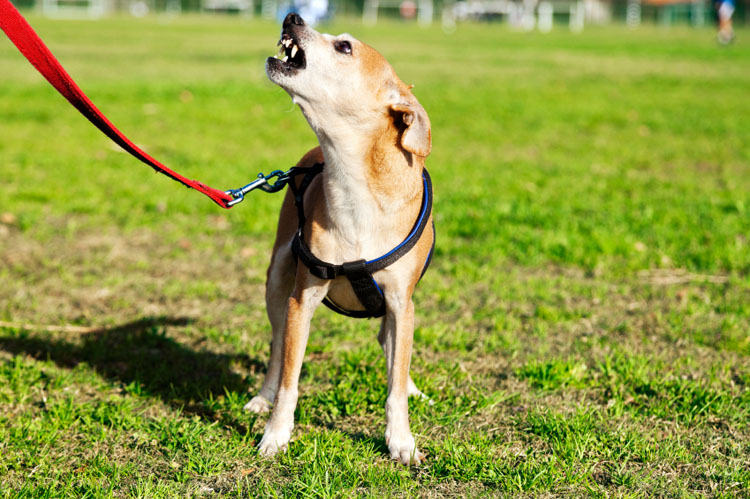
If your dog is fearful or aggressive toward anything, it’s extremely important to understand the object that triggers your dog’s reaction. You need to determine the small triggers that cause your dog to react and pair those dog aggression triggers with good things. Sound tricky? It most certainly can be, so I highly advise finding a professional dog trainer with lots of reactive dog experience.

What are Triggers?

Triggers are anything in your dog’s environment that cause your dog to react. Triggers are usually a sight, sound, smell or a combination of all three. Reacting means your dog reacts negatively toward a trigger; he either freezes, lunges, barks, backs away or starts fooling around (i.e. sniffing the group excessively, biting the leash, etc.).

Examples of triggers for most dogs:

  • Jingling of dog ID tags (indicating another dog is close by).
  • Barking dog (indicating another dog is close by).
  • Sight of a dog from a distance.
  • Smell of a dog (this one is hard for us to identify).
  • Person running behind or past during walks.
  • Fast-moving cars zooming past.
  • Approaching person.
  • Plastic bag floating through the wind.
  • New object (trash can, sign, new furniture) appears.
  • Bearded man walking with an umbrella.

Basically, triggers can be anything.

How to Identify Your Dog’s Triggers

If your dog has been reactive for some time, you probably have a pretty good idea what causes him to negatively react. However, it’s important to narrow down the trigger that sends your dog into a barking frenzy.

Many times, pet owners describe their dogs’ trigger as “seeing another dog,” but you need to narrow this down even further. How far away is the other dog before your dog reacts? Some dogs will look at other dogs calmly about 50 feet away, but when the other dogs move closer, the dog starts reacting. In this case, the specific distance between the dog and other dogs is the trigger.

Many times, reactive dogs react to sounds. Reactive dogs will freak out over the sound of jingling ID tags, four feet scampering in the distance or dogs barking. These sounds alert reactive dogs that a dog is nearby, so they better get ready to fight or flee.

Power of Triggers

Once your dog’s triggers have been identified, it’s time to start building positive associations with them. Super yummy treats should be given the moment your dog experiences a trigger, but of course always from a safe distance. If your dog reacts around other dogs or people, never allow your dog to meet them ever.

If your dog alerts or barks at jingling ID tags, then give him a treat as you’re jingling his tags. If it’s the ID tags of other dogs, borrow your neighbor’s dog’s tags. Remember, treats should be given the moment you start jingling ID tags.

For dog barking triggers, give your dog several yummy treats while a dog barks far away in the distance. Start with very far-away barks, then slowly work toward dogs barking down the street, next door and so on.

Get Help

So many pet owners try to manage dog reactivity, including dog aggression, on their own. I know you don’t want to hear this, but I’m being totally honest, you won’t get great results unless you seek professional help. As someone who works with reactive dogs for a living, I still need someone to confirm certain triggers; it’s impossible to narrow them down by myself.

Please find a dog training professional who only uses positive reinforcement methods. Punishment never works with anxiety or aggression; it’ll just make it much worse. If you’re afraid of heights and I scream and slap at you while you’re standing on the roof of a tall building, I don’t think that would help your fear. You would probably snap back at me, so please never use punishment-based methods.

Good luck and set yourself up for success by finding a professional.

Filed Under: Behavior, Dogs, Training Tagged With: dog aggression, dog aggression triggers, dog hates other dogs, dog training, Dog Training Tips, getting help dog aggression, helping an aggressive dog, how to teach a dog, how to train a dog, teach a dog, train a dog, triggers dog

Dog Breed of the Week: Standard Poodle

December 16, 2015 by Fanna Easter

Standard Poodle Breed Information

Standard Poodle
Ryhor Bruyeu/iStock

Poodles are popular. You probably see tiny, medium and large Poodles everywhere. Today, let’s discuss the less common Standard Poodle, which is the largest variety of Poodles. Standard Poodles are part of the AKC non-sporting group with their original function being water retrieving dogs and their current day function being a companion. This dog breed is versatile, can easily be trained as military and guide dogs, and is wicked smart too!

Standard Poodle Temperament

General Characteristics

The Standard Poodle stands 15’’ at the shoulder (on average) and weighs between 45 and 65 pounds with a lifespan of anywhere between 10 to 13 years. Don’t let their good looks and flashy haircuts fool you though. They’re extremely smart and full of zest, so they’re not all business. Standard Poodles are usually very friendly with dogs and people alike. They’re also tolerant, making them good with children so long as they were socialized positively as puppies and adults.

Standard Poodle Grooming Needs

Yup, you guessed it, Standard Poodles require a lot of grooming. Poodles don’t shed like most dogs. Their loose hair gets caught in their curly hair, which causes matting really quickly. To minimize grooming your Standard Poodle, ask  the professional dog groomer to give your dog a pet clip. Pet clip haircuts are stylish, yet shorter than most Standard Poodle clips, and only require maintenance every four to six weeks. You should still thoroughly brush your dog every couple of days or she’ll mat like mad.

They need weekly nail trims (or nail grinding) to prevent overgrown nails, which can be painful and break. Also, make sure to brush your Standard Poodle’s teeth every day. This will keep yearly veterinary dentals at bay.

RELATED: How to Train Your Dog to Play Fetch

Standard Poodle Training & Exercise

Standard Poodles require daily mental and physical stimulus. You can provide this by practicing polite behavior cues in short sessions, playing fetch (they’re amazing retrievers!), taking them on daily walks and joining a water sport. Not only are they smart, but they’re also extremely agile. This means they can excel in agility, competition obedience, rally obedience, nosework, tracking, dock diving, field trail (hunting and retrieving) and any other dog sport out there. Again, don’t let all their fabulous hair fool you. Standard Poodles are serious workers that love jobs!

With any dog breed, you have pros and cons, so it’s important to ensure the Standard Poodle’s characteristics and needs meet your lifestyle. If you’re interested in adding a Standard Poodle to your family, I encourage you to visit Standard Poodle Club of America for additional information on finding a responsible dog breeder or rescue in your area.

Filed Under: Breeds, Dogs, Large, Training Tagged With: dog training, Dog Training Tips, how to teach a dog, how to train a dog, standard poodle, standard poodle puppies, standard poodle rescue, standard poodle training, teach a dog, train a dog

How to Teach Your Golden Retriever Polite Behaviors

December 4, 2015 by Fanna Easter

Training Golden Retrievers Polite Behaviors

Training Golden Retrievers
Bigandt_Photography/iStock

Golden Retrievers are one of my favorite dogs to work with. They’re outgoing, driven, and usually pretty food and toy motivated. Over the years, I’ve worked with a number of Golden Retrievers, but unfortunately, I’ve never had the pleasure of sharing my home with one. Working with them on a regular basis has given me great insight into their common characteristics and behaviors. Hopefully, that can help you live more comfortably with your Golden Retriever.

Not-So-Polite Golden Retriever Behaviors

All dog breeds have their quirks and differences just like people. Becoming familiar with what is considered normal breed behavior will help you tailor their behavior to your lifestyle. With Golden Retrievers, you may deal with a lot of mouthy behaviors, such as always picking up unacceptable items or mouthing your hands while playing, petting or greeting. Let’s talk about how to make some of these Golden Retriever behaviors a little more manageable.

Always remember: with any unwanted behavior, you want to provide your dog with an acceptable behavior.

Mouthing (Putting Mouth on Your Hands)

In this case, we want to provide your Golden Retriever with proper chew toys and retrieval items, such as Kongs, Nylabones and retrieval toys for play. To help prevent your dog from mouthing you during playtime, only interact with him with his toys. This way, when your dog mouths you during petting, you can redirect his attention with your hand that contains the food treat while you pet with your other hand.

Sometimes, Goldens can become fascinated with mouthing unacceptable items. However, we can help them make the right choice by making the unacceptable item less intriguing. You do this by using a chewing deterrent on the unacceptable items, which may be your keys, remote controls or shoes. Be sure to follow the directions on the bottle. Most of the deterrents are water-based, so you most likely need to reapply every couple of days.

Now that you’re providing your dog with the appropriate chew toys and deterring them from the unacceptable items, make sure you praise all correct behavior to increase the likeliness of your dog repeating it.

Excitable Greetings (Jumping Up)

Excitable greetings are nice to come home to because you can tell how happy your dog is to see you, but on the other end of the leash it’s not so nice of a behavior when you’re carrying groceries or you have a guest coming over.

Again, teaching an alternate behavior is the best place to start; in this case, it’s the “sit” behavior. Start in a low distraction area. Use a high value food reward to lure your dog into the behavior and reward once he successfully sits. Gradually fade the lure after many dog training sessions and begin asking for the behavior in lieu of the jumping.

Another great tool you can use to gain more control of your dog during walks is the head collar or front clip harness. These dog products help you redirect your dog on walks and allow you to ask for the known “sit” behavior instead of him jumping on people.

All dogs have their own personalities and characteristics. It’s all about figuring out how to live more harmoniously with your specific dog breed and enjoying all the great things about him. Using a little bit of training and management will most certainly help facilitate polite behavior.

Filed Under: Breeds, Dogs, Large, Resources, Training Tagged With: dog training, Dog Training Tips, golden retriever bits hands, golden retriever jumps up, golden retriever puppy training, golden retriever training tips, how to teach a dog, how to train a dog, teach a dog, train a dog, training a golden retriever

How to Train Your Dog to Back Up

November 27, 2015 by Fanna Easter

Training Your Dog to Back Up

Teach Your Dog to Back Up
marinv/Deposit Photos

Training your dog to back up is not only useful in practical situations, but it can also be added to the list of tricks your dog can do. When I first taught my dogs this behavior, I used it for dog training purposes, such as boundary training, space crowding and safety situations. However, I quickly found out that people thought it was pretty neat, so now I add it to my routine of tricks!

Get Your Dog’s Attention

When teaching a new dog behavior, it’s always a good idea to begin in a low distraction area with a high value reward, as this will help keep your dog focused on the task at hand. Let’s say you’re in your living room: engage your dog by calling his name. Have your food reward in your hand, get your dog’s attention and reward.

Reward for Each Step Backwards

Now that your dog is interested, take another treat and hold it a little above your dog’s nose. Begin walking toward your dog. Once your dog takes one step backwards, give your marker word “good” followed by a treat. After your dog quickly learns taking one step backwards earns him the reward, start requiring two to three steps backwards before rewarding him again. Continue to add more steps until your dog is taking two steps backwards with each paw.

Add the Cue

You don’t want to use food every time you need your dog to back up, so let’s add a cue (word) to the behavior. The cue can be something as simple as “back up,” or you can become creative with it and use “reverse.” Whatever verbal cue you choose, be sure you stay consistent with your choice to prevent confusing your dog.

Once your dog is following your lure backwards 90 percent of the time, begin adding your cue while you’re luring him into the behavior. After you’ve practiced this about 20 times, begin asking for the behavior by cue without using a lure.

RELATED: The Right Way to Do Lure Reward Dog Training

Fade the Reward

I like to have my hands smelling like the treat and using a hand signal–I call it an air cookie. This is kind of like you’re using a lure without a lure. Once your dog completes the behavior, give your conditioned reinforcer “good” and follow it with a high value treat. When your dog can back up on cue, you want to begin fading the food treat by only rewarding perfect performances with food and rewarding other performances with physical praise.

Generalizing the Behavior

We know your dog can back up in your living room, but this doesn’t mean he can perform the behavior as easily in a more distracted area. When you move to another area of your house, ask your dog to back up at an easier level. You can train your dog to back up using the food lure and hand cue to jog your dog’s memory of the behavior you’re asking for. Once the light bulb turns on, begin using this cue in your everyday life and when you want to impress your dog-loving friends!

You may also like: My Dogs Refuse to Go Outside When It Rains

Filed Under: Dogs, Puppies, Training Tagged With: dog training, Dog Training Tips, how to teach a dog, how to train a dog, teach a dog, train a dog

  • « Previous Page
  • 1
  • …
  • 9
  • 10
  • 11
  • 12
  • 13
  • …
  • 32
  • Next Page »

About

Dog Training Nation is a community of dog trainers, dog owners and dog lovers. Our mission is to provide trainers and owners valuable information to enrich dogs' lives. We cover a range of topics, from socializing puppies to dealing with aggressive dog behavior to selecting the best dog products. It is our hope you share our content to make the dog and owner world a better place.

​

Facebook

Video

Dog Training Nation is a dog training blog for pet owners and dog lovers. We cover a range of topics from puppy socialization tips to dog aggression to dog health. It is our hope you share our content to make the world a better place for dogs.

Dog Training Nation

Quick Links

Dog Training
Dog Behavior
Dog Training Videos
Become a Dog Trainer
About
Contact Us

Copyright © 2026 · Lifestyle Pro Theme on Genesis Framework · WordPress · Log in
