Dog Training Nation

In Dogs We Trust

  • Home
  • Training
    • Dogs
    • Puppies
    • Clients
  • Behavior
    • Breeds
  • Health
  • Safety
  • Resources
    • Equipment
    • Books
  • Dog Training Videos
  • About
You are here: Home / Archives for Dogs

How to Get Your Dog to Stop Barking

June 4, 2014 by Fanna Easter

Stop Your Dog From Barking Now

Barking Dog
Elenarts/Deposit Photos

Wow wee, this is a tough one! But don’t worry folks, I have lots of tips for your barking dog. 🙂

Barking is a symptom and we need to find the cause to effectively address this behavior. First, it helps to understand why your dog is barking so we can manage and redirect this behavior. Many clients will correct their dogs whenever they are barking instead of understanding what is causing them to bark. This will confuse you and your dog quickly, which leads to frustration.

Now, some dogs are more vocal than others. I’m hesitant to label a specific breed of dog as more vocal than others. I’m just not a fan of labels. Think about a litter of puppies: some are quiet and others are vocal (Sobek, my Rottie, is super vocal and has been since he was 2 days old). Now, think of your family. We all have a talker in the group. In my family, it’s me! I’m much more vocal than my sister and our family video confirms it every holiday!

Why Do Dogs Bark?

Vocalizing (aka barking), for some, is a reinforcing way to release stress and tension. Again, let’s think in human terms. Some folks can deal with stress by bottling it up inside and never speak a word about it. Others must talk it out with anyone who will stand still long enough to listen. Managing a dog and person, both who vocalize due to stress is a tough one, but it can be managed.

Managing vs. Fixing Behaviors

Note that I mention managing an inappropriate behavior instead of saying fixing an issue. With my past experience, I don’t think we can 100% fix an issue with a living being. You can fix a car or TV, but living beings have learned behaviors that will pop up no matter how much you try to fix them. So, when I say manage, we can manage 99.9% of the time, which works for me! Example: I’m terrified of crickets. You can manage my dislike by feeding me donuts when around a cricket, but if I’m shopping at Macy’s (odd place for a cricket) and a cricket suddenly jumps on me, you better believe I will react! My fear of crickets is a learned behavior. Okay, I’ll contain my nerdy side now — back to managing barking.

3 Steps to Stop a Barking Dog

  1. Identify the trigger. What is causing your dog to bark in that environment?
  2. Choose an incompatible behavior to teach your dog (e.g. quiet, look at you or touch).
  3. Reward the incompatible behavior that prevents your dog from barking.

Dog Training Tips

  • Notice I said in that environment, which means the very moment that caused your dog to bark. Was it another dog that approached, a loud sound, a person walking up to your dog, doorbell ringing, umbrella opening, your dog noticing a strange object, or was he standing too close to another dog?
  • If your dog is a stress barker, find out what triggers the stress. Does it happen when you ignore him (attention-seeking behaviors, frustration due to confusion during a training session, an approaching dog, etc.)? Now address the stress and reward the dog when he is quiet (if he exhibited attention-seeking behavior). Take a step back in your training session and reward a simple behavior or walk the opposite way of an approaching dog.
  • Ask your dog to perform the incompatible behavior before he begins barking. If he begins barking, it’s too late. I say, “The horse is already out of the barn.” Back up until your dog quiets and try again. Timing is key!
  • If your dog barks, will not take a treat, or stop barking, back up from the trigger. In the dog training world, we say your dog is over threshold.
  • You need a really good reward. Barking is self rewarding, especially for stress barkers. Break out the really good stuff (cubed lunchmeat!).
  • At first, keep your dog on a leash so you have some control to move away from the trigger.
  • Manage the environment so your dog does not practice the behavior. This means, don’t let him bark at the trigger as this will only strengthen that behavior (think many repetitions of practice to strengthen muscles).

Example: Your dog barks at other dogs through the window.

  1. Close the curtains when you are not around. We don’t want the dog to practice this behavior and it getting stronger.
  2. Leash your dog and click/treat an incompatible behavior, such as quiet. Yes, he needs to breathe in between barks so reward the nanosecond of quiet. Or ask him to look at you and reward that behavior.
  3. If your dog will not focus on you, then back up from the window and try again.
  4. Practice this several times with fabulous treats.
  5. Keep curtains closed until your dog has more success with the incompatible behavior instead of barking at the dogs.
  6. Trust me, your dog will learn not to bark at other dogs through the window. 🙂

What Not to Do

  • Screaming, yelling and telling him to stop it right now. Basically, you are joining in with the barking party. 🙂
  • Penny cans, spray bottles and leash corrections. While it may seem to stop the behavior, it more or less suppresses it in my opinion. And I’ve seen it time and time again, corrections scare the dog and the dog thinks the trigger caused it. Now you have a dog that is scared of other dogs, people, etc. Punishment may work, but you really need to know what you are doing to prevent fallout behaviors. Make your mistakes with positive reinforcement, as it’s much more forgivable and it works!

Barking dogs of the world, unite! Share what causes your dog to bark in the comments below.

More:
Request Dog Barking
Stop Dog Barking Next Door
Attention Seeking Barking
Calming Music for Dogs

Filed Under: Dogs, Training Tagged With: dog barking, dog barking all night, dog barking at night, dog barking in crate, dog barking stop, dog barks

How to Train a Rottweiler

June 4, 2014 by Fanna Easter

Rottweiler Training
Learn about the Rottweiler breed.

Rottweiler Training

“The Rottweiler breed is my favorite. I’ve shared, and still currently share my home with Rottweilers. As a dog trainer and dog lover, I enjoy every minute of it!” says Fanna Easter.

Certified dog trainers Fanna Easter fell in love with Rottweilers while living in Germany. She was lucky enough to visit the city Rottweil, which means “red roofed” in German.

Origin of the Rottweiler

The Rottweiler was named after the Imperial City, as the breed was the butcher’s dog in the region. Fanna and her husband attended the Rottweiler Specialty, a dog show for Rottweilers only held in Rottweil, Germany. They have both learned a ton about this breed of dog. Rottweilers are very good with families that have older children, as Rotties are big and can knock down small children accidentally.

Rottweilers (Rotties) were bred to herd livestock (the butchers’ dog). After herding the cattle to the market, the cattleman would tie his earnings in a pouch around his Rottie’s neck for the walk home. This would ensure that no one would steal his hard work earnings.

Not only do Rotties herd, but they also guard and draft (pull carts) very well. Think of Rottweilers as little draft horses. They are powerfully built with heavy bones and are extremely well muscled.

Rottweilers are the powerhouses of the working dog group.

RELATED: Rottweiler Training

3 Traits of the Rottweiler Breed

  • A Rottweiler’s work ethic is intense (they will work all day).
  • Rottweilers have a natural instinct to protect their families.
  • Rotties are playful, gentle and fun loving.

Dog training tip: Always provide plenty of fresh water for your dog when he works or plays (inside or outside).

Rottweiler Grooming: Rottweilers shed throughout the year. Fanna recommends an undercoat rake to remove excessively grown undercoats. She also recommends weekly nail trims, ear cleanings and baths as needed. “It’s always a good idea to brush his teeth at least three times per week,” says Fanna. She also recommends a chicken-flavored toothpaste, which dogs tend to like. Please don’t use human toothpaste, as this can cause your dog harm.

Exercising Your Dog: Rottweilers are moderately active and need a 30-minute walk each day. Rottweilers are good at troubleshooting so feeding them using interactive toys are always fun. Interactive dog toys will dispense food as your Rottweiler moves, paws and tosses the toy around. This will ensure your Rottie receives plenty of mental stimulation.

Rough Play with Rottweilers: When watching Rottweilers play with other dogs, their play style is mostly like bully breeds. Rottweilers like to run full speed and body slam, hip check (bump their hips against other dogs) and shoulder check (slam their shoulders against other dog’s shoulders). Basically, they play roughly. Not all breeds think this is fun play so it’s vital to find dogs with similar play styles as a Rottweiler. Other bully breeds, like Rotties and Labs, usually play similarly.

Intense Fear Periods: Your Rottweiler may have fear periods just like any dog. However, herding and guarding breeds either have a longer or more intense fear period than most other dog breeds. Since Rottweilers are bred to observe constantly, they may see things a bit different than other dogs. With any fear period, it’s vital the dog can learn positive associations with anything that can cause barking or growling.

Training Rottweilers to Defeat a Fear

Fanna likes to play look at the monster game, which allows her to train Sobek to look at the scary object and be comfortable with it. This helps to reinforce positive associations with objects that her dog does not like. Fanna uses a dog training clicker and the click/treat method when training Sobek.

She suggests making sure that the person training the dog is at a safe distance away from the object that the dog fears. That way the Rottweiler will look at the trainer and will be able to take treats. Fanna says, “When in doubt move further away from the object.” This teaches the dog that the “monster” is not that bad because every time your Rottweiler looks at the object he feared, you will reward him with a training treat. Never force your Rottweiler to walk over or touch anything that causes him to be fearful. This can cause him to permanently be fearful of that object.


Pictured above is Fanna’s dog named Sobek. Fanna absolutely loves Sobek (aka Smoochie). She says, “He is the most kind and gentle Rottie soul, and he’s Momma’s honey bun.” 🙂

Fanna Easter is a volunteer Adoption Coordinator for this wonderful group: Southern States Rescued Rottweilers


Learn about Rottweiler rescue at National List of Rottweiler Rescue Groups.

Tell us about your Rottie on Facebook.com/DogTrainingNation.

You may also like: Bully Breeds

Filed Under: Breeds, Dogs, Training Tagged With: rottweiler breed, rottweiler needs, Rottweiler training, rottweilers, training rottweilers

Keep Your Dog From Pulling By Teaching Collar Pressure

June 3, 2014 by Fanna Easter

How to Stop Your Dog From Pulling on Leash

Stop Dog From Pulling on Leash

This dog training tip will teach you how to properly train your dog using collar pressure techniques, which will stop your dog from pulling on leash.

Can you imagine moving your dog away from the door with two fingers while holding his collar or leash every time someone is ringing the doorbell? You’re probably thinking there may be no way your dog can do it, right?

Train your dog to understand collar pressure. If your dog pulls on leash or lead, this is one of the first steps to teaching polite leash manners. No more pulling and tugging on your dog’s collar or leash. He will learn to yield to this pressure! 🙂

Teaching Collar Pressure to Your Dog

When teaching dogs collar pressure, we’re not forcing a dog to move, but rather we’re teaching him to offer something different than an opposition reflex. We train him not to push or pull back against the leash pressure. Dog training should be done in a positive and patient manner. Don’t get flustered (remember yoga breath).

This dog training video demonstrates collar pressure training. Again, you’re teaching your dog to move with pressure; not pull against it. This is the goal of loose-leash walking in a nutshell.

Step 1: Make touching your dog’s collar a good thing.

  1. Touch your dog’s collar, then click and treat.
  2. Do this 10 times in a row.

Step 2: Apply pressure.

  1. Apply pressure to your dog’s collar in the opposite way of where he’s standing. Use light pressure, such as holding a door open. You’re not pulling hard per se, but more like restraining.
  2. Immediately click and treat when your dog follows the direction of pressure. As he moves toward the pressure, you’re no longer applying pressure to your dog’s collar.
  3. Do this 10 times in a row. Remember to click and treat each time your dog performs the intended behavior.

Step 3: Reward your dog for moving toward you.

  1. Touch your dog’s collar as if you’re moving him away from something, such as an open door.
  2. Immediately click and treat when your dog follows the direction of pressure (he moves toward your hand instead of pulling opposite of you).
  3. Do this 10 times in a row. Remember to click and treat each time.

RELATED: Choosing the Right Dog Trainer

Dog training involves repetitive actions. Always reward your dog with praise, a click or a treat when he performs the desired action. When a dog learns something new, it should be just like the old cliché: “Practice makes perfect.” Dog training does require repetition (pun intended). Got it?

WATCH: Teaching Collar Pressure

The goal in this training exercise is to move your dog simply by touching his collar. Always click and treat your dog for good behavior when training him. Now, try it with a leash. Use the above dog training steps!

You can train your dog to move in the direction of pressure on his collar using the same steps above. However, use a flat hand against your dog’s body. This works really nicely when trying to move dogs around in a tight space.

Can you use this behavior in your everyday life? Tell us about it in the comments section below.

Filed Under: Dogs, Training Tagged With: dog coughs when pulling on collar, dog pulls against collar, dog pulls on leash, dog pulls out of collar, dog training advice, Dog Training Tips

Training Pit Bulls

June 3, 2014 by Fanna Easter

Pit Bull Training

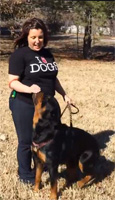
Pit Bull TerrierMany times, I’m asked if specific breeds like Pit Bulls are more difficult to train. When teaching dogs polite behaviors, about 90% is the same learning principles, which means all dogs are able to learn. So let’s discuss the differences between Pit Bull Terriers and other breeds of dogs.

Top 3 Pit Bull Terrier Behaviors

Polite Greetings

o   Dog Greetings: Some Pit Bulls can be snarky to other dogs, so it’s vital they learn to meet, greet or ignore other dogs. Not all dogs like to meet and play with other dogs, and we need to respect their requests. If we push too hard and force them to enjoy being around other dogs, they will quickly learn to bite other dogs to keep them away. This is true for all breeds of dogs.

o   People Greetings: Pit Bulls are large dogs and we need to teach them how to greet people politely. This means no jumping, body slamming or crawling into strangers’ laps. They should learn to sit when a person walks towards them. This is easy to teach: Person walks towards Pittie. If your Pittie jumps up, the person walks away. The person only walks towards Pittie when all four feet are on the ground or they are sitting. Voila!

Polite Leash Manners

Due to the large size of Pit Bull Terriers, they can pull you into parked cars or even traffic if they want to greet someone. Teach your dog that pulling does not pay off, as you remain still. If he does not pull, he can walk forward. I would recommend a front clip harness for most large dogs, as this harness controls pulling until you can teach your Pittie polite manners.

RELATED: Stop Your Dog From Pulling on the Leash

Body Handling

As with most large breed dogs, it’s important for Pitties to allow body handling, such as nail trims and people looking into their ears and mouth plus gentle restraint for blood draws. Touch your Pittie’s ear, then click and treat. Touch his nails, then click and treat. Do this for one minute each day for best results.

VIDEO: How to Train a Dog Body Handling

As with all breeds of dogs, Pit Bull Terrier owners need to socialize their Pittie puppies from an early age. They should meet lots of new people and dogs before 16 weeks old. Want to bring a Pittie into your home? Learn about the Pittie breed from a Dog Trainer’s Perspective. To learn more about Pitties and rescue, view Pit Bull Rescue Center and BadRap – Pit Bull Rescue.

Tell me about your Pittie and what polite behaviors you taught him!

Post pictures of your Pit Bull on our Facebook Page.

You may also like: American Pit Bull Terriers

Filed Under: Breeds, Dogs, Training Tagged With: american pit bull terrier, american pit bull terrier training, dog training advice, pit bull, pit bull training, pit bulls, pitbull, pittie

Rottweiler Training

June 2, 2014 by Fanna Easter

How to Train a Rottweiler

How to Train a Rottweiler
Sobek wearing his harness.

Rotties have breed specific behaviors. They were bred to herd livestock to market. Cattlemen would tie their earnings in a pouch around their Rottweiler’s neck for the walk home. This would ensure no one would steal their earnings.

Rottweiler training, as with all dogs, does not require responding with dominance or punishment-based dog training techniques. Rotties understand consequences and will respond quickly when set up for success. Pushing, pulling or forcing a Rottweiler to comply with a behavior while training will mostly likely result in a dog bite or your Rottie will become afraid of you. This is not our goal as Rottweiler owners.

RELATED: How to Train a Rottweiler

3 Rottweiler Behaviors Your Dog Should Know

    • Polite Greetings: Rottweilers are big and powerful dogs so they need to learn polite leash and greeting manners. Rottweiler training should begin when he’s a puppy. Exuberant jumping on people can be dangerous. That being said, your dog should learn to keep all four feet on the ground at all times.
    • Polite Leash Manners: Due to their large size, Rottweilers can lead you to places you wouldn’t want to be. When this happens, you want to teach your Rottie to not pull on his leash by remaining still. If your dog does not pull, then you may both walk forward. A front clip harness helps control pulling until you can teach your dog polite manners.
    • Body Handling: It is important to teach a Rottweiler to allow body handling, such as looking into his ears and mouth. Touch your Rottie’s ear, then click and treat. Touch his nails, then click and treat. For best results, do this for one minute everyday. The objective is to get him used to being handled when he is taken to the veterinarian.

VIDEO: How to Train a Dog Body Handling

Rottweiler Training Tips

You should socialize your Rottie at an early age. They should meet many people and dogs before reaching 16 weeks old. When watching Rottweilers play with other dogs, their play style is mostly like a bully breed. Rottweilers like to run full speed and body slam, hip check and shoulder check. Not all breeds think this is fun play so it’s vital to find dogs with similar play styles as a Rottweiler. Bull terriers, Pit Bulls and Rotties generally play in a similar way.

Rottweilers are not an aggressive breed. This is a myth that has been debunked. In my 20+ years of dog training, I have learned it’s not the breed of the dog. Rottweilers are an impressive and majestic breed. When they fall into the wrong hands, Rottweilers can be exploited.

Post pictures of your Rottie on our Facebook Page.

Learn about Rottweiler rescue at National List of Rottweiler Rescue Groups.
Find out more about Rotties at American Rottweiler Club.

Filed Under: Breeds, Dogs, Training Tagged With: dog training advice, how to train a rottweiler, rottweiler play, Rottweiler training, Rottweiler training tips

  • « Previous Page
  • 1
  • …
  • 29
  • 30
  • 31
  • 32
  • Next Page »

About

Dog Training Nation is a community of dog trainers, dog owners and dog lovers. Our mission is to provide trainers and owners valuable information to enrich dogs' lives. We cover a range of topics, from socializing puppies to dealing with aggressive dog behavior to selecting the best dog products. It is our hope you share our content to make the dog and owner world a better place.

​

Facebook

Video

Dog Training Nation is a dog training blog for pet owners and dog lovers. We cover a range of topics from puppy socialization tips to dog aggression to dog health. It is our hope you share our content to make the world a better place for dogs.

Dog Training Nation

Quick Links

Dog Training
Dog Behavior
Dog Training Videos
Become a Dog Trainer
About
Contact Us

Copyright © 2026 · Lifestyle Pro Theme on Genesis Framework · WordPress · Log in