Dog Training Nation

In Dogs We Trust

  • Home
  • Training
    • Dogs
    • Puppies
    • Clients
  • Behavior
    • Breeds
  • Health
  • Safety
  • Resources
    • Equipment
    • Books
  • Dog Training Videos
  • About
You are here: Home / Archives for Training

My Dog Won’t Let Me Pick Him Up: Try This Tip!

June 29, 2015 by Fanna Easter

How to Get Your Dog to Let You Pick Him Up

Picking Up Small Dogs
Offer a treat while picking up your dog. feelphotoart/iStock

When sharing your home with smaller dogs, you’ll eventually need to pick them up. Some dogs stand still while you’re walking toward them or wrapping your arm around their chest. Some dogs scamper way, stand still until you try again and take off again. Yes, let’s focus on the scamperers.

Stand Still for Pickup

You’ll need super yummy treats that’ll stop your dog in his tracks. I’m talking hot dogs or pieces of fresh deli meat. You need to make it worth your dog’s while, especially if he’s a professional scamperer.

  • Grab yummy treats, leash your dog to prevent him from moving too far way and take a seat in your chair indoors (this keeps distractions low).
  • More than likely, your dog will hang around you because of the treats. Have patience. Your dog will likely become distracted by something and walk away from you.
  • Once this happens, stand up and walk at your normal pace toward your dog while holding out a treat.
  • Your dog will likely walk right back to you or stand still. Bingo!
  • As you wrap your arm around him, click or say “yes,” and give him a treat. Remember, we’re teaching, “stand still while I pick you up.”
  • Place your dog back on the ground and practice four to five more times, and then end the training session.

Make Pickups Fun

Most dogs run away when being picked up because they’ve learned that pickups mean bath time, vet visits and the end of fun games. Instead, pick up (reward for good behavior) your dog for a few seconds and place him back down on the ground for a game of tug or chase, or let your dog continue sniffing and exploring outdoors. Aim for more positive associations with “pick up” than negative ones. As a general guideline, I recommend 10 positive experiences to each negative one.

Now, negative associations don’t mean punishment. If your dog has been running buck wild on 40 acres and finally decides to stand still for picking up, you better curse in a happy pitched and positive tone because your dog stopped. If you choose to punish instead, you’ve just ruined your dog’s polite pickup manners and it’ll take a long time to earn your dog’s trust again.

Better yet, instead of chasing your dog, check out tips on teaching your dog to come back to you. 🙂

Practice Outside

Once your dog happily stands still while you pick him up indoors, it’s time to practice outdoors–on leash, of course. If your dog is hesitant to allow you to pick him up, try squatting next to him instead of looming over him.

If your dog still ignores you, I recommend using better treats. If you’re holding a decadent cupcake, you better believe I’ll walk through traffic to get to you. 🙂

Treats Are Not Forever

Treats paired with a clicker help teach your dog new behaviors. Once your dog happily allows you to pick him up nine out of 10 times, it’s time to wean your dog from treats. Do know if your dog goes back to his scampering ways, it’s time to bring the goodies back out and practice some more.

VIDEO: My Dog Won’t Allow Me To Pick Him Up

https://youtu.be/iFeoU9NzIgM

Filed Under: Dogs, Puppies, Training Tagged With: dog is scared when picked up, dog won't let me pick him up, don't will not allow me to pick him up, picking up a dog, picking up a small dog

“Jurassic World:” Dispelling Prehistoric Training Myths

June 24, 2015 by Fanna Easter

Prehistoric Training Myths Debunked

Animal Training
geotrac/iStock

“Jurassic World” did its job. It was fast-paced and extremely entertaining. Personally, I sat on the edge of my seat in the IMAX 3D theater, holding my glasses in place as I dodged 3D effects. All the hidden messages sprinkled throughout this movie were fantastic, and I hope you chuckled and analyzed your own behavior. As a seasoned dog trainer, I just need to clear up two misunderstandings, which seemed to weave itself throughout the blockbuster hit.

First, please understand, I’m not that person–you know the fact checker who revels in finding and publicly pointing out any and all discrepancies to the world. Instead, I’m a dog trainer who teaches multiple pet parents and their dogs polite canine behavior so when a myth that I misspell on a daily basis pops up again (sigh), I need to address it.

Animal Training Myth #1: You Can Be the Alpha

My heart sank to my toes when Chris Pratt who played “Jurassic World’s” dinosaur researcher said, “I’m the alpha.” When will this myth die an agonizing death? The alpha concept has been completely dispelled even by the original author.

Humans have this thing about being alpha. It’s human nature to be on top, be an apex predator, climb to the top of the heap and so on. Let’s leave alpha syndrome with middle management at work and leave animals out of the equation. Dogs, cats and I would certainly think dinosaurs don’t see us as alphas. Instead, they learn through consequences and that’s why they comply.

Okay, here’s the truth (and I’ve included research to support my thoughts): Dogs coexist with humans because we can control resources and outcomes. They don’t bow down or listen because we’re superior (definition of alpha). Dogs know we are humans and not dogs, and they don’t secretly plot to take over the pack. New studies show multiple leaders within large groups of dogs just like humans.

Next time your dog responds to a “sit” cue, he has learned performing that behavior has consequences, such as treats, petting and happy sounds. It’s not about respect. It’s about partnerships. 

So let’s move forward from 1949 (yes, that’s when this myth started) and instead teach dogs polite manners by building bonds and partnerships. I think Chris Pratt even said this in the beginning of the movie (yes!) and then succumbed to superiority over raptors (really?). He should’ve said, “This is Blue. He’s learned he can trust me. I would never harm him and we can work together.”

Animal Training Myth #2: Continuous Clicking is Effective

Oh my word! Chris Pratt’s continuous clicking of his clicker was, shall I say, annoying. Clicking continuously to build excitement and using a clicker as a cue is misusing this powerful dog training tool. Instead, click once when an animal (dog, raptor or T-Rex) does the behavior you’re teaching and toss him a treat (hence the rat).

Rather than clicking randomly, Pratt should have clicked once when each raptor made eye contact and then tossed a treat.

Off My Soapbox

“Jurassic World” is reaching millions of people and has the power to leave a lasting message with the masses so I wanted to clear up these misconceptions, as I have painfully learned that saying nothing means you agree.

If you think only dogs can be trained by controlling resources, check out this fabulous article on training butterflies–probably my favorite article of 2015. 🙂

Check out updated information pertaining to leadership within large groups of dogs here.

Filed Under: Dogs, Training

Dog Breed of the Week: Pug

June 19, 2015 by Fanna Easter

Meet the Pug

Pug Dog Breed
Valentin Creciun/iStock

Let’s talk about the Pug this week. Pugs are a member of AKC’s Toy Group due to their size and original purpose of being a lap dog. The funny thing is they come from the Mastiff family. That is quite a difference in size if you ask me. However, you can definitely see the resemblance in their markings, extra skin and wide stature.

General Characteristics and Temperament

The Pug is considered a small dog. Pugs are about 10 to 11 inches tall and weigh between 14 and 18 pounds. I personally think they are absolutely adorable with their short and square muzzles, large prominent eyes, big round head and curled tail. This dog breed has lots of wrinkles and a perfect button face, lovingly called the “pug mug” by those who share their homes with these love bugs.

Today, the Pug is bred specifically for a companion. If you’re looking for a dog that is playful, loving and loyal, the Pug is for you! Pugs learn quickly and adapt well to many different environments. As long as Pugs are around their people, they are happy! Due to their small size, this breed is a popular choice for busy families and people who live in apartments.

Pug Grooming

A Pug’s grooming requirements are very minimal. Their smooth coat needs occasional brushing to remove dead fur. Also, frequent baths are needed to keep your dog smelling fresh and feeling great! It’s important to keep their face folds (wrinkles) clean and dry to prevent skin infections so make sure to wipe in between each wrinkle with a dry towel daily.

Teeth

Tartar tends to build up on smaller dogs’ teeth quicker than that of larger dogs. Prevent tartar buildup by brushing your Pug’s teeth every day. Be sure to use a doggy safe toothbrush and toothpaste. You can usually find these at your local pet store with no problems.

RELATED: Small Dog Dental Care Tips

Nails

Pugs have fast growing, hard nails that require regular maintenance. You should keep them clipped, using clippers or a grinder to prevent overgrowth and splitting. If you’re not comfortable trimming your dog’s nails, you can usually stop by a grooming salon and get them cleaned up pretty quickly for a fair price.

Health and Nutrition

Health

Most Pugs have a 12- to 15-year lifespan so they tend to live a long time. While all breeds have health issues, Pugs are prone to hip dysplasia, Pug dog encephalitis, eye disease, patellar luxation, breathing problems due to their small nostrils and nasal passages, and skin infections. A responsible dog breeder can educate you on the specific health concerns with this particular breed. Respectable breeders utilize genetic testing to minimize disease with their puppies, which is a must.

Due to a shorter muzzle, Pugs are super sensitive to heat and humidity, which causes heat stroke. Never leave your Pug outside. Also, expect snoring. It’s common with all short-muzzled dogs.

Nutrition

Good nutrition applies to all dogs. It’s important to feed your dog a high quality diet. Your veterinarian can advise you on which food best fits your dog’s particular needs.

Pugs love to eat so make sure not to overfeed them. With their short and wide stature, obesity can be easily achieved. When giving dog training treats, size does matter so break treats into pea-sized portions. Don’t forget to calculate treat calories given during the day and subtract them from your dog’s daily meals. Too many calories and not enough exercise play a big role in canine obesity.

Dog Training and Exercise

Training

Pugs love having fun and eating food so dog training is pretty easy! It’s a good idea to start training at a young age. Sign up for a puppy class at your local pet store or training center. Pugs also love people and other dogs so providing them with interaction is very rewarding and fun. Sometimes Pugs can be preoccupied, but that is usually fixed with removing what they want most for a couple of minutes–your attention. Once their attention is focused back on you, reward!

RELATED: Walking Two Dogs at Once Tips

Exercise

Pugs require daily exercise. Try playing a fun, lively game of fetch or going on a moderate walk around the park. Be careful though. Pugs don’t mix well with heat and humidity. Choose a cooler time of day. This is a must when setting up your exercise plan.

To get more information on Pugs, please visit any of the following websites: www.akc.org
and www.pugrescuenetwork.com.

You may also like: Dog Breed of the Week: Bulldog

Filed Under: Breeds, Dogs, Training

Walking Two Dogs at Once Tips

June 17, 2015 by Fanna Easter

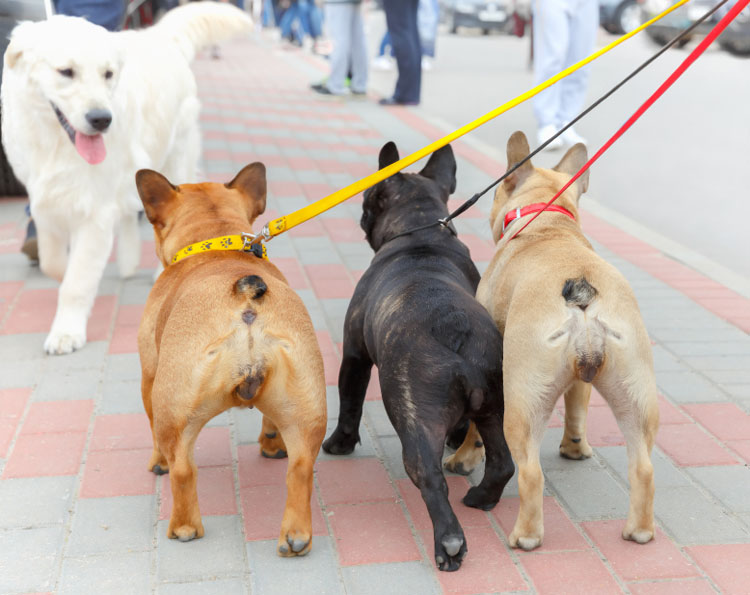
Tips for Walking Two Dogs

Dog Walking Tips
KavalenkavaVolha/iStock

If you’re fortunate enough to share your home with two or more dogs, I know this thought has crossed your mind. But, is it the right thing to do for both dogs? It depends.

Before grabbing both of your dogs’ leashes, it’s best to prepare first. Now, if one, or both dogs, pulls on a leash, I recommend teaching each dog how to walk politely on a loose leash first. Trust me, it’s not safe being hauled around by a two-dog-powered engine. It’s downright dangerous. I’ve witnessed walking teams pulled into oncoming traffic. We don’t want that to happen so let’s discuss dog walking tips.

Lastly, keep your retractable leashes at home. Walking two dogs at once with retractable leashes is dangerous. Honestly, I’m not a fan of retractable leashes. I’ve personally received rope burns across the back of my legs when one dog lunged for a squirrel and separated the leash from the handle–it was horrible.

RELATED:  Walking Two Dogs at Once: Choose the Best Equipment

Introducing Tandem Leash Walks

Let’s begin slowly. Leash up both dogs and take a short walk (10 minutes) in a quiet area. Reward your dogs often when they’re walking politely together. Usually, when one dog stops to sniff, the other dog joins in too, so stop often for mental stimulation. It’s as important as physical exercise.

Practice tandem dog walks often and increase each walk by 10 percent. By slowing increasing duration (time) of walks, you’re teaching both dogs how to walk together politely while exercising both body and mind. A short positive 10-minute walk is much better than an hour-long walking session accompanied with pulling dogs. Everyone ends up frustrated. Once you’ve reached desired walking duration, slowly increase distractions.

RELATED:  Keep Dog Training Sessions Short

Big and Little Dog

Little dog legs must move faster to keep up with a larger dog’s longer stride. Keep this in mind during long walks. Plus, it’s difficult for larger dogs to walk slowly. They’re forced to alter their far reaching gait and hence pacing (kind of looks like a wobble). Ideally, use a longer leash for large dogs (six or 10 feet long) so they have a bit more room to move forward than the smaller dog who should be attached to a four or six-foot leash.

Older and Younger Dog

Using the same principles as walking large and small dogs together, I advise taking additional breaks for senior dogs. Plus, breaks may be longer. Walk only as fast as your senior dog can tolerate. If this is too slow for your younger dog, I recommend walking them separately.

Walking Past Distractions

It happens. Distractions are a normal part of life, but how you and your dogs handle distractions is everything. Sometimes, when dogs become overly frustrated, they may turn around and fight during tandem dog walks. This is called redirected aggression and can be deadly. Until both dogs learn how to respond (ideally ignore and focus on you) around distractions, keep it simple.

Someone Approaches You

If distractions are approaching you, such as another person walking her dog, turn around and walk the other way. If that’s not an option, cross the street or, better yet, walk along another street. Your goal is to avoid distractions for now while teaching your dogs to behave quietly and ignore them. If walking away is still not an option, stop and move away from the sidewalk, as the distraction walks past. Give your dogs yummy bits of cheese for good behavior. Once all is clear, start your walk again. 🙂

Distractions in Progress

When walking around distractions, such as playing children or a soccer game in progress, keep your distance. By keeping space between you and your dogs, you’re teaching them to focus on you instead. Next time, try walking one or two feet closer, decreasing distance until your dog ignores this type of distraction.

RELATED: How to Train Your Dog Around Distractions

Homework

Practice “look at me” at home using treats and a clicker. This cue is invaluable around distractions. During dog walks, when either dog stops pulling on leash, looks at you, ignores distractions and trots along by your side, reward with lots of happy praise and yummy treats. Practice and give lots of rewards. Soon, you’ll be power walking with the best of them!

READ MORE: How Much Exercise Do Dogs Need?

Filed Under: Dogs, Training Tagged With: best way to walk two dogs, best way to walk two dogs at once, how to walk 2 dogs at same time, how to walk multiple dogs at once, tips for walking two dogs, walking big dog and little dog at once, walking older dog and young dog at once, walking two dogs at once

Walking Two Pulling Dogs on Leash

June 16, 2015 by Fanna Easter

Dog Pulling on Leash Tips

Dogs Pulling on Leash
byronwmoore/iStock

Walking two pulling dogs at the same time is very frustrating for both you and your dogs. Instead of grinning and bearing it, take a few minutes and try these tips.

RELATED: Clicker Training for Dogs

Teach Polite Leash Manners Separately

Dogs pull on leash because they were never taught not to. When you know better, you do better. It’s troubling being pulled by your dog and, believe me, I’ve been right there. It feels like a freight train is pulling me into trees. When this happens, it’s time to brush up on polite leash manners. Discontinue tandem leash walks until both dogs understand how to walk nicely on leash.

Using a clicker and lots of tiny yummy treats, leash your dog and practice inside your home. While walking up and down the hallway, click and give a treat when your leash is loose. Now, it’s important to click every time the leash is loose or your dog will become confused and start pulling forward. Don’t be alarmed if you’re clicking and treating every few seconds or so. This actually means you’re doing a good job rewarding each success.

If your dog pulls, stop walking and wait. The moment you feel pressure release in your hand, meaning your dog stopped pulling on leash, click and give him a treat. When giving treats, make sure your dog comes back to you for the treat instead of you trying to walk forward and place a treat in his mouth.

Now, practice polite leash manners while walking in the backyard on short walks with minimal distractions, slowly increasing duration (time) of walks. Yes, you have to walk both dogs separately, but it won’t be forever. 🙂

RELATED: Teach Dog Not to Pull on Leash

One Dog Per Person

While practicing polite leash manners, enlist in a human helper for tandem walks. One person walks an individual dog, however, you’re both walking at the same time. Not only does this provide great rewarding opportunities for polite manners, but both dogs are learning to walk calmly together, which is so important.

You’ve probably noticed both dogs insisting on walking side by side instead of one dog leading the way. By having an extra pair of hands, you’re able to teach both dogs that walking side by side is not a race and it’s very rewarding (hence clicks and treats) if done at a slower pace.

After several tandem walking sessions with assistance, ask your friend to tag along while you hold both leashes. This way, if something should happen, your friend can step in and grab a leash.

It’s important to keep distractions to a minimum in the beginning by walking in your neighborhood or a quiet park. Slowly increase distractions. If both dogs become overstimulated, decrease distractions and reward good behavior. In the worst case scenario, you can walk both dogs in your neighborhood, but need a friend to help walk both dogs around distractions.

Try Different Equipment

Scrumptious treats and none-pulling collars are everything. By pairing both of these tools, you’re halfway toward polite leash walks. My favorite no-pull options are front clip harnesses and head halters. Now, this equipment will manage pulling until you’re able to teach your dog that walking on a loose leash pays with hot dogs. The equipment doesn’t fix the behavior.

Another reason I really like these harnesses and head halters is you still have complete control if your dog lunges toward a squirrel. There’s a saying in the dog training world, “If you’re restraining, you’re not training.”

So let’s teach polite manners instead of playing tug-of-war with a leash. 🙂

READ MORE: Walking Two Dogs at Once: Choose the Best Equipment

Filed Under: Dogs, Safety, Training Tagged With: best way to walk two dogs, best way to walk two dogs at once, how to walk 2 dogs at same time, how to walk multiple dogs at once, tips for walking two dogs, walking big dog and little dog at once, walking older dog and young dog at once, walking two dogs at once, walking two dogs pulling, walking two dos that pull

  • « Previous Page
  • 1
  • …
  • 34
  • 35
  • 36
  • 37
  • 38
  • …
  • 60
  • Next Page »

About

Dog Training Nation is a community of dog trainers, dog owners and dog lovers. Our mission is to provide trainers and owners valuable information to enrich dogs' lives. We cover a range of topics, from socializing puppies to dealing with aggressive dog behavior to selecting the best dog products. It is our hope you share our content to make the dog and owner world a better place.

​

Facebook

Video

Dog Training Nation is a dog training blog for pet owners and dog lovers. We cover a range of topics from puppy socialization tips to dog aggression to dog health. It is our hope you share our content to make the world a better place for dogs.

Dog Training Nation

Quick Links

Dog Training
Dog Behavior
Dog Training Videos
Become a Dog Trainer
About
Contact Us

Copyright © 2026 · Lifestyle Pro Theme on Genesis Framework · WordPress · Log in