Dog Training Nation

In Dogs We Trust

  • Home
  • Training
    • Dogs
    • Puppies
    • Clients
  • Behavior
    • Breeds
  • Health
  • Safety
  • Resources
    • Equipment
    • Books
  • Dog Training Videos
  • About
You are here: Home / Archives for Games

Dog Clicker Games: Advanced Clicker Training

April 29, 2015 by Fanna Easter

Advanced Clicker Training Game for Dogs

Dog ClickerOnce you’ve mastered beginner and intermediate clicker timing games, it’s time to focus on improving your timing when clicking small movements for complex behaviors. Yes, it’s time to push your clicker training skills even further.

Touch Your Arm (You’ll Need a Partner)

You’ll need a friend to help with this game. Ask your friend to touch your forearm with one finger. As her finger touches your arm, click. Basically, you’re teaching your friend “touch with one finger.”

Now, I’ve watched people try to cheat during this game, but they were actually learning to click too late. Instead of watching their partner’s finger, people have clicked once they felt the touch on their arm. Well, that’s clicking too late. If you click after “feeling” a touch, you’re probably clicking your friend for moving her finger away from your arm. Don’t believe me? Spin around and watch. 🙂

VIDEO: Improving Your Clicker Training Skills – Advanced Game

RELATED: Clicker Training for Dogs

Pause Button on DVR

By far, this is my favorite game to improve clicker timing! When watching TV, choose a specific behavior you want to “click” for, such as the below examples. Press your DVR pause button to freeze during a specific moment. Basically, you’re using the DVR pause button as a clicker. You’re clicking the pause button to capture a specific dog behavior.

  • Person drinking: Placing glass against her lips or setting glass down on counter.
  • Animal running: Pause when an animal’s four feet are off the ground (fully extended).
  • Person talking: Pause when mouth is open.

You can choose anything to pause (click) with a DVR–use your imagination! Shoot, you can even pause blinking, pausing when a person’s eyes are closed.

VIDEO: Using a DVR to Practice Your Clicker Timing

READ MORE: Teaching a Dog “Look at Me:” Capture It

Filed Under: Clients, Games, Resources, Training Tagged With: clicker training, clicker training for puppies, clicker training mechanical skills, clicker training skills, clicker training tips, dog clicker training, dog clicker training tips, improving clicker training skills

Intermediate Games for Improving Clicker Training Skills

April 28, 2015 by Fanna Easter

Clicker Training Games for Improving Skills

Clicker Games

While perfect clicker timing seems natural to a few, it’s a struggle for most of us (me included). Sometimes I click a nanosecond after a behavior happens, especially with a fast moving dog, but my mistakes are mine to own. I always give a treat even when I click at the wrong time.

It’s important to improve your clicker training skills often and timing is an important one to sharpen before teaching your dog a new skill. Before starting a training session, warm up with a few practice games, such as these intermediate games.

RELATED: Teaching Your Dog Focus

Clicker Games

Bouncing Ball

Oi, this game is tough. Bounce a tennis ball on a hard surface and click as the ball touches the ground. Seems easy–um, yeah right! Give it a try and let me know what you think.

Want to make it harder? Bounce the tennis ball on a hard surface again and click when tennis ball reaches its highest point in between bounces. 🙂

Bending Finger

Instead of clicking a fully extended hand, you’ll click a fully extended index finger so you’ll need a partner for this game. Ask him to bend his index finger up and down. You’ll click for a fully extended index finger (finger pointed up). Trust me, there is a huge difference. A single finger is smaller and moves much quicker. 🙂

If you want to make it harder, ask your friend to move his finger quickly and move further away from you, or better yet place hand on ground and move index finger.

VIDEO: Intermediate Games for Improving Clicker Training

READ MORE: Clicker Training Game for Beginners

Filed Under: Clients, Games, Resources, Training Tagged With: clicker training, clicker training games for people, dog training tips for people, dog training using a clicker, improve clicker skills, improve clicker timing

Clicker Training Game for Beginners

April 27, 2015 by Fanna Easter

Improve Your Clicker Training Skills

Dog Clicker Game

Clicker Training for Dogs

Practice does make perfect or pretty close to it. Using a clicker to teach your dog new skills is easy and super quick, but your clicker timing (yes, you :)) must be spot on. Now, mistakes happen. I’ve made them many times and you’ve probably noticed them on our videos, but mistakes are a valuable part of learning. To improve my clicker timing, I play a few games, which I’ll share with you. I recommend practicing these games before a dog training session–think of it as stretching before a run. 🙂

RELATED: Crate Rest Games for Dogs

Hand Game

Check out this easy game that improves your clicker timing. This is perfect for beginners! We play this game during class usually during week one of puppy or basic class, and repeat when needed.

In this video, you’ll click when I fully extend my hand. We’ll move slowly and then pick up speed so watch carefully. At home, you can practice with a friend.

VIDEO: Improving Your Clicker Training Skills – Beginner Game

Make the Game Harder

Once you get the hang of it, ask a friend to make it harder by moving her hand faster. Also, when playing the game, drop a treat into a cup every time you click. This makes it very realistic because you always give your dog a treat after clicking.

You may also like: Clicker Training for Dogs

Filed Under: Clients, Games, Resources, Training Tagged With: clicker training, clicker training for puppies, clicker training mechanical skills, clicker training skills, clicker training tips, dog clicker training, dog clicker training tips, improving clicker training skills

Dog Nail Trimming Tips: Teach Dog to Use Scratchboard

April 24, 2015 by Fanna Easter

How to Teach Your Dog to Use a Scratchboard

How to Trim Dog Nails

You’ve built a size-appropriate nail scratchboard and now it’s time to teach your dog how to drag her front nails across it. You’ll need a clicker, lots of yummy treats (about the size of a pea), scratchboard and a room with a door.

Room With a Door

During the beginning stages, choose a small room with a door for dog training sessions. Before starting a dog training session, click and treat your dog for walking into the room and close the door behind you. By closing the door, you’re keeping your dog with you while minimizing distractions (e.g. movement around the house). Usually, I use our bathroom so my dogs associate it with fun instead of bath time. 🙂

This is not the torture room. This closed room means choice and fun, as your dog can decide to not participate. Remember, choice is a powerful reinforcer–sometimes even more so than food!

RELATED: Trimming Dog Nails: Let’s Get Busy Scratching

Placement of Scratchboard

After a few trials and errors, I discovered maximum nail filing when placing the scratchboard at a 45-degree angle to the ground. At this angle, your dog files the bottom portion first and then the middle and top of nail, forming a nice rounded and smooth nail. When keeping the scratchboard flat on the ground, I noticed a blunter bottom portion instead of a rounded nail tip, which seemed to grow out faster.

First Training Sessions

Goal: Positively introduce your dog to scratchboard.

Gather needed supplies, bring your dog into your chosen room, close the door and have a seat on the floor. Place treats on the seat of a chair before beginning each session. Basically, treats are kept up high so you can easily reach while keeping your dog from self snacking. Next to your treats, place the scratchboard. Placing the board on the floor means “let’s scratch at the board” to your dog. Plus you don’t want to miss any nail drags.

  1. Place bottom of board on floor and leave top against your leg. The front should be facing your dog.
  2. When your dog looks at, walks toward or touches her front paw on the board, click and toss her a treat.
  3. Usually, looking at and walking toward the board happens during your first training session. Your dog is learning that the board means something so she’s going to investigate, which you will heavily reward.
  4. Practice 5-10 times and end training session.

Paw on Board

Goal: Teach dog to touch paw to board.

  1. Settle in chosen room, and set up treats and scratchboard.
  2. Place board on ground with top portion leaning against your legs. Get ready. When the board is in place, this gives your dog the green light to start offering paw movements.
  3. Click and treat paw touches (either paw or both) even if for a nanosecond.
  4. After 5-10 treats, end training session.

If Dog Walks Away During Training Session

This can happen. Think of it as a temperature check of your training session. If your dog walks away, there are a few things going on:

  • Your dog is confused. She’s not sure what you’re asking her. Take a step back and click/treat for looking, walking toward and touching the scratchboard. Your dog should think: “When I touch this board with my paw, I hear a click and get a treat.”
  • Your treats are boring. Hey, your dog chooses what she works for just like us. So find treats your dog loves and use in next training session.
  • Too many distractions: Turn down the TV, close blinds or play soft music to drown out loud sounds.
  • Up your rate of reinforcement: Ideally, you should be clicking and treating every 5-10 seconds. I know your dog is offering behaviors in that short time. If you’re not noticing these behaviors, you’ll be shocked at what you missed. 🙂

VIDEO: Teaching Dog to Use Nail Scratchboard

READ MORE: Natural Pest Control for Your Home

Filed Under: Equipment, Games, Health, Training Tagged With: dog file nails, dog nail file board, dog nail scratch board, dog nail trims, dog scratching board, easy dog nail trims, how to teach dog to trim own nails, teach dog to file own nails, teach dog to trim own nails

Dog Nail Trimming Tips: Teaching Nail Drags Across Board

April 22, 2015 by Fanna Easter

Teaching Your Dog to Drag Her Nails Across Scratch Board

Dog Nail Trimming
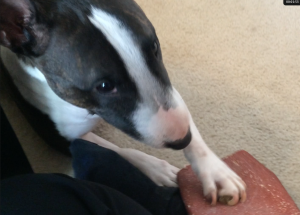
Look what I can do!

By now, your dog will place one paw on the scratch board, usually holding her paw still as you click and treat. Now, we’re clicking for a front nail drag along the board so get your clicker and treats ready.

Paw Drags

This is probably the most challenging part when teaching dogs how to use a scratch board. The timing of your click is important right now so you may want to practice your timing before moving forward. You’ll notice frustration creeping in. Take a deep breath. You and your dog will get it.

Goal: Using one paw (left, right or both front paws) to drag (slides paw down board) nails across board.

  • Settle in chosen room with door closed. Set up treats and scratch board.
  • Place board on ground with top portion leaning against your legs. Get ready. When board is in place, this gives your dog the green light to start offering paw movements.
  • Watch for when her paw slides down (click for either left or right front paw). This happens once your dog places her paw on the board.
    • When she doesn’t hear a click, she will remove her paw from the board (meaning she’ll remove her paw and try to place her paw on the board again).
    • Removing paw off board looks like a slide down the board. The moment you see this, click and treat! It usually takes two or three clicks at the right moment and she learns “Oh, moving paw downward on board earns treats. It’s not placing paw on board and holding still any longer.”
    • Paw pads are tough so dragging across fine grade sandpaper is safe. For thin or sensitive paw pads, choose finer grit sandpaper grit, such as 100.
  • Practice five times and end session (place board on shelf).

Teach Dog To Trim Own Nails: Teaching Nail Drags

RELATED: Trimming Dog Nails: Let’s Get Busy Scratching!

Nail Drags

Now, your dog understands to drag her paw along the scratch board. Great job! Now, we’ll wait for nail drags to happen. You may have noticed a few attempts when teaching paw drags. Since the scratch board is held at a 45-degree angle, your dog needs to extend out her paw to promote nail drags.

Goal: Dog drags nails across scratch board once.

  • Place scratch board against legs again, keeping at a 45-degree angle.
  • Wait for nails to touch board instead of paw pads. This usually happens at the beginning of a paw touch to board.
  • Some dogs place paw on board and then flex nails out. When this happens, click and treat!
  • Within two to three clicks, your dog will immediately offer nails dragged across board.
  • Now, don’t get greedy. Click and treat for one nail drag and not several, or you’ll totally confuse your dog. We’ll work on multiple nail drags later.
  • Practice five times, then pick up board and place on shelf.

READ MORE: Why Dogs Dislike Nail Trims

Filed Under: Games, Health Tagged With: cut dog nails, dremel dog nails, easy way to trim dog nails, file dog nails, nail trims

  • « Previous Page
  • 1
  • …
  • 4
  • 5
  • 6
  • 7
  • 8
  • 9
  • Next Page »

About

Dog Training Nation is a community of dog trainers, dog owners and dog lovers. Our mission is to provide trainers and owners valuable information to enrich dogs' lives. We cover a range of topics, from socializing puppies to dealing with aggressive dog behavior to selecting the best dog products. It is our hope you share our content to make the dog and owner world a better place.

​

Facebook

Video

Dog Training Nation is a dog training blog for pet owners and dog lovers. We cover a range of topics from puppy socialization tips to dog aggression to dog health. It is our hope you share our content to make the world a better place for dogs.

Dog Training Nation

Quick Links

Dog Training
Dog Behavior
Dog Training Videos
Become a Dog Trainer
About
Contact Us

Copyright © 2026 · Lifestyle Pro Theme on Genesis Framework · WordPress · Log in