Dog Training Nation

In Dogs We Trust

  • Home
  • Training
    • Dogs
    • Puppies
    • Clients
  • Behavior
    • Breeds
  • Health
  • Safety
  • Resources
    • Equipment
    • Books
  • Dog Training Videos
  • About
You are here: Home / Archives for Health

Dog Nail Trimming Tips: Teach Dog to Use Scratchboard

April 24, 2015 by Fanna Easter

How to Teach Your Dog to Use a Scratchboard

How to Trim Dog Nails

You’ve built a size-appropriate nail scratchboard and now it’s time to teach your dog how to drag her front nails across it. You’ll need a clicker, lots of yummy treats (about the size of a pea), scratchboard and a room with a door.

Room With a Door

During the beginning stages, choose a small room with a door for dog training sessions. Before starting a dog training session, click and treat your dog for walking into the room and close the door behind you. By closing the door, you’re keeping your dog with you while minimizing distractions (e.g. movement around the house). Usually, I use our bathroom so my dogs associate it with fun instead of bath time. 🙂

This is not the torture room. This closed room means choice and fun, as your dog can decide to not participate. Remember, choice is a powerful reinforcer–sometimes even more so than food!

RELATED: Trimming Dog Nails: Let’s Get Busy Scratching

Placement of Scratchboard

After a few trials and errors, I discovered maximum nail filing when placing the scratchboard at a 45-degree angle to the ground. At this angle, your dog files the bottom portion first and then the middle and top of nail, forming a nice rounded and smooth nail. When keeping the scratchboard flat on the ground, I noticed a blunter bottom portion instead of a rounded nail tip, which seemed to grow out faster.

First Training Sessions

Goal: Positively introduce your dog to scratchboard.

Gather needed supplies, bring your dog into your chosen room, close the door and have a seat on the floor. Place treats on the seat of a chair before beginning each session. Basically, treats are kept up high so you can easily reach while keeping your dog from self snacking. Next to your treats, place the scratchboard. Placing the board on the floor means “let’s scratch at the board” to your dog. Plus you don’t want to miss any nail drags.

  1. Place bottom of board on floor and leave top against your leg. The front should be facing your dog.
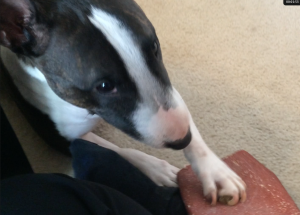
  2. When your dog looks at, walks toward or touches her front paw on the board, click and toss her a treat.
  3. Usually, looking at and walking toward the board happens during your first training session. Your dog is learning that the board means something so she’s going to investigate, which you will heavily reward.
  4. Practice 5-10 times and end training session.

Paw on Board

Goal: Teach dog to touch paw to board.

  1. Settle in chosen room, and set up treats and scratchboard.
  2. Place board on ground with top portion leaning against your legs. Get ready. When the board is in place, this gives your dog the green light to start offering paw movements.
  3. Click and treat paw touches (either paw or both) even if for a nanosecond.
  4. After 5-10 treats, end training session.

If Dog Walks Away During Training Session

This can happen. Think of it as a temperature check of your training session. If your dog walks away, there are a few things going on:

  • Your dog is confused. She’s not sure what you’re asking her. Take a step back and click/treat for looking, walking toward and touching the scratchboard. Your dog should think: “When I touch this board with my paw, I hear a click and get a treat.”
  • Your treats are boring. Hey, your dog chooses what she works for just like us. So find treats your dog loves and use in next training session.
  • Too many distractions: Turn down the TV, close blinds or play soft music to drown out loud sounds.
  • Up your rate of reinforcement: Ideally, you should be clicking and treating every 5-10 seconds. I know your dog is offering behaviors in that short time. If you’re not noticing these behaviors, you’ll be shocked at what you missed. 🙂

VIDEO: Teaching Dog to Use Nail Scratchboard

READ MORE: Natural Pest Control for Your Home
Filed Under: Equipment, Games, Health, Training Tagged With: dog file nails, dog nail file board, dog nail scratch board, dog nail trims, dog scratching board, easy dog nail trims, how to teach dog to trim own nails, teach dog to file own nails, teach dog to trim own nails

Dog Nail Trimming Tips: Teaching Nail Drags Across Board

April 22, 2015 by Fanna Easter

Teaching Your Dog to Drag Her Nails Across Scratch Board

Dog Nail Trimming
Look what I can do!

By now, your dog will place one paw on the scratch board, usually holding her paw still as you click and treat. Now, we’re clicking for a front nail drag along the board so get your clicker and treats ready.

Paw Drags

This is probably the most challenging part when teaching dogs how to use a scratch board. The timing of your click is important right now so you may want to practice your timing before moving forward. You’ll notice frustration creeping in. Take a deep breath. You and your dog will get it.

Goal: Using one paw (left, right or both front paws) to drag (slides paw down board) nails across board.

  • Settle in chosen room with door closed. Set up treats and scratch board.
  • Place board on ground with top portion leaning against your legs. Get ready. When board is in place, this gives your dog the green light to start offering paw movements.
  • Watch for when her paw slides down (click for either left or right front paw). This happens once your dog places her paw on the board.
    • When she doesn’t hear a click, she will remove her paw from the board (meaning she’ll remove her paw and try to place her paw on the board again).
    • Removing paw off board looks like a slide down the board. The moment you see this, click and treat! It usually takes two or three clicks at the right moment and she learns “Oh, moving paw downward on board earns treats. It’s not placing paw on board and holding still any longer.”
    • Paw pads are tough so dragging across fine grade sandpaper is safe. For thin or sensitive paw pads, choose finer grit sandpaper grit, such as 100.
  • Practice five times and end session (place board on shelf).

Teach Dog To Trim Own Nails: Teaching Nail Drags

RELATED: Trimming Dog Nails: Let’s Get Busy Scratching!

Nail Drags

Now, your dog understands to drag her paw along the scratch board. Great job! Now, we’ll wait for nail drags to happen. You may have noticed a few attempts when teaching paw drags. Since the scratch board is held at a 45-degree angle, your dog needs to extend out her paw to promote nail drags.

Goal: Dog drags nails across scratch board once.

  • Place scratch board against legs again, keeping at a 45-degree angle.
  • Wait for nails to touch board instead of paw pads. This usually happens at the beginning of a paw touch to board.
  • Some dogs place paw on board and then flex nails out. When this happens, click and treat!
  • Within two to three clicks, your dog will immediately offer nails dragged across board.
  • Now, don’t get greedy. Click and treat for one nail drag and not several, or you’ll totally confuse your dog. We’ll work on multiple nail drags later.
  • Practice five times, then pick up board and place on shelf.

READ MORE: Why Dogs Dislike Nail Trims

Filed Under: Games, Health Tagged With: cut dog nails, dremel dog nails, easy way to trim dog nails, file dog nails, nail trims

Trimming Dog Nails: Let’s Get Busy Scratching

April 21, 2015 by Fanna Easter

How to Teach Your Dog to File Her Nails

How to Trim Dog Nails

Once your dog will drag her nails along the scratch board, it’s time to ask for multiple scratches before clicking and treating. Grab a clicker and treats, and let’s get started.

Two Nail Drags

Goal: Two nail drags in a row.

  • Place nail scratch board in place.
  • Wait for two nails drags before clicking.
    • About 50 percent of dogs will drag once, stop and look at you (or the clicker), waiting for the click sound. If they don’t hear the click sound, they’ll usually drag their nails again. Click and treat. The other 50 percent will remove their paws from the board, think for a moment, then offer two quick nail drags. Click and treat!
    • Tip: Wait for second nail drag. If your dog becomes frustrated and leaves, then she is confused. Go back to single nail drags for a couple of training sessions and slowly wait for two nail drags.
  • Practice five times. Pick up board and end training session.

RELATED: Dog Nail Trimming Tools

Three Nail Drags

Goal: Three nail drags in a row

  • Follow the  instructions for two nail drags.
  • If your dog gets stuck and you’re seeing results, there is nothing wrong with two nail drags for one treat. 🙂

Other Paw

Goal: Other paw (non-dominant paw) scratches board.

By now, your dog is probably switching paws in between nail drags. If not, move the scratch board directly in front of the non-scratch front paw. This usually gets it moving. When she offers her non-scratch paw, click and give her two treats. Trust me, she will notice and start offering it again!

Both Paws

Goal: Both paws scratch one after the other (digging motion).

Depending on your dog’s personality, this may have happened already. Stella (my Bull Terrier) offered this behavior in the beginning so I clicked and treated. Some dogs need to experiment and practice more, and some dogs may never offer this behavior. Remember, the goal is filing down nails. 🙂

Read more:
Trimming Dog Nails: Reaching for Paw
Trimming Dog Nails: Restraining Your Dog’s Paw
Why Dogs Dislike Nail Trims

Dog Nail Trims: How Much to Trim Off?

Filed Under: Equipment, Games, Health, Resources Tagged With: dog nail file board, dog nail scratch board, dog nail trims, dog scratching board, easy dog nail trims, how to teach dog to trim own nails, teach dog to file own nails, teach dog to trim own nails

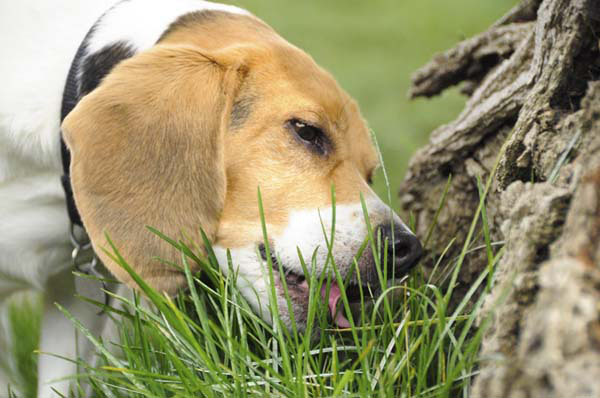
Why Do Dogs Eat Grass?

April 17, 2015 by Fanna Easter

Dog Eating Grass

Tips for Discouraging Grazing Dogs

Dog Eating GrassDogs eat grass for many reasons so I wouldn’t worry. As for the reason why dogs eat grass, who knows.  Why do people eat Doritos?  So many reasons, right? 🙂  If your dog eats a lot of grass and vomits it up on your floor, try these tips.
If your dog is sick, meaning he or she refuses to eat or drink, I recommend a prompt visit to your vet.

Upgrade Kibble

Just like humans, dogs are what they eat so make sure your dog is eating high quality kibble. High quality kibble means real food is listed in your dog’s kibble ingredient list. There is nothing wrong with corn or byproducts  regardless of what specific dog food companies claim unless your dog is allergic to them. If you’re not sure, here’s a list of the most popular high quality kibbles. Or, you may want to explore cooking homemade meals for your dog. If so, check out tips here.

Add Pulped Veggies

If your dog loves eating grass and it causes digestive stress, I recommend adding pulped vegetables to your dog’s diet. By pulping or cooking veggies and fruits, you’re breaking down the plant cellulose layer so dogs can easily digest and utilize the nutrients.

For pulping, I add fruits and veggies (remove pits and seeds first) to a food processor and pulverize until finely ground (resembling pesto). Depending on your dog’s size, add one teaspoon or tablespoon to your dog’s meals. You’ll be shocked. He’ll gobble it up!

Usually, I pulp kale, apples, broccoli, carrots, sweet potatoes or cauliflower and place in plastic freezer bags for storage. All bags go in the freezer and I thaw as needed. After feeding pulped fruits and veggies for a few days, I usually notice a reduction in or elimination of grass eating so your floors are now safe. 🙂

READ MORE: Understanding Dog Nutrition

Filed Under: Health Tagged With: dog eating grass, dogs eating grass, stop dog from eating grass

My Dog’s Cruciate Ligament Repair: 4 Wonderful Outcomes That Surprised Me

April 16, 2015 by Fanna Easter

Canine Cruciate Ligament Repair

4 Surprising Outcomes From My Dog’s Surgery

Cruciate Ligament in DogsTrust me, I was just as upset as you were when our vet muttered “partially torn CCL.” My heart sank to my feet. Just envisioning weeks of crate rest made my brain throb, not to mention tear-inducing major surgery.

Sobek is eight weeks post-op TTA surgery and, as we rounded the yard yesterday during a potty break in pounding rain, I discovered the wonderful things about his surgery–the proverbial light at the end of the tunnel, I guess. And this light shined bright on this rainy day!

Deepened Our Bond

By far, this was the most rewarding of all outcomes. Sobek and I built an unbreakable bond. Don’t get me wrong, we had a strong relationship before surgery, but now we’re even stronger. He learned to trust me unconditionally.

I remember the exact moment this happened. There was a mutual understanding right there in the living room. Sobek was home maybe 24 hours after surgery and I was following vet instructions on icing his incision. Well he was clearly uncomfortable with ice touching his sensitive suture line. I listened and backed off. At that moment, he learned I would never intentionally hurt him. If he was in pain, I acknowledged and never pushed further. From then on, he happily allowed icing the next day plus incision desensitization, knee flexes and much more. I watched his body language carefully and moved as far as he was willing to go.

Immensely Improved Leash Walking Skills

Well we had plenty of time to practice–that is for sure! With 10 weeks of strict crate rest, meaning all walks (including potty ones) are on leash, he now walks beautifully on a loose leash. Now, he still gets excited and yanks when he glimpses his canine rehab expert from far away, but he’s pretty darn good 80 percent of the time. I’ll take it!

RELATED: Stop Your Dog From Biting on His Leash

Built More Confidence

This one shocked me. Sobek is a tender boy and not too keen on trying new things–you should’ve seen him in agility, oh my word. 🙂  Well now, this boy will climb on the tallest and highest physical therapy peanut (imagine a four-foot long yoga ball) with all four legs! He resembles a circus bear balancing on a ball, dangling three feet from the ground. Shoot, we have to lure him off the peanut with food. He loves it!

RELATED: Canine Hydrotherapy Training Tips

Hydrotherapy. Shoot, he makes a beeline for the tank door the moment we walk in rehab and with a huge smile. I never thought this would happen, and I’m so proud of my big baby boy. 🙂

Mastered Self Settling

Oi, I never thought this would happen either. Sobek is a young dog. He’s only two years old and a bouncy thing. Would I describe him as hyperactive? Probably so. I’ve spent countless hours teaching him to self settle, meaning learning how to calm himself. Well, during crate rest, he not only mastered self settling, he can do so quickly now too. And having a dog learn how to calm himself down is worth its weight in gold!

Hindsight is 20/20 so take a moment to recognize and enjoy all types of improvements!

You may also like: Canine Rehabilitation

Filed Under: Health Tagged With: dog cruciate ligament repair, dog torn acl, preparing for dog's cruciate ligament surgery, tips for dogs ACL, TTA surgery for dogs

  • « Previous Page
  • 1
  • …
  • 28
  • 29
  • 30
  • 31
  • 32
  • …
  • 40
  • Next Page »

About

Dog Training Nation is a community of dog trainers, dog owners and dog lovers. Our mission is to provide trainers and owners valuable information to enrich dogs' lives. We cover a range of topics, from socializing puppies to dealing with aggressive dog behavior to selecting the best dog products. It is our hope you share our content to make the dog and owner world a better place.

​

Facebook

Video

Dog Training Nation is a dog training blog for pet owners and dog lovers. We cover a range of topics from puppy socialization tips to dog aggression to dog health. It is our hope you share our content to make the world a better place for dogs.

Dog Training Nation

Quick Links

Dog Training
Dog Behavior
Dog Training Videos
Become a Dog Trainer
About
Contact Us

Copyright © 2026 · Lifestyle Pro Theme on Genesis Framework · WordPress · Log in