Dealing with Redirected Aggression in Dogs

Redirected aggression is interesting and scary rolled up into one ball of madness.
And it’s common. Dogs, cats and humans will redirect their frustration onto the closest thing. Dogs can’t browse the self-help section of a bookstore so it’s up to their humans to understand why it happens before preventing it.
Examples of Redirected Aggression
An example of redirected aggression is when you’re walking two dogs at the same time in the park and one dog becomes really excited at seeing another dog in the distance. The excited dog becomes overly agitated. She is unable to get to the other dog. Then, she turns and attacks her walking mate, and they begin squabbling.
Road rage is a perfect human example of redirected aggression. A person becomes so frustrated by lack of control in a stressful situation so she lashes out at the nearest person. Lashing out ranges between horn blowing or snapping at the children in their car seats. This person is trying to deal with her frustration.
What is Redirected Aggression?
Redirected aggression is when a dog takes out his frustration on others when dealing with his frustration. Others can be dogs, pet parents and even objects. Once, when dealing with dog aggression in a client’s home, I witnessed a dog fighting with his neighbor dog along their fence line. Both dogs were separated by a chain link fence and you could tell they’ve practiced the game for a long time, as they would immediately lock eyes and their fence fighting began. This consult was during the fall and a large leaf had fluttered through the wind right next to the frustrated dog, and he attacked it. Wow, he was in a total frenzy.
Redirected aggression is not revenge seeking. I don’t think dogs plot revenge, at least I’ve not witnessed it yet. 🙂 But redirected aggression, in its mildest form, can turn into bullying behavior, which needs to be addressed quickly.
I’ve witnessed on numerous occasions dogs redirecting their frustration onto their pet parents. They become so overwhelmed, they’ll turn around and pinch or bite their owners in the leg or arm. Scary stuff!
Usually, dogs susceptible to redirected aggression have underlying anxiety struggles. These dogs can react quickly to perceived threats and have difficulty calming themselves during stressful situations. It’s the same for people too and I fit right into this category myself. I can get worked up in a matter of seconds!
By understanding the fact dogs prone to redirected aggression can react quickly, it’s important to:
- Stop frustration before it starts.
- Teach dogs how to deal with frustration without resorting to violence.
How to Deal with Redirected Aggression
Identify Frustration Triggers
It’s time to do a bit of homework. Find your dog’s frustration triggers. Now, list them in order of highest to lowest levels of frustration. For example, if your dog lunges and barks at other dogs, this will probably be first on the list followed by watching movement from a window and barking at a ringing doorbell. These are only examples so put on your detective hat and find your dog’s frustration triggers.
Stop Frustration Before it Starts
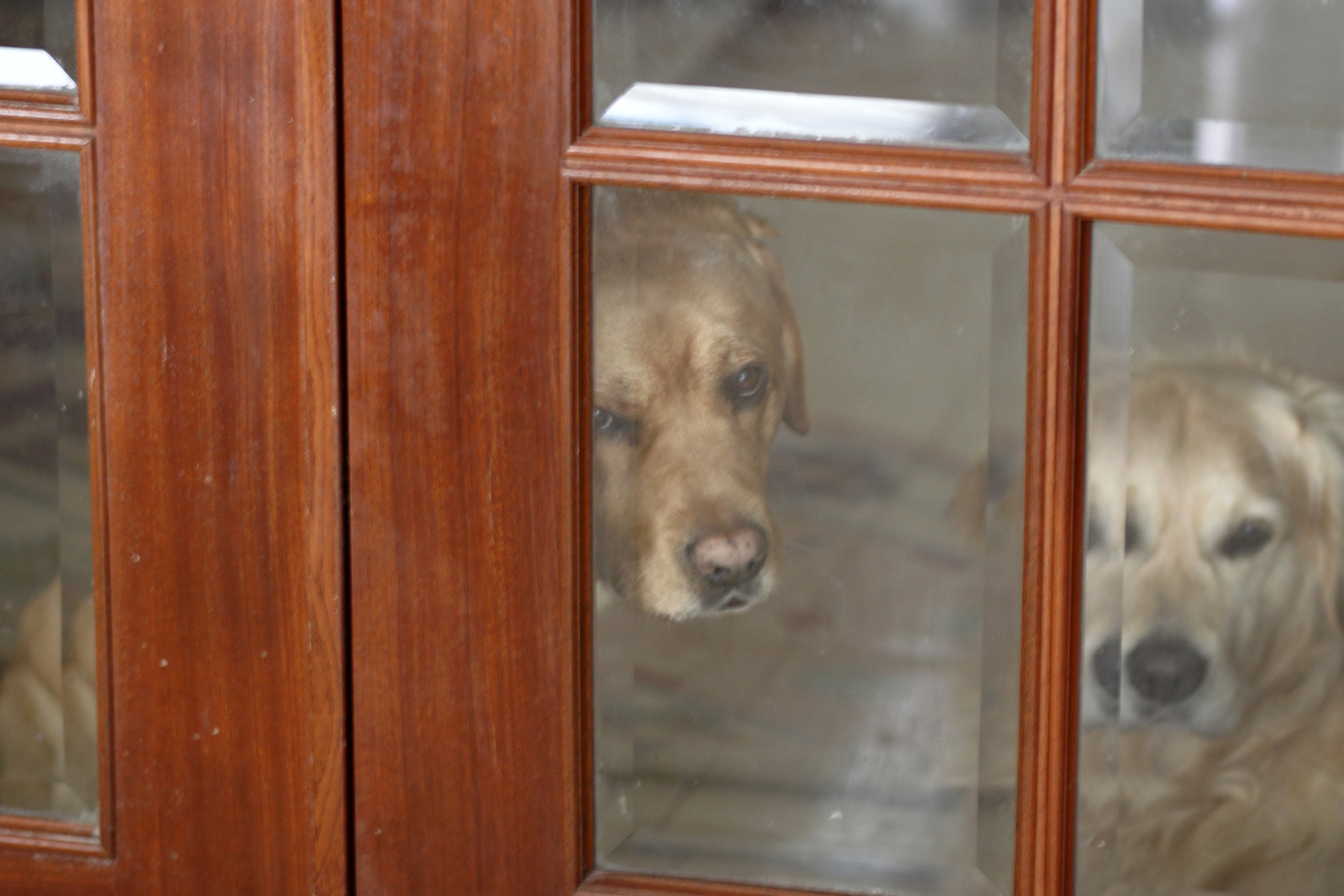
This means avoid frustration triggers.
- If you see another dog approaching, turn and walk the opposite direction.
- Ask guests to knock instead of ringing the doorbell. Duct tape across the doorbell works great as a reminder (cue). 🙂
- Close curtains or blinds. For “lookie loos,” block access to windows and move a chair or piece of furniture to block access.
- Block visual access for fence fighting. I’ve successfully used rolls of felt about four feet wide and zip-stripped it along the inside of my fence. You can purchase felt at Home Depot or Lowe’s.
- Walk one dog at a time. This prevents squabbling around triggers.
I promise you will not have to live with your sofa blocking a window or ugly felt-covered fences. These measures are to prevent a dog from practicing this behavior until you can teach him how to deal with frustration.
Dealing with Frustration
Ah, here’s the fun part! What do you want your dog to do instead of XYZ. It’s easy to say “don’t do that” but what do you want him to do instead? What if I told you to stop talking while driving? So, should you sing, hum, listen to music or read text messages instead? The devil is in the details!
- Dog approaching: Your dog looks at you.
- Fence fighting: Dog eats a food stuffed Kong.
- Lay on mat when doorbell rings.
- Heel when walking on a leash.
Seeking Professional Help
If anyone gets hurts (person, dog, cat, whatever), seek professional assistance. Having an experienced person advising you provides quicker results and prevents injuries. When in doubt, seek help.

My 4 year pitty has become aggrisive toward our 7 year old in the last few months even if she hears or sees another dog outside she charges we keep them separate atvall times my son who’s 41 has gotten bitten twice trying to break up fight but now she’s starting to redirect towards us she heard a dog outside and grabbed my ankle then just tonight she tried to get at me this is a very scary situation BC we never now when she might hear something and I live in an apt I have taken her to vet she’s healthy we muzzle her when going out and also I’ve had her since a puppy I’ve tried remedy’s calming chews anything I can to help but I don’t now what else to since she’s a danger to me my son and other two dogs I would be devastated to pts
Oh Linda, this is a tough one….. I don’t think remedies will help, but I do believe finding a professional dog trainer that uses positive reinforcement will help. Many years ago, we thought puppies were born with “clean slates”, meaning if something bad happened, it was our fault or something we exposed our dog too. Now, studies have shown that genetics are in control, we can certainly positively expose them to new situations, but we can’t always control the outcome. I would continue to keep her away from your other dogs and people until she’s been evaluated by an expert. Redirected aggression is unpredictable, as it could happen anywhere and to anyone, and it will only get worse until she learns different ways to handle stress. Until you’re able to see an expert (I would do this soon), play music to keep audible distractions to a minimum. I wish I could help further, but you need someone to find triggers which cause this behavior. Good luck and if you need a dog trainer recommendation, shoot me an email and I’ll find someone for you. 🙂
Thanks for the info we just started her on prozac two weeks ago if this doesn’t help he I’m not sure what else to do I’ve become very scared of my own dog I will not stay in the same room with her unless my son’s home I never no when she might redirect she could just here a dog barking outside and she’s frustrated it’s a very sad situation for me her behavior escalated in June when she attacked another dog when my son was playing fetch with her shes a very high energy girl loves to play fetch and loves water my son and I are trying to find a place with a yd maybe more exercise might help thanks
Make sure you’re working with a qualified dog trainer, prozac only will not change behavior on it’s own. Plus, it takes months to figure out the correct dose before seeing results, so having an expert in your corner is always best. Also, an expert will help you decide when your dog’s quality of life is no-existent, this is a tough situation.
Why is it that the girl on the left sometimes for no real reason gets viciously mad at the one on the right? And it’s very scary. Last night Nadia on right sleeps at the foot of the bed all night. Nikita on left gets up at the head of the bed when we first go nite nite. But after about 15 minutes she jumps of and lays on the floor until about 3-4 am. Then gets back up. Last night she got up on the bed and started growling bad at Nadia. She was like so pissed for no reason. I had to hold her collar so she wouldn’t attack. I held her for a good 30 minutes until she calmed down enough for me to (with one hand on her collar) go and open the door to let Nadia out. Then shut the door. Then in the morning when we went downstairs where Nadia was, there was like nothing ever happened. They both were normal and getting along. Then tonight I was making a salad and I gave each of them a slice of summer sausage Ike I always do. Well I was putting away the sausage in the fridge and I almost dropped it but caught it. They must have thought I dropped on the floor and both started fighting over what they thought I dropped. I broke it up instantly. But now Nikita is mad at Nadia again. And keeps following her and growing. I can’t get her to calm down when she gets like that. What next? P.s. These are Australian Shepherds
Hi Bobby! It sounds like resource guarding. Dogs will guard space, beds, food, treats and even people. This behavior must be addressed quickly, or it will get worse. Please never punish this behavior either or it will make it much worse. I’ll post a resource guarding link below, but I HIGHLY recommend locating a positive reinforcement dog trainer in your area, this person can work with you and your dog at home to prevent this behavior from bubbling back up. 🙂
Here’s the article! https://dogtrainingnation.com/dog-behavior-2/resource-guarding