Tips for Walking Two Dogs
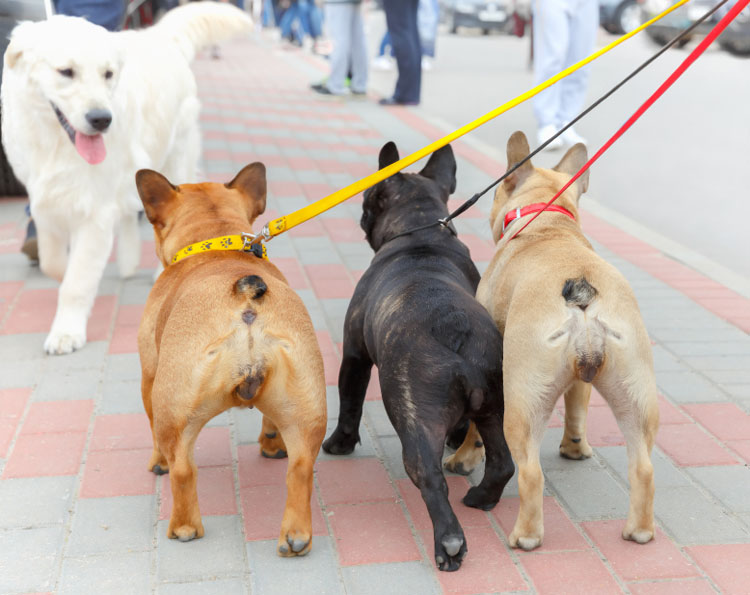
If you’re fortunate enough to share your home with two or more dogs, I know this thought has crossed your mind. But, is it the right thing to do for both dogs? It depends.
Before grabbing both of your dogs’ leashes, it’s best to prepare first. Now, if one, or both dogs, pulls on a leash, I recommend teaching each dog how to walk politely on a loose leash first. Trust me, it’s not safe being hauled around by a two-dog-powered engine. It’s downright dangerous. I’ve witnessed walking teams pulled into oncoming traffic. We don’t want that to happen so let’s discuss dog walking tips.
Lastly, keep your retractable leashes at home. Walking two dogs at once with retractable leashes is dangerous. Honestly, I’m not a fan of retractable leashes. I’ve personally received rope burns across the back of my legs when one dog lunged for a squirrel and separated the leash from the handle–it was horrible.
RELATED: Walking Two Dogs at Once: Choose the Best Equipment
Introducing Tandem Leash Walks
Let’s begin slowly. Leash up both dogs and take a short walk (10 minutes) in a quiet area. Reward your dogs often when they’re walking politely together. Usually, when one dog stops to sniff, the other dog joins in too, so stop often for mental stimulation. It’s as important as physical exercise.
Practice tandem dog walks often and increase each walk by 10 percent. By slowing increasing duration (time) of walks, you’re teaching both dogs how to walk together politely while exercising both body and mind. A short positive 10-minute walk is much better than an hour-long walking session accompanied with pulling dogs. Everyone ends up frustrated. Once you’ve reached desired walking duration, slowly increase distractions.
RELATED: Keep Dog Training Sessions Short
Big and Little Dog
Little dog legs must move faster to keep up with a larger dog’s longer stride. Keep this in mind during long walks. Plus, it’s difficult for larger dogs to walk slowly. They’re forced to alter their far reaching gait and hence pacing (kind of looks like a wobble). Ideally, use a longer leash for large dogs (six or 10 feet long) so they have a bit more room to move forward than the smaller dog who should be attached to a four or six-foot leash.
Older and Younger Dog
Using the same principles as walking large and small dogs together, I advise taking additional breaks for senior dogs. Plus, breaks may be longer. Walk only as fast as your senior dog can tolerate. If this is too slow for your younger dog, I recommend walking them separately.
Walking Past Distractions
It happens. Distractions are a normal part of life, but how you and your dogs handle distractions is everything. Sometimes, when dogs become overly frustrated, they may turn around and fight during tandem dog walks. This is called redirected aggression and can be deadly. Until both dogs learn how to respond (ideally ignore and focus on you) around distractions, keep it simple.
Someone Approaches You
If distractions are approaching you, such as another person walking her dog, turn around and walk the other way. If that’s not an option, cross the street or, better yet, walk along another street. Your goal is to avoid distractions for now while teaching your dogs to behave quietly and ignore them. If walking away is still not an option, stop and move away from the sidewalk, as the distraction walks past. Give your dogs yummy bits of cheese for good behavior. Once all is clear, start your walk again. 🙂
Distractions in Progress
When walking around distractions, such as playing children or a soccer game in progress, keep your distance. By keeping space between you and your dogs, you’re teaching them to focus on you instead. Next time, try walking one or two feet closer, decreasing distance until your dog ignores this type of distraction.
RELATED: How to Train Your Dog Around Distractions
Homework
Practice “look at me” at home using treats and a clicker. This cue is invaluable around distractions. During dog walks, when either dog stops pulling on leash, looks at you, ignores distractions and trots along by your side, reward with lots of happy praise and yummy treats. Practice and give lots of rewards. Soon, you’ll be power walking with the best of them!
READ MORE: How Much Exercise Do Dogs Need?