Make Sure Your Clients Know These Behaviors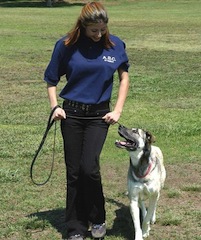
Do you want to spice up your Basic Family Manners Class? Are you bored teaching the same foundation exercises over and over again? Don’t you ever feel like you’re forgetting something? Are your dogs still pulling on a leash and jumping up on people? Here ya go! Learn three new behaviors all dogs should know!
Body Handling
While this is mostly covered in Puppy Class, we forget to cover in Basic Family Manners Class geared for dogs six months and older. Body handling means a dog learns to allow a person to touch, handle and restrain his body. Trust me, it’s not fun having a dog bucking around the room when you’re trying to apply eye medicine or brushing mats out of his coat. 🙂 Plus, your vet and vet tech will thank you profusely!
Body handling teaches a dog to stand still while being examined at the vet’s office, brushed at the groomers, having nails trimmed, having teeth brushed, having medicine and ointments applied to the eyes or ears and so on. Many dogs can learn to remain still for blood withdrawals and injections. We just need to teach the dog what is expected during these procedures.
How to teach:
- As you touch your dog’s shoulder, click and treat (repeat 5 times in a row).
- Touch his nose, click and treat (repeat 5 times in a row).
- Touch his front foot, click and treat (repeat 5 times in a row).
- Touch his tail, click and treat (repeat 5 times in a row).
Move forward until:
- Touch your dog’s nose, foot, tail or shoulder for 1 second, then click/treat.
- Continue until you can touch longer or look in his ear or mouth for longer, then click/treat.
Park Your Dog
During the first week of Basic Family Manners, I teach “Park Your Dog.” We all know that Week One is usually the loudest and rowdiest class by far so teach pet parents how to teach their dogs to calm themselves. I explain how to teach it, demo with the rowdiest dog in class, and then ask pet owners to practice for 5 minutes while I walk around providing feedback. Then I ask owners to “Park Your Dog” during lecture time and when they first arrive at class.
How to teach:
- Step on your leash about halfway up to your dog (your dog should have 3 feet of extra leash).
- Click and treat your dog the instant the leash becomes loose (Tip: Instead of watching your dog, feel when the leash tightens and loosens under your feet. The moment you feel slack in the leash, click/treat!).
- That’s it! Bingo, you are rewarding calm and quiet behavior!
Additional troubleshooting:
- Dog still jumps up on you, shorten the leash.
- Dog continues to pull on leash, your timing is probably off a bit. Click and treat every time the leash is loose.
- My dog is still pulling, call his name and click/treat five times in a row. Now you have his attention, so keep it by rewarding frequently.
View demo video and additional training tips here.
Collar Pressure
I love teaching this behavior, especially for big dogs and little pet parents. 🙂 Having a large dog is tough as he seems to always pull you forward even when teaching him polite leash manners. Well, problem solved, this behavior teaches a dog to follow collar pressure instead of pulling away from it.
Step 1: Touching your dog’s collar is a good thing!
- Touch your dog’s collar, next click and treat.
- Try this 10 times in a row.
Step 2: Following the pressure on the dog collar.
- Apply pressure to the dog’s collar the opposite way he is standing. Use light pressure, such as holding a door open. You are not pulling hard per se, but more like restraining.
- Immediately click and treat when your dog follows the direction of pressure (as the dog moves towards the pressure, so that you are no longer applying pressure to your dog’s collar).
- Try this 10 times in a row, remember to click and treat each time.
Step 3: Your dog now follows you on the leash.
- Touch your dog’s collar, as if you are moving him away from something, such as an open door.
- Immediately click and treat when your dog follows the direction of pressure (he moves towards your hand instead of pulling opposite of you).
- Try this 10 times in a row, remember to click and treat each time.
View demo video and additional training tips here.
Dog trainers, bark back! What behaviors would you like to teach in class?
 Five Things You Need to Know About Rescuing a Dog