Dog Training Nation

In Dogs We Trust

  • Home
  • Training
    • Dogs
    • Puppies
    • Clients
  • Behavior
    • Breeds
  • Health
  • Safety
  • Resources
    • Equipment
    • Books
  • Dog Training Videos
  • About
You are here: Home / Archives for dog barking stop

Separation Anxiety in Dogs

September 2, 2014 by Fanna Easter

Preventing & Treating Separation Anxiety in Dogs
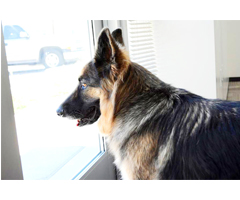
Separation Anxiety in Dogs
Is dog barking a symptom of separation anxiety?

Is your dog barking due to separation anxiety (SA)? Learn how to identify and prevent dog separation anxiety, and how to seek professional help if needed.

What is Separation Anxiety?

Separation anxiety occurs when a dog has a panic attack when left home alone. It’s like your dog freaks out and can’t control his terror or panic. He’s terrified to be left alone.

Dogs with mild separation anxiety usually pant heavily, vocalize, spin in their crates or at the back door when they’re left alone. Moderate to severe SA dogs will self-mutilate themselves trying to escape, such as ripping out their teeth or crashing through glass windows in an effort to escape.

Identifying Separation Anxiety

As a professional dog trainer, I can usually spot dogs predisposed to separation anxiety. It’s almost like they’re super sensitive and feel things at a deeper level than most dogs. Lovingly, I refer to them as “velcro dogs,” as dogs with separation anxiety are always by your side and looking into your soul. 🙂

Most dogs with anxiety follow you from room to room, watch over you while taking a shower or bath (I think they’re making sure you don’t drown), scream in excitement when you come home and crawl in your lap when you’re sad.

While most dogs will bark and whine when they’re alone, especially when left in a crate, it’s important to differentiate between a dog that isn’t crate trained and a dog with separation anxiety.

When in doubt, revisit “Crate Training Tips” to brush up on your crate training skills. If after putting those dog training tips in practice and your dog still stresses out, then you need to seek professional help from animal behaviorists.


 Still not sure if your dog has separation anxiety? Record your dog when left alone.

If you don’t have a dog monitor camera, use Skype or FaceTime.


How to Prevent Separation Anxiety in Dogs

Our behavior is critical to preventing and managing separation anxiety in dogs. Many times, pet parents reward separation anxiety behaviors because it’s really reinforcing us to be unconditionally loving and we don’t want to upset our velcro dog.

Trust me, I totally understand the feeling and emotion when coming home to your dog. He celebrates with unbridled enthusiasm and vocalizes as if his heart is full again. He’s thinking, “You’re home!” Be careful though. It’s not fair to your dog when you reinforce his excitement for your arrival. He needs to learn coping skills when left alone.

  • Make leaving uneventful
    • Give your dog a yummy food stuffed toy about 5 minutes before leaving.
    • Get your car keys, say nothing to your dog and leave.
  • Make your return uneventful
    • The moment you step into the door, ignore your dog. Trust me, I know it’s hard! Not only are you preventing SA, you’re teaching your dog not to jump on you.
    • Set your keys down and then take your dog out to potty.
    • Once he potties, then reward your dog, but keep celebrations to a minimum. No more happy dances. 🙂
  • Teach your dog that alone time is good
    • When taking a shower:
      • Give your dog a food stuffed toy.
      • Close the bathroom door to separate you and your dog.
      • When opening the door, don’t celebrate.
    • When leaving for 5-10 minutes:
      • Get the mail alone every other day.
      • Work in the yard alone for 10 minutes, then bring your dog out to enjoy yard work.
    • Close a door between you and your dog for a few minutes every day to teach your dog how to be alone.

Additional Valuable Tips

  • Exercise your dog or puppy daily. Most tired dogs will sleep when left alone.
  • Pair yummy food stuffed toys with leaving. This redirects his attention rather than worry about being left alone.
  • Turn on calming music for dogs. Personally, I use and recommend Through A Dog’s Ear CDs or downloads. They’re very relaxing—even for me. 🙂
  • Invest in pheromone plugins or sprays. These emit pheromones mimicking a nursing mother dog and have proven very effective with dog separation anxiety cases.

Yes, in the past and currently, I share my home with SA dogs with variable degrees of anxiety. It’s a tough road, but with professional help, this can be successfully managed and your dog can learn to be alone. 

When Separation Anxiety is Serious

If your dog displays moderate-to-severe separation anxiety symptoms, you need professional help.

Your dog’s behavior will only worsen. It won’t resolve itself, and your dog won’t get over it. I’ve witnessed dogs de-gloving their ears trying to escape from their crates. One client’s dog amputated his own tail, trying to escape his home when left alone. It can get that serious.

What are your questions about separation anxiety? I’m listening!

Filed Under: Behavior Tagged With: barking dog complaint, crate training, dog anxiety, dog bark, dog barking, dog barking all night, dog barking stop, dog behavior, how to stop a dog barking, no bark collar, separation anxiety, stop dog barking, velcro dog, velcro dogs, why dogs bark

Excessive Dog Barking: How to Stop It

August 15, 2014 by Fanna Easter

How to Stop Excessive Dog Barking

Excessive Barking
daviles/Adobe Stock

Each dog is an individual. While dog breed and age play a small role, dogs have their own personalities. Within a litter of 10 puppies, personalities range from shy to outgoing to bossy. There’s always a noisy one, or the puppy that whines and barks more than the other puppies. This also applies to people. I talk a lot, but my sister is super quiet—same genes, but different personalities. 🙂

Dogs bark to communicate and, at times, we can inadvertently reward this behavior. Barking, whining and howling are normal canine behaviors. However, excessive barking can be frustrating and, if loud enough, can become a problem for your neighbors.

What is Excessive Dog Barking?

Excessive barking is when a dog barks more than necessary in a specific situation. There’s a reason your dog is barking, and it’s our job to find the trigger, so we can dial down the barking and reduce his frustration as well as ours. 🙂

If you ask your dog to stop barking, and your dog continues to bark, this means your dog didn’t understand what “stop barking” meant, so you need to teach him. Ready to learn more? Let’s get busy!

Training Your Dog to Stop Barking

Before we fix the issue, we need to dive deeper to find out what is causing your dog to bark. When, where and what causes your dog to bark?

Once you’ve identified the trigger, it’s so important to catch your dog not barking around the trigger instead of waiting for him to bark. In the South, we have a saying: “Once the horse is out of the barn, not much you can do.”

Applying this to excessive barking, grab a clicker and a handful of training treats your dog loves. When your dog is around the trigger and is quiet, immediately click and give your dog a treat.

It’s very important you catch this good behavior (not barking around trigger). The more your dog is rewarded for being quiet around the trigger, the less he’ll practice bad behavior (excessive barking).

If your dog constantly barks all day long, even at night, and has other issues, such as not eating or sleeping, consult your veterinarian to rule out any health issues.

True Story About a Dog That Wouldn’t Stop Barking

Daisy, a recently rescued Beagle Mix, attended my group dog training class. Her pet parents were at their wit’s end. Daisy barked at the cat, door, people, during class, at night and when left alone. This went on for weeks. Even I was shocked at how much she barked.

[perfectpullquote align=”right” cite=”” link=”” color=”” class=”” size=””]Daisy was in pain, and trying to tell us the best she could.[/perfectpullquote]

Nothing would prevent her from barking—not even meat loaf. While Daisy wasn’t a big eater, she would take treats in class and barked and barked even more! I was puzzled, what was going on?

Daisy’s owners took her to the vet and after a complete workup, they discovered Daisy had a bone shard lodged in her throat and it had been there awhile! Once removed, Daisy became quiet as a mouse.

Most owners would’ve punished Daisy, and thank goodness they didn’t. It wasn’t her fault. Daisy was in pain and trying to tell us the best she could.

Ready, set and let’s train!

More:
Request Dog Barking
Attention Seeking Barking
Stop Dog Barking Next Door
Dog Barking at Sounds

Filed Under: Behavior, Dogs, Training Tagged With: bark collars, barking dog, barking dogs, barking dogs sound, dog bark, dog bark collar, dog barking, dog barking all night, dog barking sound effect, dog barking sounds, dog barking stop, dogs barking, how to stop dog barking, no bark collar, train dog not to bark, why dogs bark

How to Get Your Dog to Stop Barking

June 4, 2014 by Fanna Easter

Stop Your Dog From Barking Now

Barking Dog
Elenarts/Deposit Photos

Wow wee, this is a tough one! But don’t worry folks, I have lots of tips for your barking dog. 🙂

Barking is a symptom and we need to find the cause to effectively address this behavior. First, it helps to understand why your dog is barking so we can manage and redirect this behavior. Many clients will correct their dogs whenever they are barking instead of understanding what is causing them to bark. This will confuse you and your dog quickly, which leads to frustration.

Now, some dogs are more vocal than others. I’m hesitant to label a specific breed of dog as more vocal than others. I’m just not a fan of labels. Think about a litter of puppies: some are quiet and others are vocal (Sobek, my Rottie, is super vocal and has been since he was 2 days old). Now, think of your family. We all have a talker in the group. In my family, it’s me! I’m much more vocal than my sister and our family video confirms it every holiday!

Why Do Dogs Bark?

Vocalizing (aka barking), for some, is a reinforcing way to release stress and tension. Again, let’s think in human terms. Some folks can deal with stress by bottling it up inside and never speak a word about it. Others must talk it out with anyone who will stand still long enough to listen. Managing a dog and person, both who vocalize due to stress is a tough one, but it can be managed.

Managing vs. Fixing Behaviors

Note that I mention managing an inappropriate behavior instead of saying fixing an issue. With my past experience, I don’t think we can 100% fix an issue with a living being. You can fix a car or TV, but living beings have learned behaviors that will pop up no matter how much you try to fix them. So, when I say manage, we can manage 99.9% of the time, which works for me! Example: I’m terrified of crickets. You can manage my dislike by feeding me donuts when around a cricket, but if I’m shopping at Macy’s (odd place for a cricket) and a cricket suddenly jumps on me, you better believe I will react! My fear of crickets is a learned behavior. Okay, I’ll contain my nerdy side now — back to managing barking.

3 Steps to Stop a Barking Dog

  1. Identify the trigger. What is causing your dog to bark in that environment?
  2. Choose an incompatible behavior to teach your dog (e.g. quiet, look at you or touch).
  3. Reward the incompatible behavior that prevents your dog from barking.

Dog Training Tips

  • Notice I said in that environment, which means the very moment that caused your dog to bark. Was it another dog that approached, a loud sound, a person walking up to your dog, doorbell ringing, umbrella opening, your dog noticing a strange object, or was he standing too close to another dog?
  • If your dog is a stress barker, find out what triggers the stress. Does it happen when you ignore him (attention-seeking behaviors, frustration due to confusion during a training session, an approaching dog, etc.)? Now address the stress and reward the dog when he is quiet (if he exhibited attention-seeking behavior). Take a step back in your training session and reward a simple behavior or walk the opposite way of an approaching dog.
  • Ask your dog to perform the incompatible behavior before he begins barking. If he begins barking, it’s too late. I say, “The horse is already out of the barn.” Back up until your dog quiets and try again. Timing is key!
  • If your dog barks, will not take a treat, or stop barking, back up from the trigger. In the dog training world, we say your dog is over threshold.
  • You need a really good reward. Barking is self rewarding, especially for stress barkers. Break out the really good stuff (cubed lunchmeat!).
  • At first, keep your dog on a leash so you have some control to move away from the trigger.
  • Manage the environment so your dog does not practice the behavior. This means, don’t let him bark at the trigger as this will only strengthen that behavior (think many repetitions of practice to strengthen muscles).

Example: Your dog barks at other dogs through the window.

  1. Close the curtains when you are not around. We don’t want the dog to practice this behavior and it getting stronger.
  2. Leash your dog and click/treat an incompatible behavior, such as quiet. Yes, he needs to breathe in between barks so reward the nanosecond of quiet. Or ask him to look at you and reward that behavior.
  3. If your dog will not focus on you, then back up from the window and try again.
  4. Practice this several times with fabulous treats.
  5. Keep curtains closed until your dog has more success with the incompatible behavior instead of barking at the dogs.
  6. Trust me, your dog will learn not to bark at other dogs through the window. 🙂

What Not to Do

  • Screaming, yelling and telling him to stop it right now. Basically, you are joining in with the barking party. 🙂
  • Penny cans, spray bottles and leash corrections. While it may seem to stop the behavior, it more or less suppresses it in my opinion. And I’ve seen it time and time again, corrections scare the dog and the dog thinks the trigger caused it. Now you have a dog that is scared of other dogs, people, etc. Punishment may work, but you really need to know what you are doing to prevent fallout behaviors. Make your mistakes with positive reinforcement, as it’s much more forgivable and it works!

Barking dogs of the world, unite! Share what causes your dog to bark in the comments below.

More:
Request Dog Barking
Stop Dog Barking Next Door
Attention Seeking Barking
Calming Music for Dogs

Filed Under: Dogs, Training Tagged With: dog barking, dog barking all night, dog barking at night, dog barking in crate, dog barking stop, dog barks

About

Dog Training Nation is a community of dog trainers, dog owners and dog lovers. Our mission is to provide trainers and owners valuable information to enrich dogs' lives. We cover a range of topics, from socializing puppies to dealing with aggressive dog behavior to selecting the best dog products. It is our hope you share our content to make the dog and owner world a better place.

​

Facebook

Video

Dog Training Nation is a dog training blog for pet owners and dog lovers. We cover a range of topics from puppy socialization tips to dog aggression to dog health. It is our hope you share our content to make the world a better place for dogs.

Dog Training Nation

Quick Links

Dog Training
Dog Behavior
Dog Training Videos
Become a Dog Trainer
About
Contact Us

Copyright © 2026 · Lifestyle Pro Theme on Genesis Framework · WordPress · Log in
