Dog Training Nation

In Dogs We Trust

  • Home
  • Training
    • Dogs
    • Puppies
    • Clients
  • Behavior
    • Breeds
  • Health
  • Safety
  • Resources
    • Equipment
    • Books
  • Dog Training Videos
  • About
You are here: Home / Archives for dog behavior

Can Dogs Speak Human?

August 6, 2014 by Fanna Easter

Communicate With a Dog, Don’t Scare Him!

Dog Speak
Your dog’s point of view!

Can dogs understand human behavior? Yes and no. Mostly, humans confuse dogs. Some human behaviors are offensive to dogs, especially when we crowd and insist on petting them. In this guide, we teach you how to better communicate with a dog.

How to Communicate With a Dog

Dos

As a dog approaches you, stand still and turn sideways.

  • Turning sideways is much more inviting than facing a dog with your body held forward (same for people too!).
  • Standing still asks the dog to make the first move.

Allow a dog to approach you first.

  • If a dog ignores you, it’s OK. Do you want to meet and shake hands with everyone in the grocery store? Probably not.
  • Dogs can engage without physical contact just like when a person nods and then goes about his business. Take the hint and do the same. 🙂

Bend down when attaching your dog’s leash or collar or petting him.

  • It’s intimidating when someone looms over you. I’m 5’2″ and it’s uncomfortable when this happens. I move away from the person.
  • Toss treats toward your dog. He learns you equals treats.

RELATED: Dog Socialization Tips

Only pet a dog when he wants to be petted.

  • Never reach out and sneak a few pats in. Read the dog’s body language if he’s ignoring you. Take the hint! 🙂
  • If you reach out to pet a dog and he moves away, it’s OK. Most people take this as an insult, but it’s your dog’s way of saying, “Nice to meet you too, but I’m not too sure about this situation.”
  • Always listen to the dog’s body language, then explain to the pet parent, “Well, she’s not too sure about me, so I’ll respect her space.”

Allow a dog to sniff you before petting him.

  • When dogs sniff you, they’re deciding if they want to meet you or not.
  • Just because a dog sniffs you does not mean he wants to be petted. If he moves away from you, do not attempt to pet him.

Provide plenty of space, especially if a dog is fearful or stressed.

  • Respect a dog’s bubble. We all have space bubbles and some have larger bubbles than others. We dread the guy who gets in your face when talking. He has a small bubble!
  • If a dog is uncomfortable, take 4 steps away from the dog. Respect the bubble!

Don’ts
How to Interact With Dogs
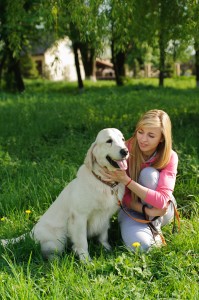
Good job! Bend down, stand sideways and pet dog’s chest.

While you’re reading these examples, imagine a person doing these things to you. Scary, right?

  • Stare directly into a dog’s eyes. Instead, look at the dog’s chin or upper neck.
  • Walk directly toward a dog to pet him.
  • Reach out and pet a dog you’ve never met before. Allow the dog to approach your hand held by your side.
  • Greet a dog and pet him on top of the head or face.
  • Force a dog to meet another person, dog or scary object.
  • Force your dog to play with other dogs, and it’s clear he isn’t comfortable in that situation. Not all dogs enjoy playing with other dogs. Just like some people don’t like hanging out with a bunch of other people.
  • Put your face next to your dog’s face (hugging or kissing your dog). In the dog world, this is rude behavior. Remember, dogs smell each others’ butts as greetings. 🙂 If your dog turns his head away or pulls away from you, he doesn’t like it.
  • Yell or scream at your dog. Dogs don’t know why you’re mad. They live in the moment and act guilty because you’re scaring them. Acting guilty is a combo of stress behaviors.
  • Play “I’m gonna get you!” game with a dog you’ve never met before. Usually, this involves a person jumping toward a dog, which is very scary to dogs. I’ve seen dogs lunge and attack a person because they were terrified. Dog are fast and have huge teeth, so never tease them.
  • Chase a scared or stranger dog. Instead, stop, bend down and say “puppy puppy puppy” in a high-pitched voice. Remember, when you’re standing still and squatting down, you’re more approachable and the high-pitched voice will draw the dog toward you.
  • Take a treat away from a dog. Instead, play the trade game.
  • Scare your dog by hiding and jumping out, wearing a mask, etc. Your dog learns you’re unpredictable, and this could cause a dog to become aggressive to people.

Can you imagine a person patting you on the head or a stranger walking directly up to you and touching you—yikes, respect the bubble! If you’ve done some of these human behaviors dogs hate, don’t beat yourself up. You did it because you didn’t know any better. 🙂 But now you do! It’s time to try to communicate with your dog again with these tips! Trust me, your dog will thank you!

Now, it’s your turn! How well do you communicate with your dog? What human behaviors have you noticed your dog hates? Please comment below!

Filed Under: Behavior Tagged With: dog aggression, dog aggression to other dogs, dog behavior, dog growls, dog tips, dog training, dog training advice, Dog Training Tips, how to train a dog, how to train a puppy, how to train your dog, how to train your puppy, preventing dog aggression, preventing dog bites, puppy training, puppy training tips, stop a dog from biting

Is Your Dog Confused?

August 4, 2014 by Fanna Easter

Confused Dog: Dog Training Tips

Confused Dog
Huh? What do you want?

If you’re wondering whether or not your dog is confused, the answer is probably yes!

I will say it: it’s our fault when a dog becomes confused. We didn’t give clear instructions. Many teachers are quick to blame their students, but it’s not the students’ fault when they make mistakes. The teacher wasn’t clear enough for the students to understand. Students must be successful within 1-2 attempts. If not, they will become confused.

Don’t allow your dog to make mistakes. If he doesn’t understand within 1-2 attempts, stop and make the next attempt easy. Mistakes are part of the learning process, but too many mistakes cause frustration, which stops the learning process.

What does a confused dog look like?

Confused dogs display many signs, such as:

  • Become hyperactive
  • Ignore you and their high value treats
  • Startle easily
  • Bark or lunge at other dogs
  • Lay on the ground and totally ignore you

During group dog training class, when I notice a confused dog, the owners are usually very frustrated at this point. They feel the dogs are blowing them off. I gently explain their dogs are simply confused and they should take a break. If you keep pushing, your dog will shut down completely, and we never want to get this far ever.

What should I do?

When you have a confused dog, remain still and drop 10 treats on the ground for your dog. Take 5 deep breaths and relax for a few minutes. Continue relaxing until you and your dog feel better. Pushing, pulling, tugging or yelling will only make the situation worse.

In a few minutes, your dog will look up at you, so smile and ask your dog to “touch.” Touch is an easy cue, which sets your dog up for success immediately. We all like small wins, right? Now, you and your dog are feeling much better, so you can get started again.

VIDEO: Teach the “Touch” Behavior

How to Prevent Confusing Your Dog Again

  • Use treats your dog loves! Confused dogs are more forgiving if you’re using fabulous treats. 🙂
  • Take lots of breaks: Let your dog drink some water, enjoy a quick play session in the backyard or let him sniff outside. Meanwhile, you should sit and relax, drink some water, or read the paper.
  • Keep dog training sessions short: Think 1-2 mins.
  • If your dog becomes confused and isn’t successful within 2 attempts, this means it’s too difficult for him to understand. End the dog training session with an easy behavior, such as “touch.”  Then, try to simplify the behavior further by breaking it into smaller sections.
    • Example 1: Your dog will stay until you step away. This is normal, as your dog has learned that your movement means he’s moving too.
    • Instead of stepping away, shift your feet while remaining in the same place.
    • When your dog is successful, take one step back and then one step forward, and so on.
    • Move at your dog’s pace until he learns “stay” means to remain in this spot while you walk away.

Prevent Learned Helplessness

Learned helplessness is when your dog shuts down, meaning he’s become so discouraged. Make sure to listen to your dog.

It’s your turn! When does your dog become confused?

READ ALSO: Leash Corrections & Leash Pops Don’t Work

Filed Under: Behavior Tagged With: clicker training, dog behavior, dog training, dog training advice, Dog Training Tips, how to train a dog, how to train a puppy, how to train your dog, how to train your puppy, obedience training, puppy training classes, puppy training tips

My Dog Growls at Me

July 25, 2014 by Fanna Easter

Dogs Growling

My Dog Growls at Me
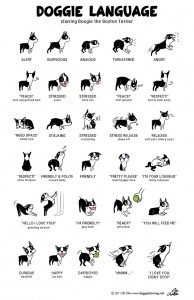
Chart of calming signals.

What should you do when your dog growls?

Dogs will growl. This is completely normal behavior. They may growl during play or when encountering something new or scary (like a plastic bag flapping wildly in the wind). Always look at your dog’s body language and environment to determine if your dog is having fun or your dog is growling out of fear.

Dog Growls When Playing

When dogs play, they usually growl. Some puppies may be more vocal than others. If your dog or puppy is playing with another dog and he begins growling, separate your dog from the other dog in a calm manner. Pay close attention to watch the other dog’s body language. If the other dog runs away, then your dog’s growling (or play style) may be too much for that dog. That is a safe time to end the play session.

If the other dog continues to play with your dog, then allow them to continue playing.View the Chart of Calming Signals created by Doggie Drawings to understand your dog’s body language.

A special shout-out to Doggie Drawings by Lili Chin. This site has wonderful educational tools for everyone, including posters for educating children about dog bites.

RELATED: Dog Aggression

When Your Dog Growls, But it’s Not Playtime

Dogs will display signals that say to a dog behaviorist that the dog is uncomfortable in a situation before he growls. Think of it this way: How do you know a thunderstorm is approaching? The wind picks up, dark clouds roll in, you can smell an increase of moisture in the air, and it begins to rain, then you hear lightening strike. Think of growling as lightening strikes. We need to interrupt and acknowledge calming signals before the lightening strikes. In my 20+ years of dog training, I’ve never witnessed a dog growl or bite without warning signs. We must understand a dog’ s body language to be able to prevent dog bites.

Never punish a dog for growling! This is your dog’s warning system. A dog growl means that he is uncomfortable in the current situation. People react the same way when scared. We may say, “Leave me alone,” “Stop” or “You are scaring me” to the person who is causing discomfort. As pet parents, we must respect a dog’s growl.

To learn more about dog body language, visit “Learn to Speak Dog” by Dog Gone Safe and watch videos and free downloads. The “Learn to Speak Dog” series is highly educational and will help you better understand dog behavior and growling signals.

Doggie Language Chart
Calming Signal Chart by DoggieDrawings by Lili Chin

What should I do if my dog growls as a warning?

  • Acknowledge and respect your dog’s calming signals (example: a growl).
  • Scan the environment to locate what caused your dog to growl (flying plastic bag, another dog standing too close in his  face, doorbell ringing, stranger approaching, touching his toenails, meeting new strangers, child is too close and in his face, fill in the blank).
  • Calmly move the dog away from the trigger that caused the growl.
  • Write down important facts about the trigger:

– Happened when…
– Trigger was…
– We were doing…
– Has happened X amount of times…

  • Keep your dog away from these triggers. If he is exposed to his trigger over and over again, he rehearses his stressed behavior, which strengthens it and that means it will take much longer to teach him good behavior around the trigger. Anxiety is caused by repeated exposure to a stressor, and we don’t want your dog to become anxious. Not removing the dog from the situation that brought on a growl reinforces that the growling is the default.

Use desensitization and counter conditioning to overcome the trigger that caused your dog to growl fearfully.


Dictionary.com defines desensitization as:

1. The elimination or reduction of natural or acquired reactivity or sensitivity to an external stimulus, as an allergen.
2. A behavior modification technique, used especially in treating phobias, in which panic or other undesirable emotional response to a given stimulus is reduced or extinguished, especially by repeated exposure to that stimulus.

Both definitions apply to training your dog so he can overcome things that he may have first thought were threatening or scary.


To better illustrate the fear-based growl, here is a brief example:

If your dog is terribly scared of crickets and he growls because of the:

  • Noise they make
  • Unpredictable hops
  • Scent they carry

This is generally a fear-based or warning growl.

The dog growl as the cricket is encroaching in his space is the dog’s trigger warning.

If the dog was taken out of the growl situation, but can still acknowledge that the cricket is in the room you can begin to reward the dog with his favorite treat while he can still see the cricket. Doing this will begin to teach your dog to associate that the cricket isn’t something to fear. Instead, he can begin to learn that a cricket present followed by yummy food and no growling is an acceptable behavior.

Overtime even if the cricket moves closer towards the dog (slowly) while feeding the dog treats. You will see improvement in the dog’s temperament. Your dog will become more comfortable with the cricket in the room.

You will want to feed the dog a treat as he continues looking at the cricket. If, at any time, it comes too close and the dog begins to growl or his body language shows he is getting uncomfortable, it is important to remove the dog from the situation and not treat during the uncomfortable moments. That will only reinforce the wrong feelings or behavior with getting a reward.

  • Never force, pull a dog towards a trigger or repeatedly introduce a dog to a known trigger, which causes them to freak out. This will make your dog way worse, we call this “flooding.”

This does not work. You are teaching a dog to become helpless, which is cruel.

This example is no substitute for a professional behaviorist or dog trainer assessing the behavior problem that causes your dog to growl. There is no one size fits all scenario.

Please consult with a local professional to correct growling behavioral issues.


Locate a qualified animal behaviorist and dog trainer in your area to begin the desensitization process. We recommend having an expert physically involved to offer guidance and to be successful with these behavior modifications. Hiring a professional dog behaviorist and/or a professional dog trainer will quicken positive results.


If you have any concerns, find a qualified dog trainer and animal behaviorist. Most dog trainers will meet you and your dog, assess their behavior and answer your questions. Dog trainers have many resources at their fingers tips, such as qualified animal behaviorists. Qualified animal behaviorists (ABs) are extremely knowledgeable in dealing with complex behaviors. A certified animal behavior trainer or an animal behavioral expert will work with your local vet and dog trainer. I’ve consulted with pet parents and animal behaviorists in several cases to arrive at a point where the dog has overcome his fears and provide the animal’s owner with excellent results.

When does your dog display calming signals? Please share in the comment section below.

READ ALSO: Choosing an Animal Behaviorist

Filed Under: Behavior Tagged With: calming signals, dog aggression, dog aggression to children, dog aggression to other dogs, dog aggression to owner, dog behavior, dog behaviour, dog growls, dog training advice, Dog Training Tips, my dog growls, stop a dog from biting, why dogs growl

Choosing an Animal Behaviorist

July 23, 2014 by Fanna Easter

Animal Behaviorist

Animal BehavioristDealing with dog aggression, moderate to severe anxiety or fearfulness or obsessive compulsive behaviors (OCD) is extremely trying for pet owners. I’ve held these owners in my arms, as they sobbed. It’s a difficult situation for dogs and their owners.

That is why I refer these cases to a qualified animal behaviorist. Within my 20 years of dog training experience, I find difficult cases are solved much quicker and with better results when a qualified animal behaviorist is involved.

What is an Animal Behaviorist?

An animal behaviorist is an expert who deals with difficult behavior cases, such as dog aggression, anxiety and obsessive compulsion behaviors on a daily basis.

Veterinarians, whom are board certified in animal behavior:

  • Bring their expert veterinary knowledge plus four years of solving and studying dog behavior (and many other animals) to their cases
  • Have completed their vet requirements and studied dog behavior, solving difficult behavioral cases for a minimum of four years, plus have passed a demanding animal behavior board certification
  • Can prescribe medications, if needed, so a dog can learn how to overcome his fears

Applied Animal Behaviorists have:

  • Earned a Masters or PhD degree in animal behavior
  • Studied dog behavior for a minimum of 7 years
  • Been required to successfully solve difficult cases under supervision with field experts during their internships

Prescribed Anti-Anxiety Medications

Some pet owners are reluctant to use anti-anxiety medications and I understand. You’re scared you will make your dog worse or drug him. Personally, when training dogs with life-destroying anxiety, I’ve seen amazing results when anti-anxiety medications are used. “The ultimate goal is to reach a point where the drugs are no longer necessary, a point where your dog has overcome his anxiety and learned to react in an appropriate fashion,” says Dr. Lorie Hudson DVM.

RELATED: Medical Modalities for Dogs

Why Contact an Animal Behaviorist?

Dog trainers and animal behaviorists are two different professions, yet they work together as a fabulous team. Think of dog trainers as general practitioners (GPs) and animal behaviorists as specialists in dog behavior. 

  • Animal behaviorists study and treat difficult cases daily with great success rates. They are required to complete yearly continuing education in their field of study and stay updated on the latest findings with fear, anxiety, aggression or OCD.
  • Animal behaviorists provide immediate assistance and solutions for the issue at hand, which provides quicker results for your dog and saves money. Dog trainers (GPs) teach polite manners, solve everyday pet issues and are usually a pet owner’s first contact when dealing with difficult behaviors. 
  • Dog trainers’ knowledge is vast. They are prepared for anything that might walk through their training center doors, complete yearly continuing education and provide recommendations to ensure the success of a dog and their owners. They are the general practitioners of the dog training world. They triage to specialists when needed. Personally, I’m extremely proud to be a dog trainer and empowered to have qualified animal behaviorists to call upon when needed.

Referral Process and Consultation

  1. When dog trainers encounter moderate to extreme fear, aggression, anxiety or OCD, they refer pet parents to an animal behaviorist, as these cases require one-on-one attention that provides specific training protocols for success. Dog trainers usually have their preferred animal behaviorist and will always ensure this person works for you and your dog too.
  2. An animal behaviorist will ask you to complete an extensive history background. Answer to the best of your knowledge. This history report is key to note triggers (what causes your dog to act fearful, aggressive, anxious or causes OCD behavior to happen).
  3. Then, an animal behaviorist will involve your local veterinarian to rule out any health issues.
  4. Once heath issues have been ruled out, the animal behaviorist will schedule a time to discuss your dog’s history background. Ask questions and observe your dog.
  5. After the consultation, a training protocol is designed and medications are prescribed if needed.
  6. Dog trainers will assist you with your prescribed training protocol and report back to the animal behaviorist on progress.
  7. Most animal behaviorists require a six-month check-in, especially if medications were prescribed.

Contacting an Animal Behaviorist

Usually, local positive reinforcement dog trainers work with an animal behaviorist in the area. However, still research your dog trainer’s referral. Qualified animal behaviorists should be listed in the below database:

  • American College of Veterinary Behaviorists Directory
  • American Veterinary Society of Animal Behavior
  • Animal Behavior Society

If you’re unable to find a qualified person in your area, the below vets (both are board certified in animal behavior) provide phone consultations through your regular vet:

  • Tufts Behavioral College Vet Fax Program
  • Veterinary Behavior with Dr. Martin

Animal Behaviorist Tips

  • Not recommended: Dog trainers or unqualified animal behaviorists boasting they can fix any issue is equivalent to a general practitioner saying they can preform open heart surgery.
  • Choose a qualified animal behaviorist. The cost is the same or less than an unqualified animal behaviorist.
  • Do not choose an animal behaviorist using punishment-based training methods.

You’re more than welcome to ask any questions on this subject in the comment section below. This is a tough situation and I hope this article points you in the right direction with solutions.

READ ALSO: ASPCA – Finding Professional Help

Filed Under: Behavior Tagged With: animal behaviorist, Certified Dog Trainer, dog aggression, dog anxiety, dog behavior, dog bites, dog growls, dog trainer, dog training classes, Dog Training Tips, fearful dog, how to train a puppy, obedience dog trainer, obedience training, puppy aggression, puppy obedience training, scared dog, stop a dog from biting, stop a dog from growling

Choosing the Right Dog Trainer

July 23, 2014 by Fanna Easter

Find a Trainer for Your Dog

Dog Trainer
Happy dog trainer!

How do you pick the right dog trainer for you and your dog?

Dog Trainer Requirements

  1. Use positive reinforcement training. This means he uses treats to reward good behaviors and redirects or ignores bad behaviors. Positive reinforcement works!
  2. Use positive reinforcement on humans too! Basically, dog trainers are teaching you how to train your dog. And if it’s not fun, who wants to do it, right? 🙂
  3. Provide a safe, clean and fun learning environment. Potty accidents must be cleaned immediately. Dogs should not be allowed to bark and growl at each other. Good dog trainers will provide visual barriers to ensure everyone is safe and having fun! If a dog is barking constantly, the dog trainer should be offering the pet parent tips to manage this barking.
  4. Has excellent communication skills. Dog trainers should smile, encourage, ignore mistakes, offer different tips to ensure success. Students should feel comfortable and encouraged.
  5. Understands dogs are individuals. Dogs learn differently, just like humans, so a dog trainer should have plenty of fun ideas in his Dog Trainer Tool Box. He needs to find what works for your dog.
  6. Provides plenty of time to practice behaviors during class. While your dog trainer will explain how to teach a behavior, his stories should be kept to a minimum. About 70% of class time should be focused on practice time.
  7. Shows up on time for each session and is available to answer questions after class.
  8. Helps pet parents meet or exceed their training goals. Dog trainers should check in with each team before, during and after class even if it’s a “thumbs up”or “high five” when they reach their goal 🙂
  9. Leaves you feeling empowered. You must feel successful during and after each class. Fabulous dog trainers strive to ensure you and your dog are always successful.

For additional details, click here.

Locating a Dog Trainer

My advice is to begin searching for dog trainers at Animal Behavior College Certified Dog Trainers, Karen Pryor Academy, Council of Certified Dog Trainers Database, International Associates of Animal Behavior Consultants,  and American Veterinary Society of Animal Behavior Consultants.

Interviewing a Dog Trainer

Now that you understand the requirements and have located a dog trainer, it’s time to interview them. It’s best to speak with dog trainers on the phone and ask to observe a class in session. Dog trainers are honored when pet owners ask to observe a class because they can show off their skills. Using your list of dog trainer requirements, observe a group class in session. Are they meeting your requirements? If, at any time, you are not comfortable observing/practicing any techniques, stop and speak with your trainer. I’m empowering you to be your dog’s voice. 🙂

Tell us about your dog trainer in the comment section below!

More: 
Dog Trainer Fanna Easter 
Dog Trainer Karen Pryor 
Dog Training Classes 
Dog Obedience Training

Filed Under: Dogs, Training Tagged With: animal behaviorist, dog behavior, dog obedience training, dog trainer, dog training, dog training classes, Dog Training Tips, how to train a dog, how to train a puppy, how to train your dog, obedience training, puppy training, puppy training classes

  • « Previous Page
  • 1
  • …
  • 10
  • 11
  • 12

About

Dog Training Nation is a community of dog trainers, dog owners and dog lovers. Our mission is to provide trainers and owners valuable information to enrich dogs' lives. We cover a range of topics, from socializing puppies to dealing with aggressive dog behavior to selecting the best dog products. It is our hope you share our content to make the dog and owner world a better place.

​

Facebook

Video

Dog Training Nation is a dog training blog for pet owners and dog lovers. We cover a range of topics from puppy socialization tips to dog aggression to dog health. It is our hope you share our content to make the world a better place for dogs.

Dog Training Nation

Quick Links

Dog Training
Dog Behavior
Dog Training Videos
Become a Dog Trainer
About
Contact Us

Copyright © 2026 · Lifestyle Pro Theme on Genesis Framework · WordPress · Log in