Dog Training Nation

In Dogs We Trust

  • Home
  • Training
    • Dogs
    • Puppies
    • Clients
  • Behavior
    • Breeds
  • Health
  • Safety
  • Resources
    • Equipment
    • Books
  • Dog Training Videos
  • About
You are here: Home / Archives for dog behavior

DIY Cavaletti Course For Dogs

November 3, 2017 by Fanna Easter

Building a Dog Cavaletti Course at Home
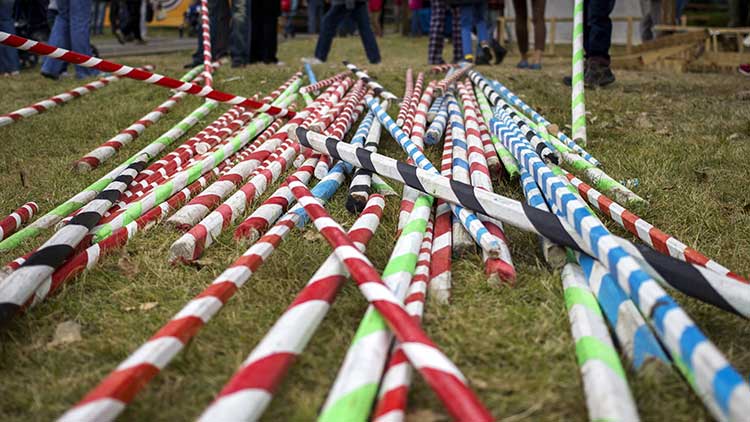
Build Dog Cavaletti
taniasv/Adobe Stock

Cavaletti is a fun exercise that teaches dogs to walk over poles at various heights or across different surfaces. Most pet owners have watched horses complete cavaletti courses with some obstacles featuring fallen logs or low jumps.

Cavaletti is an excellent way to improve your dog’s balance, help him rebuild muscle after surgery, lengthen his stride for the show ring and regain range of motion after an injury. Plus, cavaletti courses are a great form of exercise that also builds confidence in dogs.

With your veterinarian’s permission, have your dog practice cavaletti for 10 minutes a day. Below are tips for building a dog cavaletti course at home.

DIY Cavaletti Equipment Ideas

With a bit of imagination and a non-skid surface, you could create a DIY cavaletti set from things lying around your home.

  • Use broomsticks or mop handles as cavaletti poles, and place horizontally on the ground.
  • Place 2×4 boards about 2-3 feet apart with the flat part (widest part) on the ground.
  • For small dogs, place a ladder horizontally flat on the ground.
  • If you have a large dog, create a ladder out of 1-inch PVC pipes.
  • Use large fallen branches as poles. Place 2-3 feet apart in your backyard.
  • To increase the height, place broomstick ends inside holes of a laundry basket.

Purchasing Cavaletti Sets Online

If you’re not crafty, and would rather purchase a cavaletti set, there are several options online. By far, the most popular cavaletti set is made by FitPaws and costs $60. FitPaws offers a set of 3 poles and 6 cones with several height adjustment levels. There are other brands available, but they don’t offer the adjustability that FitPaws offers with their cavaletti set. Plus, FitPaws’ equipment is yellow, blue and green, which are colors easily seen by dogs. With moderate use, this cavaletti set will last years.

A Few Cavaletti Tips

Slow controlled movements are best. Set up your cavaletti set on a non-skid surface, such as grass, rug or rubber. If it’s too warm outside, practice indoors on a thick rug. Remember to lure your dog over each pole slowly. If your dog jumps or hops over any pole, you’re moving the lure too quickly. For dogs that leap in the air around treats, practice loose leash walking across the bars.

Show us pictures of your DIY cavaletti course! Post below. 🙂

WATCH: DIY Cavaletti Equipment Ideas For Dogs

Filed Under: Equipment, Games, Resources Tagged With: build dog cavaletti, canine cavaletti training, cavalettis for dogs, DIY dog cavaletti, dog behavior, dog cavaletti, dog games, dog training, Dog Training Tips, homemade cavalettis, how to make cavalettis, how to teach a dog, how to train a dog, teaching a dog, training a dog

How To Teach Your Dog Cavaletti

November 1, 2017 by Fanna Easter

Cavaletti for Dogs

Cavaletti for Dogs
ARochau/Adobe Stock

Cavaletti training teaches dogs to walk over poles and different surfaces placed on the ground. It is a form of exercise that focuses on slow controlled movements. As a dog approaches and steps over each pole, she must lift up each leg carefully to prevent stepping on or bumping the pole. While this seems easy, it’s really challenging, especially when dogs have altered their gait due to injury.

Benefits of Cavaletti for Dogs

During a cavaletti exercise, dogs relearn how to maintain their balance as they carefully place one paw down over a pole while raising their other paw up. Cavaletti increases a dog’s range of motion and teaches her to put equal amount of weight on each limb.

Cavaletti courses are fun exercises for all dogs even for those without injuries. It’s a great way to build a dog’s confidence, lengthen her stride, and keep her fit both mentally and physically. Plus, you can place cavaletti equipment anywhere.

RELATED: Barn Hunt: The Nose Sport Your Dog Needs to Try

How to Set Up a Cavaletti Course

On a non-skid surface, place cavaletti poles horizontally and flat on the ground. For large dogs, place poles 3 feet apart and, for smaller dogs, 1-2 feet apart.

Lure your dog over each pole slowly with a yummy treat. If your dog hops or jumps over the poles, you’re moving too quickly. Sometimes, dogs get a bit nervous when poles roll around under their feet, so secure them by stepping on a pole as your dog crosses over it. Bumping and tapping poles are normal at first. After some practice, your dog will precisely pick up and place her feet between each pole! If your dog becomes super excited around treats, practice loose leash walking across poles first. Remember, slow controlled movements are key.

Making It More Difficult

Slow controlled movement builds muscle and teaches dogs how to balance around obstacles. Once your dog learns to carefully step over each pole, move the poles closer together. Now, she will have to step over several poles at one time, which is extremely challenging, so move slowly. For larger dogs, slightly increase the height of poles, so they must pick up each leg.

Has your dog tried cavaletti yet? Post your pictures below!

WATCH: How To Teach Your Dog Cavaletti

Filed Under: Games, Resources Tagged With: cavaletti for dogs, cavaletti jumps for dogs, cavaletti poles, DIY dog cavaletti, dog agility cavaletti, dog behavior, dog cavaletti, dog sports, dog training, Dog Training Tips, how to make cavalettis, how to teach a dog, how to teach cavaletti, how to train a dog, teaching a dog, training a dog

Is Your Dog’s Behavior Improving?

October 23, 2017 by Fanna Easter

Improve Your Dog’s Behavior in 3 Steps

Dog's Behavior
melounix/Adobe Stock

When teaching a dog one or several new behaviors, it can be tricky to gauge if a dog’s behavior has permanently changed. Dog behavior can fluctuate depending on the situation and your dog’s health (hey, he might not feel well that day). Before assuming your dog’s behavior has changed, it’s best to follow these steps to ensure your dog’s behavior improves. These steps will also help you identify where your dog’s behavior fell apart.

Step 1: Dog Readily Offers Learned Behavior

You’ll know when a dog has learned a new behavior when he readily offers it during dog training sessions. As an example, dogs learn how to “sit” pretty quickly, especially when they receive a treat for it. They will usually offer a “sit” behavior because it makes cheese appear. When teaching a new behavior, such as “down,” a dog should offer or can be easily lured into this behavior before you continue to step 2.

Step 2: Dog Responds to Cue

Once a dog offers or can be easily lured into a new behavior, it’s time to give it a “cue.” Putting a behavior on cue is extremely important because that’s how to ask a dog to perform a behavior (stimulus control).

If you would like your dog to “sit and stay” around guests, then these behaviors need a name, so your dog will know what to do when you say it around guests. Once a cue (sit) is paired with a behavior (sitting down), your dog should respond to the cue within a few seconds. Continue to practice until your dog responds within a second after hearing the cue. Rewarding generously will certainly speed up the process.

RELATED: Learn From Dog Training Mistakes

Step 3: Dog Performs Around Distractions

Most dogs can “sit,” “down,” “come” and “stay” at home, but can they perform these behaviors in the front yard or park? This is the most difficult part of improving a dog’s behavior. In fact, this is where most pet owners become frustrated and give up. As a general rule, when training your dog, 90% of teaching a new behavior is practiced around distractions. It’s great when dogs “sit” instantly on cue, but it’s even better when dogs can “sit” instantly when guests come over.

Moving from one step to the next certainly shows improvement, so keep practicing! 

Filed Under: Clients, Training Tagged With: dog behavior, dog behavior improving, dog obedience cues improving, dog trainer, dog training, dog training commands getting better, Dog Training Tips, dog's behavior, how to teach a dog, how to train a dog, is dog training working on my dog, is my dog's behavior improving, professional dog trainer, teach a dog, train a dog, training dogs

Learn From Dog Training Mistakes

October 20, 2017 by Fanna Easter

Dog Training Mistakes Provide Valuable Information

Dog Training Mistakes
Kzenon/Adobe Stock

When teaching dogs new behaviors, mistakes will happen. It’s part of the learning process. During a dog training session, either the pet owner (teacher) or dog (learner) will make a mistake. While identifying and overcoming mistakes seems complicated, it really is super easy with a few tips. When mistakes happen, remind yourself that they provide valuable information you can learn from.

Human Mistakes

It’s important to remember the dog is always right. Teaching is challenging, so reward your dog, especially when she picks up on a behavior quickly and easily. As the pet owner, it’s important to set your dog up for success by following these few easy steps.

  1. Always choose a distraction-free environment to begin training your dog a new behavior.
  2. Split the behavior into easy-to-understand sections.
  3. Encourage your dog by generously rewarding steps forward.
  4. Keep dog training sessions short (1 minute long).
  5. If progress stops, identify the issue and stop the training session immediately, then resume with an updated plan.

Here’s an example of setting a dog up for success when teaching her to lie down on the floor.

  1. Practice in your home with minimal distractions.
  2. Teach your dog to sit first. Once she sits reliably, lure her front half down with a treat. Click when elbows touch the ground and reward generously.
  3. Reward each step forward.
  4. Stop the session after 1 minute.
  5. If your dog won’t lie down, step back and figure out why. Maybe try teaching your dog with a mat under her elbows or slowing down your luring hand.

Dog Mistakes

When pet owners teach their dogs new behaviors, they are building a bond of trust between them as well as learning how to communicate effectively. Remember, dogs are considered learners during training sessions, so they can’t make mistakes. Dogs (learners) are always right even when they’re confused.

Pet owners (teachers) should remember that dogs are not choosing to be stubborn; dogs are genuinely confused in those situations. If this happens, end the training session and re-evaluate your training plan. If you find yourself frustrated because progress has come to a halt, seek advice from a positive reinforcement dog trainer.

Think about it this way: If you become confused while learning how to ski, then your ski instructor has not communicated how to ski properly. As a dog trainer, if my students become confused and make mistakes, that means I didn’t communicate how to do a behavior effectively—and I own it

Identifying Mistakes

This is the hardest part. Most pet owners immediately blame their dog when training sessions become confusing. Humans have huge egos. The best way to identify dog training mistakes is to record a training session on a smartphone.

Set up the phone, so both you and your dog are easily viewable, such as propped up on top of a table. Hit the record button, walk over and teach a 1-minute training session covering a difficult behavior. End the session, then watch the video to identify the issue.

About 90% of the time, pet owners immediately identify their mistake and adjust during their next training session. If you do this and are still stumped, send the video to a professional positive reinforcement dog trainer for advice.

Learn From Mistakes

Each mistake provides valuable information. When you learn what caused the mistake, you’re less likely to repeat it. Once mistakes are identified and changes are made, dog training success progresses quickly.

Filed Under: Clients, Training Tagged With: am I making dog training mistakes, common dog training mistakes, dog behavior, dog can't learn, dog keeps making mistakes, dog refuses to learn, dog training, dog training mistakes, how to teach a dog, how to train your dog, untrainable dog, untrainable puppy

Dog On Dog Aggression In The Home

October 4, 2017 by Fanna Easter

Dog Training: Dog Aggression Between Housemates

Dog On Dog Aggression In The Home
Jne Valokuvaus/Adobe Stock

When two dogs in the same home start fighting, it’s a frightening and extremely urgent situation. The tension between both dogs is pliable, and pet owners are often frustrated, yet hopeful. If your dogs are fighting, follow these steps today. Don’t hesitate because this situation will not get better on its own.

Why Are Your Dogs Fighting?

Many pet owners dwell on the exact cause for the fighting between their dogs. As a professional dog trainer, it’s extremely hard to pinpoint the exact cause for the dog on dog aggression in the home, but it’s evident that tension has been present long before their fighting began.

Dogs protect resources, such as food, toys, treats, beds, space and humans. Additionally, overly anxious dogs will redirect their frustration onto their housemate. Regardless of the reason, it’s important to understand this situation will only get worse until it’s addressed with a professional dog trainer or veterinary behaviorist.

[perfectpullquote align=”full” cite=”” link=”” color=”” class=”” size=””]Allowing dogs to fight only makes the situation much worse and is considered torture for both dogs.[/perfectpullquote]

What Should You Do First?

Prevent your dogs from meeting or seeing each other. Never allow dogs to fight it out or work it out for their spot in the pack because this never works. Allowing dogs to fight only makes the situation much worse and is considered torture for both dogs. Plus, it’s not fair to the dog being attacked over and over; his or her life is a living hell.

Separate both dogs to opposite sides of the house. Keep doors firmly closed and place gates to prevent fighting. Bring one dog out to potty at a time, and ensure each dog is securely confined in his or her area before letting the other dog out to potty. Preventing fights stops your dogs from practicing the behavior while keeping each dog safe.

Get Professional Help

Pet owners with squabbling dogs need professional help. It’s impossible to prevent housemates from fighting, even with management, without intense dog behavior modification. Contact a professional dog trainer or veterinary behaviorist immediately, and keep all dogs separated until a professional can help you implement behavior protocols.

While it’s tempting to seek advice online, it’ll be difficult to find specific answers for your case unless a professional has met each fighting dog and the environment. If someone does offer advice without meeting your dogs, that person is doing a disservice to your household.

Find a local professional immediately for best results. Plus, make sure the professional has extensive knowledge with dog aggression and uses positive reinforcement training only. Punishment will only make the problem worse.

Filed Under: Behavior, Training Tagged With: dog behavior, dog obedience, dog on dog aggression, dog on dog aggression in the home, dog to dog aggression, dog training, Dog Training Tips, dogs in same house fight, fighting dogs in same house, help for dogs fighting in same household, how to stop dogs from fighting, how to teach a dog, how to train your dog, stop dog fighting, stop dogs from fighting

  • « Previous Page
  • 1
  • …
  • 3
  • 4
  • 5
  • 6
  • 7
  • …
  • 12
  • Next Page »

About

Dog Training Nation is a community of dog trainers, dog owners and dog lovers. Our mission is to provide trainers and owners valuable information to enrich dogs' lives. We cover a range of topics, from socializing puppies to dealing with aggressive dog behavior to selecting the best dog products. It is our hope you share our content to make the dog and owner world a better place.

​

Facebook

Video

Dog Training Nation is a dog training blog for pet owners and dog lovers. We cover a range of topics from puppy socialization tips to dog aggression to dog health. It is our hope you share our content to make the world a better place for dogs.

Dog Training Nation

Quick Links

Dog Training
Dog Behavior
Dog Training Videos
Become a Dog Trainer
About
Contact Us

Copyright © 2026 · Lifestyle Pro Theme on Genesis Framework · WordPress · Log in