Dog Training Nation

In Dogs We Trust

  • Home
  • Training
    • Dogs
    • Puppies
    • Clients
  • Behavior
    • Breeds
  • Health
  • Safety
  • Resources
    • Equipment
    • Books
  • Dog Training Videos
  • About
You are here: Home / Archives for dog training

Does Positive Reinforcement Really Work?

May 23, 2017 by Fanna Easter

Yes, Positive Reinforcement Dog Training Does Work
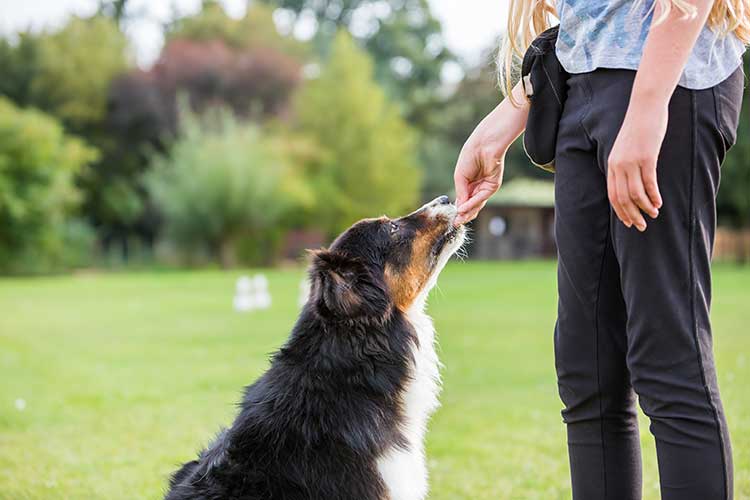
Positive Reinforcement Dog Training
Christian Müller/Adobe Stock

Every single day, I’m asked whether or not positive reinforcement dog training works. While many pet owners purposely pursue a positive dog trainer, there are still doubts written across their face. This is very evident when working with reactive dogs; many pet owners just don’t trust the dog training technique.

As with anything, there are pros and cons, but you’ll notice very few cons with positive reinforcement dog training. When doubt creeps in, tell yourself to trust the process because positive dog training really works.

What is Positive Reinforcement Dog Training?

Positive reinforcement dog training is when you reward your dog for a specific behavior, so the behavior will happen more often. When a dog sits, and he gets a treat, he learns to sit more often. Positive reinforcement works even when pet owners don’t suspect it.

Positive Reinforcement Examples

If you open a crate door, while your dog is barking inside it, your dog learns barking means you’ll open the crate door. Begging is a good positive reinforcement example too. If you feed your dog while he sits next to your plate, he learns that sitting close to your plate makes food happen. Yup, this is positive reinforcement too!

Positive reinforcement works in the human world too. We work for paychecks—that’s our reward for working hard. Pats on the back, bonuses and hugs are human rewards too. Super yummy treats are easily great dog rewards because everyone loves food. Praise, pats, fun games, tidbits from your dinner plate, escaping a boring crate or moving away from a scary dog are great positive reinforcement examples for dogs too.

Pros and Cons of Positive Reinforcement Training

Pros

  • Easy to do: You can’t make mistakes.; just reward behaviors you want to see more often.
  • Fun for dog and pet owner: Positive reinforcement is fun because earning rewards is fun! Celebrating wins are much more fun than digesting mistakes.
  • Extremely effective: Hands down, positive reinforcement works much faster than punishment-based dog training methods. Don’t believe me? Check out the latest research on teaching children. 🙂
  • Can be done anywhere: Dog training sessions can happen anywhere; just grab food treats and go!
  • You don’t need fancy equipment: Throw out choke chains, pinch collars and electronic collars. All you need are a handful of treats, a clicker and your dog! If you’re training your dog outside, attach a leash to your dog’s body harness.

RELATED: Clicker Training Game for Beginners

Cons (And Solutions)

  • Treat dependency: Dog will only work for treats.
    • This is an easy fix; just fade training treats once a dog understands a cue.
  • Withholding treats is frustrating: In the beginning, this can happen.
    • Again, this is a quick fix. Set a dog up for success and reward every single step toward a goal.
    • If needed, take a few steps back and build until the desired behavior happens.
  • What if you don’t have treats? Simple. Use praise, games and the happy dance to reward your dog for good behaviors.
Filed Under: Dogs, Puppies, Training Tagged With: best dog training methods, dog behavior, dog training, Dog Training Tips, how to train a dog, how to train a puppy, positive dog trainer, positive dog training, positive reinforcement, positive reinforcement dog training, positive reinforcement examples, positive reinforcement works, treat training dogs, treat training puppy

Dog Training: When & How To Add A “Down” Cue

May 12, 2017 by Fanna Easter

Adding the “Down” Cue

Dog Training Commands
lnichetti/Adobe Stock

When training your dog, it’s important to add a cue once the behavior has been fine-tuned. So often, pet owners will spend oodles of time training their dogs how to lie down, but fail to add a “down” cue to the behavior. Those who do use a training cue assume their dogs know what it means, but half the time their dogs don’t.

Dog training cues are vital when teaching a dog new behaviors because they serve as information for a dog. Check out these steps on when and how to add a “down” cue to the behavior.

Dog Training Commands vs. Cues

Dog training cues are a signal to perform a specific behavior. Many decades ago in the dog training world, cues were known as commands. Commands meant “do this or else” while cues signal information. Thankfully, the term “command” is considered outdated terminology and no longer used in dog training.

What to Use as Dog Training Cues

Cues can be anything. In dog training, cues are usually short verbal words or hand signals (either one or the other). Dogs learn contextual cues too, such as the presence of a leash means walks and the jingling of car keys means car rides.

Dogs usually respond to hand signals quicker than verbal cues because pet owners use hand signals consistently. Verbal cues are tricky because people say them differently, repeat the cue over and over, or add additional words.

When choosing a dog training cue, select a word or hand signal and use it consistently. If you’re using a verbal cue, use a flat tone. Imagine you’re giving directions to a stranger. High-pitched or low growl cues are confusing unless the pet owner uses this tone each and every time, which is very difficult for humans. Keep it simple and use your “follow these directions” voice. 🙂

When to Add a Cue

Most pet owners add training cues way too soon. When teaching a new behavior, it’s important to say nothing. Refrain from saying a cue during the learning process because the dog hasn’t learned the behavior yet.

Think about it this way: If someone is trying to teach you to stand on your left foot and continued repeating “mais,” you would get frustrated. Once you understand standing on your left foot makes it rain $100 bills and then someone said “mais” right before you stand on your left foot, you learn the meaning of “mais.” When practiced, you’ll quickly learn to stand on your left foot every time you hear “mais” because you know you’ll earn money.

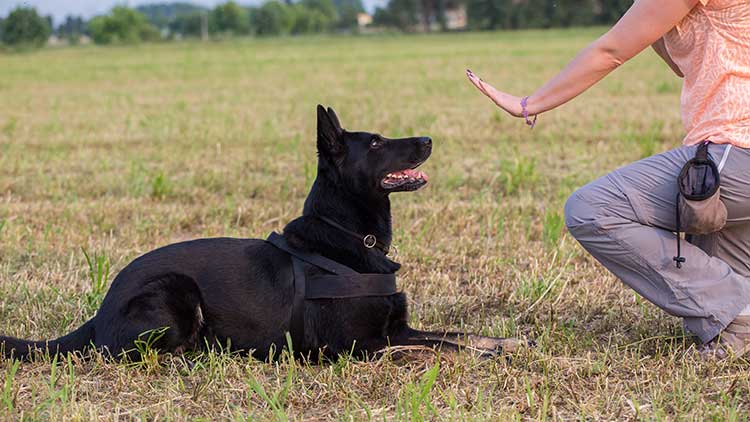
Once a dog will readily offer a “down” behavior 90% of the time, it’s time to add a “down” cue. Offering a behavior means a dog will lie down during a dog training session or can be easily lured into the behavior. Take a moment and think of a short word or hand signal cue for the next step. Ensure your entire family is precisely aware of the “down” cue and that everyone says or does the signal consistently.

How to Add a “Down” Cue

Grab a handful of pea-sized high value training treats, a clicker (or marker word, such as “yes”) and start a session with your dog. Right before your dog offers the desired behavior, give the “down” cue and click/reward the behavior. Practice this 3-4 more times, then end the training session. After a 5-10 minute break, practice adding the cue before the behavior 5 more times, then end the session.

If, for some reason, your dog offers a “sit” or “stand” when given a “down” cue, wait until your dog chooses to do the “down” behavior. The moment your dog finally lies down, click and reward. When this happens, your dog is learning exactly what the dog training cue means, and is brilliantly problem solving. Reward generously (give 2-3 treats) when your dog chooses to lie down.

RELATED: Healthy Dog Treats

Reward Cued Behavior Only

Once your dog will lie down when given a “down” cue, it’s time to reward cued behavior only. This is called stimulus control, and it’s an important step. If you miss this step, your dog will learn to walk right in front of the TV (during movie night) and “down” for a treat. 🙂

WATCH: How to Add a “Down” Cue

Filed Under: Dogs, Puppies, Training Tagged With: dog training, dog training commands, dog training cue, Dog Training Tips, down command dog training, down cue dog training, how to add command dog training, teaching a dog to lie down, teaching down command dog, teaching puppy down command, training cue

How To Teach A Small Dog To Lie Down

May 10, 2017 by Fanna Easter

Teaching a Small Dog the “Down” Behavior

Teach a Dog to Lie Down
cynoclub/Adobe Stock

The three most challenging dog behaviors pet owners struggle to teach their dogs are walking on a loose leash, coming when called and lying down on cue. Let’s discuss simple tips for teaching a small dog to lie down. Teaching a small dog to lie down can be challenging, and it’s much different than teaching a large dog.

First, You’ll Need a Few Things

You’ll need 20 pea-sized pieces of yummy treats, a clicker (or verbal marker, such as “yes”) and your dog. Before a dog training session, chop up treats and place them in a bowl or treat bag next to you.

OK, here’s the hard part: Remain silent when training your small dog to lie down. Don’t say “down,” “lie down,” “platz” or whatever the verbal cue will be—this will happen later. Speaking while teaching a new behavior interrupts the learning process. Can you imagine your French teacher babbling while teaching you specific French words? Talking muddles the water. There are two ways to teach a small dog the “down” behavior: using a food lure and capturing the behavior.

Using a Food Lure

In a low distraction area, such as your living room with the TV turned off and/or children napping, sit on the floor with your treats. If your dog tries to mug you, move the treats away. Now, take a treat in your hand and place the food lure right on the tip of your dog’s nose. Think of a food lure as a magnet stuck to your dog’s nose. As the treat moves, so will your dog’s nose.

Front Half Down

With your dog sitting or standing, place the food lure on the tip of your dog’s nose and slowly lower the treat straight down to the floor. A dog will follow the lure, but sometimes “fall off,” so move the lure slowly. (Of course, it’s totally acceptable for your dog to nibble on the food lure as you lower it.)

The moment your dog follows the food lure and the front half of his body is almost on the ground, click and give your dog the treat. Practice this 4-5 times, and end the session for 5 minutes or so.

RELATED: Can a Dog Be Too Food Motivated?

Back End Goes Down

It’s time to teach your dog to lower his entire body to the ground. Place the food lure on your dog’s nose, and lower it to the ground. Once he lowers his head, wait a few seconds for him to lower his rear end too and place his elbows on the ground.

If your dog pops back up into a stand, lure him down again and wait a few seconds. Usually, a dog will lower his rear end into a crouch, so click and reward this behavior. Continue practicing until his elbows touch the ground.

Capturing the Behavior

Many pet owners swear their small dogs just won’t lie down. Hmm, dogs have to sleep, right? Dogs lie around the house right? Capturing your dog lying down is a great way to teach your dog the “down” behavior.

Grab your dog training treats and bring your dog inside the bathroom. You may need to toss a few treats inside the bathroom to reassure your dog it’s not bath time. Now, close the door and have a seat on the toilet (yes, you can multi-task during this training session 🙂 ).

Watch your dog from the corner of your eye. The moment he lies down, click and toss a treat across the bathroom. Say nothing and wait for him to lie down again, then click and treat the moment he does. Practice a couple of times, and soon your small dog will lie down and look right at you. Reward it! 🙂

London Bridge

Sit on the ground with both legs straight out in front of you. Bend your left leg upward to form a triangle. Using your right hand, lure your dog under your bent left leg. As he crawls under your leg, he’s forced in a “down” position, so click and treat the moment this happens. Practice a few more times, then end the training session.

Next, Add a Cue

Practice teaching your small dog to lie down several times a day for 1-2 minutes. End the session by placing unused treats in the refrigerator for your next dog training session and putting your clicker in a drawer. Soon, your dog will offer a “down” behavior with neither food lures nor bent knees. When this happens, it’s time to add a verbal or visual cue.

WATCH: How To Teach A Small Down To Lie Down

Filed Under: Dogs, Puppies, Training Tagged With: dog training, down dog training, how to teach a dog to lay down on command, how to teach a puppy to lay down, small dog down, teach small dog how to lie down, teaching a small dog to lie down, teaching down dog training

How To Teach A Large Dog To Lie Down

May 8, 2017 by Fanna Easter

Teaching a Large Dog “Down”

Teach a Dog to Lie Down
mariedolphin/Adobe Stock

Teaching a large dog to lie down on cue can be challenging, especially during the early stages. If a large dog becomes easily excited, teaching him this behavior can really test someone’s abilities and patience. Check out two different ways to teach a large dog to lie down without putting your hands on your dog.

2 Ways to Teach a Large Dog to Lie Down

You should teach a large dog how to lie down first before adding a verbal or visual cue. It’s important to remain completely quiet when teaching this behavior, as chitter-chatter can slow down the learning process. As a general rule, it’s best to silently teach and reward the behavior. Once a dog readily offers the behavior, then it’s time to add a cue.

What You’ll Need

You’ll need lots of chunk-sized high value treats the size of a nickel as well as a clicker (or verbal marker, such as “yes”). Do not use your hands to teach a large dog “down.” Pushing or pulling teaches your dog nothing—it’s an outdated process anyway. Using hands or hand pressure will eventually make that a cue to your dog that’s impossible to fade. Plus, it’s hard to ask a dog to lie down from across a room if your cue is hand pressure.

Option 1: Using a Food Lure

With treats in a bowl nearby, grab a large treat lure and place it right on the tip of your dog’s nose. If he tries to bite at the treat, hold it in your closed hand with a bit peeking out (like holding a piece of chalk when writing on a blackboard). Think of the food lure like a magnet; as you move the treat around, your dog’s nose will follow.

Lower the Front Half

Have your large dog either sit or stand. Place the treat lure on your dog’s nose and slowly lower your hand straight down to the ground. If you move too fast, your dog will fall off the lure, meaning his nose is no longer on the lure.

Try again, and lower the treat down slowly and wait for your dog’s head to touch the ground. The moment your dog lowers his front half down, click or say “yes” and give him the treat lure. Practice 3-4 more times, and end the session for 5-10 minutes.

Lower the Bottom Half

At this point, your dog is in a praying position. He will readily lower his front half to the ground while following a treat. Now, it’s time to teach his bottom half to follow. Grab a large treat lure, lower it straight down to the ground and wait for your dog to lower his bottom half.

As soon as he crouches down where his bottom lowers down some, click and give him the treat. If your dog pops back up into a sit or stand position, it’s no big deal. Just place the food lure on his nose and try again. Continue practicing, so he gets lower and lower to the ground. Practice 4-5 more times, then end the session for 5-10 minutes.

Get Elbows Down

Grab a treat and lure your dog’s nose to the ground. Wait for your dog to lie completely down (elbows touching the ground). The moment his elbows touch the ground, click and give him the treat lure. Continue practicing and only reward complete “downs.” Remember, no visual or verbal cue has been added yet. If your dog remains lying down (smart dog!), reset him by tossing the treat about four feet away from him, so he must get up to eat the treat.

Option 2: Capturing the Behavior

For easily excited dogs, capturing a “down” behavior is much easier than luring with treat rewards. Grab pea-sized treats, a clicker (or use a verbal marker, such as “yes”) and your dog, then head to the bathroom. If your dog is hesitant to enter the bathroom, toss a few treats to convince him it’s not bath time. Once inside, close the door and have a seat (you can multitask during this practice session 🙂 ).

Just sit and wait. Your dog will eventually lie down. The moment his elbows touch the ground, click or say “yes,” and toss his treat about six feet away from his front legs. You should toss it far enough, so he must stand up to get the treat. Now, wait for him to lie down again and repeat. Your dog will immediately lie back down and look at you for a treat. Bingo! If this happens, immediately click and reward!

Practice Makes Perfect

Continue practicing the “down” behavior for 1 minute 2-3 times per day. If you captured the behavior, wait for your dog to lie down and click/reward immediately. Once a dog training session is over, put all unused treats in the refrigerator for your next session. Put your clicker in a drawer too. This signals to your dog that the training session is over.

If your dog lies down on his own after a session has ended, you can reward with praise or ignore. This will become much easier once your dog learns the “down” cue.

The Next Step

Once your dog will readily offer or lure in a “down” behavior, it’s time to add a verbal or visual cue. Watch the video below to learn how to add a cue to the “down” behavior.

WATCH: How To Teach A Large Dog To Lie Down

Filed Under: Dogs, Puppies, Training Tagged With: dog training, dog training down, down command dog, down cue dog, down cue puppy, how to teach a large dog to lay down, how to teach a large puppy to lie down, my dog refuses to lay down, teach a dog to lay down, teach a dog to lie down

The 3 Most Challenging Steps Of The CGC Test

May 5, 2017 by Fanna Easter

Tips for Passing the Canine Good Citizen Test

CGC Test
kichigin19/Adobe Stock

Completing and passing the AKC Canine Good Citizen (CGC) test is difficult for both dog and pet owner. To pass the CGC test, you have to do all 10 steps completely successfully.

The three most difficult steps are Sitting Politely For Petting, Reaction To Another Dog and the dreaded Supervised Separation. To best prepare your dog and yourself for the CGC, enroll in a CGC prep course, which lasts 6-7 weeks. This will give you plenty of time to practice.

The 3 Most Challenging CGC Steps

Sitting Politely For Petting

Sitting still is challenging for some dogs, and being petted by a friendly stranger makes it even more difficult to sit still. In the beginning, use high value food rewards and ask a friend for help. Move slowly and ask your dog to sit first. Then, ask your friend to take one tiny step toward your dog, and click/treat when your dog chooses to remain sitting.

Ask your friend to turn around and slowly walk away from your dog (like resetting almost). After a few seconds, have the person repeat this exercise again (one tiny step toward the dog). It may be helpful to place a strip of tape on the floor, so your friend knows where to start again.

Over a period of 4 weeks, slowly practice one step at a time with different friends until a person is able to stand next to your dog while he or she sits politely.

The next step is to introduce petting. As a friendly stranger touches the side of your dog’s neck or chest once, click as the pat happens. When the person walks away, give your dog a treat. Continue adding one pat at a time, and vary where your dog is petted. Now, practice with different people and in different environments, such as:

  • Your backyard
  • Your home
  • Vet’s office
  • Park
  • Sidewalk

Reaction To Another Dog

Most dogs get super excited when they see another dog and will pull toward him or her. To prevent this dog behavior from happening, enroll in a 4- to 6-week long group puppy training class and teach your puppy to focus on you instead of other puppies.

There are group adult dog training classes where you can practice the “look at me” cue. You can also practice during a 7-week CGC prep course. It takes a lot of practice, but teaching your dog to ignore other dogs is worth it!

Practice the “look at me” cue in various environments. Reward your dog with treats every time, then reward every other time once your dog gets really good at it. Continue weaning your dog from treats, and reward only really good performances, such as ignoring another barking dog. Remember, no treats can be used during a CGC test, so fading dog training treats completely before entering a CGC test is required.

Supervised Separation

Some dogs and pet owners ace every part of the CGC test except the Supervised Separation step. Expecting a dog to hang out with a stranger for 3 minutes is tough. Enrolling in a puppy and adult dog group class is invaluable, and will help prepare your dog and you for a CGC prep course.

During a CGC prep course, each dog will have ample time to practice supervised separation. You’ll also receive valuable tips from the instructor. Continue practicing at home by asking family members to hold your dog’s leash while you walk around the block. During vet visits, ask veterinary staff to hold your dog’s leash while you run to the bathroom. While your dog is hanging out, ask friends to play a game of “touch” for a few seconds. By pairing good things with scary things, your dog will soon learn to enjoy previously scary things.

Passing the CGC test is difficult. It takes time and lots of practice to learn polite manners. Spend extra practice time on these 3 challenging steps and complete a CGC prep course!

Filed Under: Clients, Dogs, Puppies, Training Tagged With: canine good citizen test, cgc test, CGC tests, dog training, Dog Training Tips, passing CGC, studying for CGC test, tips for passing cgc test

  • « Previous Page
  • 1
  • …
  • 14
  • 15
  • 16
  • 17
  • 18
  • …
  • 49
  • Next Page »

About

Dog Training Nation is a community of dog trainers, dog owners and dog lovers. Our mission is to provide trainers and owners valuable information to enrich dogs' lives. We cover a range of topics, from socializing puppies to dealing with aggressive dog behavior to selecting the best dog products. It is our hope you share our content to make the dog and owner world a better place.

​

Facebook

Video

Dog Training Nation is a dog training blog for pet owners and dog lovers. We cover a range of topics from puppy socialization tips to dog aggression to dog health. It is our hope you share our content to make the world a better place for dogs.

Dog Training Nation

Quick Links

Dog Training
Dog Behavior
Dog Training Videos
Become a Dog Trainer
About
Contact Us

Copyright © 2026 · Lifestyle Pro Theme on Genesis Framework · WordPress · Log in