Dog Training Nation

In Dogs We Trust

  • Home
  • Training
    • Dogs
    • Puppies
    • Clients
  • Behavior
    • Breeds
  • Health
  • Safety
  • Resources
    • Equipment
    • Books
  • Dog Training Videos
  • About
You are here: Home / Archives for dog training advice

Crate Training

July 16, 2014 by Fanna Easter

How to Crate Train a DogCrate Training a Puppy

In the dog world, there are many opinions on how to crate train your puppy and I’ll share mine. But first, I need to explain what crate training is not:

  • A crate is not used for punishment ever.
  • Dogs should not be left in their crates longer than 4 hours at a time. If you work an 8-to-5 job, please hire a pet sitter. Pet sitters are worth every penny. You will definitely get your return on investment. 🙂 You can begin searching and interviewing pet sitters here.

Keep these thoughts in your mind as I explain how to crate train your puppy or dog. 🙂

Choosing a Crate

  • A dog should be able to stand up, turn around and lay down comfortably.
  • For a fast growing puppy, choose a crate he can fit in as an adult. These large crates have a moveable divider so you can adjust as your puppy grows.
  • If a crate is too big (too long or wide), your puppy will sleep in the front and poop in the back- oops! 🙂
RELATED: Choosing a Dog Crate

Purpose of a Crate

  • Teaches your dog bladder and bowel control, and basically how to hold it.
  • Provides your pooch a relaxing and safe napping place and a getaway from distractions (visitors, children playing, etc.).
  • Serves as a secure and safe place to leave your puppy alone when no one is home (keeps him from chewing drapes, carpet, furniture, electrical cords, etc.).
  • Serves as a great tool when traveling with your dog!

Once upon a time, a puppy was left alone in the apartment all day (no crate was used). He chewed through the drywall and entered the next door neighbor’s apartment and destroyed his home too! Yes, it happened!

Training Your Dog to Go in His Crate

Plan on teaching your puppy these steps before you plan on leaving him alone. This will take 1-2 days to teach, depending on your training skills.

Step One

  • Start by tossing a treat in your puppy’s crate so he can walk in and eat it. Keep the crate door open so he can come right back out. Repeat this 10 times in a row.

Step Two

  • Toss a larger treat in the crate. As he enters and eats the treat, close the door. Once he is done eating his treat, open the door and let him out. Say nothing, as the reward is the crate door opening. Repeat this 10 times in a row.

Tip: Toss the treat in the back of the crate so your dog walks all the way inside the crate. Please don’t push your puppy inside.

Good girl, she goes in her crate!
Crate training. Good girl!

Training Your Puppy to Stay in His Crate Quietly

Step One

  • Hide treats in his crate (10 treats) and then open the crate door. Once your puppy goes in the crate, close the door behind him. Once he is done eating the treats, open the door so he can step out.

Step Two

  • Hide 2-3 treats in his crate and close the door after your dog steps all the way inside. Once he is finished eating these treats, throw a few treats in the crate with him (crate door is still closed). Throw treats five times in a row about 10 seconds apart. If you wait too long to give him treats, he will begin to whine in his crate. We want him to learn that staying in his crate quietly earns treats!

Step Three

  • Throw a larger treat (biscuit) in his crate and close the door once he walks inside. Take a few steps away from the crate, then walk over and toss one treat in the crate. Count two seconds silently (1 Mississippi, 2 Mississippi), walk over and toss another treat in the crate. Repeat until your dog can stay in his crate for 10 seconds (Move slowly. We don’t want him to whine!). After 10 seconds, toss a treat and open the crate door. Great job!

Step Four

  • Add a luscious food filled toy in his crate. He only gets this wonderful reward when he is in his crate. Toss the filled toy in his crate, walk away and let him enjoy!
RELATED: Puppy Training Classes

Troubleshooting

Barking/whining in crate:

  • Oops, if this happens, you moved too quickly with the above steps. Take a few steps back and begin again. If your dog is whining, don’t open the crate until he is quiet (opening the crate door is a reward).
  • Ensure your dog has plenty of exercise (a minimum of a 30-minute walk) before going in his crate.
  • Freeze his food stuffed toy so it will last longer.
  • If your puppy or adult dogs whine at night, bring him potty on leash, and put him back in his crate with a treat. You are not rewarding whining, as he may very well need to potty. We don’t want puppies to learn to potty in his crate. 🙂
  • If your dog is pottying on his crate bedding, remove it for a week until he learns to hold it. Once he understands to potty outside, you can add his bedding back.

 Barking at visitors when in crate:

  • Set up a bowl of treats about 6 feet from your dog’s crate.
  • Put dog in his crate.
  • When guests walk by, toss a treat into your dog’s crate and keep walking past him.
  • Have all guests play this game. Soon your dog learns guests equals treats.

Leaving your dog alone in crate:

  • Before leaving your puppy alone in his crate, exercise him mentally and physically.
  • Leave a frozen food stuffed toy in his crate anytime you leave. (A frozen food stuffed toy will help puppies while teething.)
  • Play soft music in the background. Dogs have excellent hearing. Try crinkling a potato chip bag when your dog is upstairs, he will come running! Help him tune out neighborhood dogs’ barking, nearby construction and sirens. I recommend Through a Dog’s Ear Music. I have the entire series and it works! I will admit it helps calm me too, especially when I’m stuck in traffic. 🙂
  • This may sound hokey, but spraying lavender has proven to calm dogs (and humans!). What will it hurt? At least your house will smell wonderful!
  • Another tool I recommend are Dog Appeasing Pheromone Sprays and Diffusers. Personally, I’ve had wonderful results and have a diffuser plugged in near my dogs’ crates. There is supporting research on DAP’s effectiveness.

In the comments below, tell us how you create a spa atmosphere in your dog’s crate.

READ ALSO: Dog Time Out

Filed Under: Puppies, Training Tagged With: crate training, crate training 101, crate training a puppy, crate training an older dog, crate training at night, crate training schedule, crate training while at work, crate training whining, dog training advice, how to train a dog, how to train a puppy

Keep Your Dog From Pulling By Teaching Collar Pressure

June 3, 2014 by Fanna Easter

How to Stop Your Dog From Pulling on Leash

Stop Dog From Pulling on Leash

This dog training tip will teach you how to properly train your dog using collar pressure techniques, which will stop your dog from pulling on leash.

Can you imagine moving your dog away from the door with two fingers while holding his collar or leash every time someone is ringing the doorbell? You’re probably thinking there may be no way your dog can do it, right?

Train your dog to understand collar pressure. If your dog pulls on leash or lead, this is one of the first steps to teaching polite leash manners. No more pulling and tugging on your dog’s collar or leash. He will learn to yield to this pressure! 🙂

Teaching Collar Pressure to Your Dog

When teaching dogs collar pressure, we’re not forcing a dog to move, but rather we’re teaching him to offer something different than an opposition reflex. We train him not to push or pull back against the leash pressure. Dog training should be done in a positive and patient manner. Don’t get flustered (remember yoga breath).

This dog training video demonstrates collar pressure training. Again, you’re teaching your dog to move with pressure; not pull against it. This is the goal of loose-leash walking in a nutshell.

Step 1: Make touching your dog’s collar a good thing.

  1. Touch your dog’s collar, then click and treat.
  2. Do this 10 times in a row.

Step 2: Apply pressure.

  1. Apply pressure to your dog’s collar in the opposite way of where he’s standing. Use light pressure, such as holding a door open. You’re not pulling hard per se, but more like restraining.
  2. Immediately click and treat when your dog follows the direction of pressure. As he moves toward the pressure, you’re no longer applying pressure to your dog’s collar.
  3. Do this 10 times in a row. Remember to click and treat each time your dog performs the intended behavior.

Step 3: Reward your dog for moving toward you.

  1. Touch your dog’s collar as if you’re moving him away from something, such as an open door.
  2. Immediately click and treat when your dog follows the direction of pressure (he moves toward your hand instead of pulling opposite of you).
  3. Do this 10 times in a row. Remember to click and treat each time.

RELATED: Choosing the Right Dog Trainer

Dog training involves repetitive actions. Always reward your dog with praise, a click or a treat when he performs the desired action. When a dog learns something new, it should be just like the old cliché: “Practice makes perfect.” Dog training does require repetition (pun intended). Got it?

WATCH: Teaching Collar Pressure

The goal in this training exercise is to move your dog simply by touching his collar. Always click and treat your dog for good behavior when training him. Now, try it with a leash. Use the above dog training steps!

You can train your dog to move in the direction of pressure on his collar using the same steps above. However, use a flat hand against your dog’s body. This works really nicely when trying to move dogs around in a tight space.

Can you use this behavior in your everyday life? Tell us about it in the comments section below.

Filed Under: Dogs, Training Tagged With: dog coughs when pulling on collar, dog pulls against collar, dog pulls on leash, dog pulls out of collar, dog training advice, Dog Training Tips

Training Pit Bulls

June 3, 2014 by Fanna Easter

Pit Bull Training

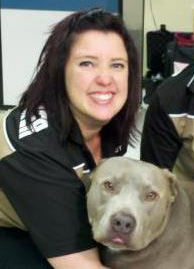
Pit Bull TerrierMany times, I’m asked if specific breeds like Pit Bulls are more difficult to train. When teaching dogs polite behaviors, about 90% is the same learning principles, which means all dogs are able to learn. So let’s discuss the differences between Pit Bull Terriers and other breeds of dogs.

Top 3 Pit Bull Terrier Behaviors

Polite Greetings

o   Dog Greetings: Some Pit Bulls can be snarky to other dogs, so it’s vital they learn to meet, greet or ignore other dogs. Not all dogs like to meet and play with other dogs, and we need to respect their requests. If we push too hard and force them to enjoy being around other dogs, they will quickly learn to bite other dogs to keep them away. This is true for all breeds of dogs.

o   People Greetings: Pit Bulls are large dogs and we need to teach them how to greet people politely. This means no jumping, body slamming or crawling into strangers’ laps. They should learn to sit when a person walks towards them. This is easy to teach: Person walks towards Pittie. If your Pittie jumps up, the person walks away. The person only walks towards Pittie when all four feet are on the ground or they are sitting. Voila!

Polite Leash Manners

Due to the large size of Pit Bull Terriers, they can pull you into parked cars or even traffic if they want to greet someone. Teach your dog that pulling does not pay off, as you remain still. If he does not pull, he can walk forward. I would recommend a front clip harness for most large dogs, as this harness controls pulling until you can teach your Pittie polite manners.

RELATED: Stop Your Dog From Pulling on the Leash

Body Handling

As with most large breed dogs, it’s important for Pitties to allow body handling, such as nail trims and people looking into their ears and mouth plus gentle restraint for blood draws. Touch your Pittie’s ear, then click and treat. Touch his nails, then click and treat. Do this for one minute each day for best results.

VIDEO: How to Train a Dog Body Handling

As with all breeds of dogs, Pit Bull Terrier owners need to socialize their Pittie puppies from an early age. They should meet lots of new people and dogs before 16 weeks old. Want to bring a Pittie into your home? Learn about the Pittie breed from a Dog Trainer’s Perspective. To learn more about Pitties and rescue, view Pit Bull Rescue Center and BadRap – Pit Bull Rescue.

Tell me about your Pittie and what polite behaviors you taught him!

Post pictures of your Pit Bull on our Facebook Page.

You may also like: American Pit Bull Terriers

Filed Under: Breeds, Dogs, Training Tagged With: american pit bull terrier, american pit bull terrier training, dog training advice, pit bull, pit bull training, pit bulls, pitbull, pittie

Rottweiler Training

June 2, 2014 by Fanna Easter

How to Train a Rottweiler

How to Train a Rottweiler
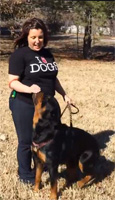
Sobek wearing his harness.

Rotties have breed specific behaviors. They were bred to herd livestock to market. Cattlemen would tie their earnings in a pouch around their Rottweiler’s neck for the walk home. This would ensure no one would steal their earnings.

Rottweiler training, as with all dogs, does not require responding with dominance or punishment-based dog training techniques. Rotties understand consequences and will respond quickly when set up for success. Pushing, pulling or forcing a Rottweiler to comply with a behavior while training will mostly likely result in a dog bite or your Rottie will become afraid of you. This is not our goal as Rottweiler owners.

RELATED: How to Train a Rottweiler

3 Rottweiler Behaviors Your Dog Should Know

    • Polite Greetings: Rottweilers are big and powerful dogs so they need to learn polite leash and greeting manners. Rottweiler training should begin when he’s a puppy. Exuberant jumping on people can be dangerous. That being said, your dog should learn to keep all four feet on the ground at all times.
    • Polite Leash Manners: Due to their large size, Rottweilers can lead you to places you wouldn’t want to be. When this happens, you want to teach your Rottie to not pull on his leash by remaining still. If your dog does not pull, then you may both walk forward. A front clip harness helps control pulling until you can teach your dog polite manners.
    • Body Handling: It is important to teach a Rottweiler to allow body handling, such as looking into his ears and mouth. Touch your Rottie’s ear, then click and treat. Touch his nails, then click and treat. For best results, do this for one minute everyday. The objective is to get him used to being handled when he is taken to the veterinarian.

VIDEO: How to Train a Dog Body Handling

Rottweiler Training Tips

You should socialize your Rottie at an early age. They should meet many people and dogs before reaching 16 weeks old. When watching Rottweilers play with other dogs, their play style is mostly like a bully breed. Rottweilers like to run full speed and body slam, hip check and shoulder check. Not all breeds think this is fun play so it’s vital to find dogs with similar play styles as a Rottweiler. Bull terriers, Pit Bulls and Rotties generally play in a similar way.

Rottweilers are not an aggressive breed. This is a myth that has been debunked. In my 20+ years of dog training, I have learned it’s not the breed of the dog. Rottweilers are an impressive and majestic breed. When they fall into the wrong hands, Rottweilers can be exploited.

Post pictures of your Rottie on our Facebook Page.

Learn about Rottweiler rescue at National List of Rottweiler Rescue Groups.
Find out more about Rotties at American Rottweiler Club.

Filed Under: Breeds, Dogs, Training Tagged With: dog training advice, how to train a rottweiler, rottweiler play, Rottweiler training, Rottweiler training tips

How to Train Your Dog to Park It

June 2, 2014 by Fanna Easter

Train Your Dog to Stay

One dog training cue that I strongly encourage every dog owner to train his dog to know would be to “park.” In a nutshell, this behavior means to stay with me while I’m doing something else. You can use these behaviors when:

  • Talking to someone at the park
  • Having guests over
  • Dining outdoors
  • Paying at the pet store or vet’s office
  • Listening to instructions

VIDEO: Train Your Dog to Park

You can use the dog park behavior when your dog becomes overwhelmed by another barking dog or excited in a new situation. You are teaching him to bring his arousal level down. It’s like taking a yoga breath for your dog. Having him know the ability to remain poised and look to the dog owner for approval before chasing or barking is key to a safe and calm interaction with other dogs, people or animals.

When teaching hyperactive dogs to be calm, many folks ask them to sit still. This is tough, as they are learning how to manage their extra energy and excitement. I want to set you and your dog up for success and asking for a rock solid stay or wait is not fair so let’s ask for something easier, such as park.

Let’s look at it from a human perspective. Have you been with a friend who meets up with another friend and you are not part of the conversation? It’s awkward, but it happens. Now, what if your friend asked you to sit on a bench and wait until their conversation is over? You can not check your Facebook page or text messages, you just watch them. Wow, I could not do it! Same thing for your dog. Let him walk around and occupy his mind by sniffing around and looking around if he wants to (as long as he is not pulling on the leash). Voila! You’ve parked your dog!

Don’t get this behavior confused with wait, as you’re not asking your dog to sit or down in one spot. I think of wait as a pause button. You stay in that position until released. Stay means you are asking the dog to sit or lay down until you pick him up or call (releasing him from the cue) to come.

Why are there so many words in dog training for similar things?

We need to clear up any confusion for our dogs. If I asked you to turn, you will ask which way (left or right), in a circle, just my head or my entire body. Let’s make sure we communicate clearly to our pooches. I think they will appreciate it. 🙂

Just by teaching this simple behavior, you are teaching your dog:

  • Self control (teaching your hyper dog to relax)
  • Polite greetings to people (not to jump on people)
  • Polite leash manners (not pull on the leash)
  • How to ignore other dogs
  • To stay
  • Not to bark

How to train a dog to park:

  1. Step on your leash about halfway up to your dog. He should have 3-4 feet of extra leash.
  2. Click and treat your dog the instant the leash becomes loose. Example: Your dog is pulling to visit another dog. Wait until the leash becomes loose and click/treat!
  3. Bingo. You are rewarding calm and quiet behavior!

This is very easy to teach. Just make sure you practice this behavior 1-2 minutes per day. Also, this is the first behavior you practice in the park before a walk and when guests come over.

Subscribe to our channel on YouTube for more dog training videos.

Have a comment? Tell us how the “parking your dog” behavior can be useful for you in the section below!

More on parking your dog:
Learn How to Park Your Dog
How to Park Your Dog

Filed Under: Dogs, Training Tagged With: dog, dog training, dog training advice, dog training tip, how to train a dog, how to train a puppy

  • « Previous Page
  • 1
  • 2
  • 3
  • 4

About

Dog Training Nation is a community of dog trainers, dog owners and dog lovers. Our mission is to provide trainers and owners valuable information to enrich dogs' lives. We cover a range of topics, from socializing puppies to dealing with aggressive dog behavior to selecting the best dog products. It is our hope you share our content to make the dog and owner world a better place.

​

Facebook

Video

Dog Training Nation is a dog training blog for pet owners and dog lovers. We cover a range of topics from puppy socialization tips to dog aggression to dog health. It is our hope you share our content to make the world a better place for dogs.

Dog Training Nation

Quick Links

Dog Training
Dog Behavior
Dog Training Videos
Become a Dog Trainer
About
Contact Us

Copyright © 2026 · Lifestyle Pro Theme on Genesis Framework · WordPress · Log in