Dog Training Nation

In Dogs We Trust

  • Home
  • Training
    • Dogs
    • Puppies
    • Clients
  • Behavior
    • Breeds
  • Health
  • Safety
  • Resources
    • Equipment
    • Books
  • Dog Training Videos
  • About
You are here: Home / Archives for Dog Training Tips

Teach Your Dog to Wear a Sweater

November 11, 2015 by Fanna Easter

How to Train Your Dog to Wear a Sweater

Dog Sweater
michellegibson/iStock

You’ve scoured the Internet looking for the perfect sweater for your dog and it finally arrives. Now is the real test. How does it look and will your dog wear it? After stuffing your dog into his new sweater, he refuses to walk forward. Yup, this happens a lot.

Most dogs will either stand still, pancake to the ground, or, worse, run and hide. Some dogs will growl while you’re trying to stuff them in the sweater. They’re not happy. Understand wearing clothes is totally new to your dog. If you ran around naked most of your life and then someone stuffed you into a tight turtleneck sweater, you would cringe and stiffen up too. Thankfully, we can teach dogs wearing sweaters is a good thing!

Fit is everything when it comes to dog sweaters. You can’t expect a dog to enjoy wearing a sweater if it impacts his movement.

RELATED: Fit Matters When Choosing a Dog Sweater

Dog Sweater Means Treats

Take your time introducing the sweater to your dog, especially if you plan to purchase an extensive wardrobe for your pooch! Teaching your dog to enjoy putting on and wearing a sweater (or clothes) ensure proud prancing while wearing fabulous garments.

Putting It On

Before training your dog to wear a sweater, you’ll need several super yummy treats and your dog’s new sweater. Better yet, practice with an older sweater or a child’s shirt. This prevents stretching and stains.

Head First

Bunch up the fabric, so only the neck portion is visible. Hold the neck hole in front of your dog’s face and hold a treat on the opposite side. Basically, your dog will follow the treat through the neck hole. Once the sweater is around your dog’s neck, give him the treat. Now, stop there and take the sweater off your dog. Practice teaching your dog to push his head through the neck hole and reward every time.

Now the Body

After a couple of sessions, lure your dog’s head through the neck hole. Give your dog a treat as you pull the sweater over one leg at a time. Sometimes, it’s easier having a person hold a spoonful of peanut butter in front of your dog, so he can lick away while you’re maneuvering the sweater in place.

If your dog backs away when putting on the sweater, allow him to collect himself for a few minutes and decide if he’ll engage again. If he’s confused, go back to luring his head through the sweater neck hole and move slowly.

Wearing It Proudly

Once the sweater is on, have a party! Good things happen when wearing a sweater, so clap, speak in happy high-pitched tones and, of course, reward with lots of super yummy treats. Then, take the sweater off and end the party. Seriously, who wouldn’t want to put the sweater back on, right?

If your dog refuses to walk forward, sprinkle a few treats about a foot in front of your dog like a trail. This will surely get him moving. Keep sprinkling treats until he’s walked a few feet. Don’t forget to have a party while he’s wearing it. Once the sweater is off, the party stops. Keep practicing, and soon your dog will run toward his new sweater, happily stick his neck through the hole and walk around proudly!

If you take your time, your dog will love his sweater! Have a sweater party!

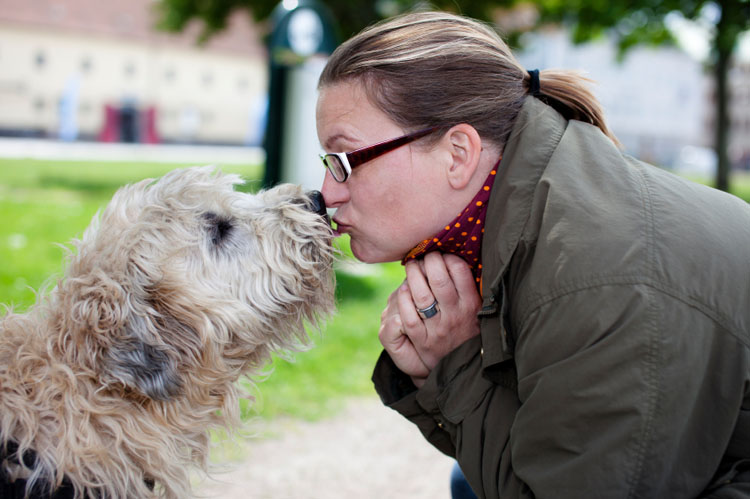
You may also like: Training Your Dog to Give Kisses
Filed Under: Dogs, Equipment, Puppies, Resources, Training Tagged With: dog hates sweater, dog hates wearing clothes, dog training, Dog Training Tips, dog wear clothes, dog wear sweater, get dog wear coat, get dog wear sweater, how to teach a dog, how to train a dog, puppy wear sweater, teach a dog, teach dog wear sweater, train a dog

Training Your Dog to Give Kisses

November 5, 2015 by Fanna Easter

Get Your Dog to Give Kisses on Cue

Training Your Dog to Give Kisses
Multiart/iStock

Who doesn’t love a big wet kiss from their dog? Okay, maybe there are a lot of you out there who would rather not receive a wet one, but maybe you know someone who loves receiving kisses from her dog. Well good news! You can train your dog to give kisses on cue, allowing you to clearly communicate to your dog when he is welcome to give kisses.

What You’ll Need

• Treats – I suggest using something that can easily slather onto your hand, such as peanut butter, cream cheese or a roll on treat.
• Training Location – Begin your dog training in a quiet, distraction-free area. This will help your dog learn quickly.
• Marker – Choosing a marker is very important, as this is what informs your dog he has made the right choice and performed the desired behavior. A marker or conditioned reinforcer is a word or sound that you’ve associated with a reward, such as “good” or” yes” or clicker.

How to Teach Your Dog to Give Kisses

Once you’re all set up in your training area, start with a hungry and calm dog. The reason I say to work with your dog while he’s hungry is because you want him to be motivated to work for the food reward. You also don’t want him to be full of energy, so he can focus better.

Step One

Put a small amount of your lure (peanut butter) in the palm of your hand or on the back of your hand, and then present your hand to your dog. Once your dog shows interest in the food, give your marker word “good” and provide your dog with a secondary treat from your pocket. Most dogs will give your hand a lick when they smell the yummy lure in your hand. If this is the case, you don’t need to provide a secondary reward; just give your marker word “good” and allow the lure to be his reward.

Practice this step in small sessions multiple times a day for the next couple of days. Once your dog becomes fluent with the lure, you can move onto the next step.

Step Two

Begin to fade the lure by only using a very small amount of peanut butter on your hand. Add the cue while your dog licks your hand (kisses) and mark the behavior with “good.” The key to fading the lure and adding the cue is to only use the food lure intermittently, meaning you don’t need to reapply the peanut butter right away if your dog licks the reward off the first time. You can reward with a less valuable reward like a Charlie Bear or soft dog treat. Once your dog does the behavior without or with little food, you can move to the next step.

Step Three

Now, you’re ready to begin training your dog to give kisses on cue. Continue to practice in the same place without distractions to facilitate success, present your un-baited hand and give your cue “kisses.” When your dog performs the behavior, give your marker word “good” followed by a high value reward! Once your dog is 90 percent compliant with performing the cue on command, begin fading the reward like we discussed above.

Enjoying Your Dog’s Kisses

Once your dog becomes fluent with this new behavior, you can really use it in any capacity you’d like: as a fun trick to show your guests, a normal greeting routine for you and your pup, a way to tell your dog you’ve had enough kisses or even a way to wake your family members up when they won’t get out of bed!

READ NEXT: How to Help Hand Shy Dogs

Filed Under: Behavior, Dogs, Training Tagged With: dog kisses, dog training, Dog Training Tips, how to teach a dog, how to train a dog, teach a dog, train a dog, training your dog to give kisses

Dog Breed of the Week: Chow Chow

October 30, 2015 by Fanna Easter

Chow Chow Dog Breed Information

Chow Chow
Bokstaz/Deposit Photos

The Chow Chow has a very distinctive look almost like a little fluffy bear! Chow Chows are well-known for their black tongues and curled up tails. They have a lifespan of eight to 12 years with some health concerns you want to be aware of. Some of the major health concerns include CHD, entropion and patellar luxation. The few minor concerns are elbow displasia, cataract, gastric tortion and glaucoma. To help ensure you’re getting a healthy dog, it’s wise to pair up with a reputable breeder who does health checks on their dogs. If you choose to go the adoption route, there are tests available to find out the dog’s health.

Chow Chow Temperament

Chow Chows are part of the AKC Non-Sporting Group with their original function being guardians and today’s function being a companion. You will find the Chow to be dignified, reserved and weary of strangers, making them great guard dogs. They also tend to be serious and inexpressive dogs, which may not make them the best dog for children. The Chow stands anywhere from 17″ to 20″ tall and weighs between 45 to 70 pounds.

Dog Grooming Requirements

Chow Chows either have a smooth or rough coat. Despite the texture of their coat, all Chow Chows have a thick undercoat that provides them insulation from the cold. Dog grooming requirements for a smooth-coated Chow are minimal. However, rough-coated Chows require more grooming, such as regular brushing and bathing. These dogs don’t do well in really hot, humid weather because they have such a thick undercoat. If you do happen to live in a humid climate, then your Chow should have a way to stay cool, such as a kiddy pool, your house or even a temperature-controlled dog house.

RELATED: Heavy Duty Dog Shampoo

Exercise and Dog Training

Chow Chows don’t require extensive exercise, but they do require regular outdoor activity such as morning or evening walks. Providing your dog with daily exercise will facilitate a calmer and healthy attitude, allowing you to be more successful when it comes to training. Dog training can be a little difficult with this dog breed, as they tend to be reserved and unemotional, but by no means does this mean they’re not trainable.

You need to find out what motivates your particular dog. Most dogs with these types of personalities don’t take well to corrective negative training techniques. You’ll have much more success using positive reinforcement training techniques instead. I have not only trained, but also owned Chow Chows and only used positive techniques when training.

With any dog breed, there are pros and cons. It’s important your chosen dog’s personality and functions meet the needs of you and your family. Not all dogs are perfect for every home, so doing research and educating yourself on the breed you’re considering will help you find the right dog for your family. After all, you’re adding another member to your family! For more information on the Chow, please check out the links below.

Chow Chow


http://chowclub.org/ccci/

You may also like: Chinese Crested Dog

Filed Under: Breeds, Dogs, Training Tagged With: chow chow breed information, chow chow dog, chow chow dog training, dog training, Dog Training Tips, how to teach a dog, how to train a dog, teach a dog, train a dog

Dog Trainer Confession: Puppy Playtime is Not For All Puppies

October 27, 2015 by Fanna Easter

Puppy Playtime Isn’t as Great as You Think It Is

Puppy Play
Fred De Bailliencourt/iStock

Trust me, I’m quite aware I’m treading on the newest trend in the pet industry and totally understand many dog training experts feel puppies must be exposed to “safe” playtime during their younger months. I also understand the concept of puppy play and its positive outcomes, but it doesn’t always work out well. While it sounds lovely in theory, puppy playtime is not all sunshine and roses from a dog trainer’s perspective.

The Magical Unicorn of Proper Play Sessions

Most puppy playtime sessions happen before, during or after puppy manners class. There are some locations that offer additional puppy play sessions separate from class time, which focuses on socializing puppies for 30 minutes to an hour.

In concept, puppies play with other puppies their same age or younger than four months old under supervision. Some puppy play sessions are separated by size, and others are further divided by play style. Before engaging in puppy playtime, puppies are temperament tested to ensure they play well with others. Sounds perfect, right? This is not reality.

RELATED: Choosing the Best Doggy Day Care

Safety is Impossible to Achieve Without Hurt Feelings

In a class of 8-10 puppies, there will be one or two that don’t play well with other puppies. These puppies just don’t want to be bothered with all the commotion or are simply terrified. Yes, in a perfect world, puppies should learn how to nicely disengage from playtime, but some puppies are relentless.

Personally, I don’t allow a puppy to be bullied by other dogs. It’s not fair and will teach terrible behaviors in the long run. Explaining to dog owners their puppy is no longer allowed to play with puppies is gut-wrenching. Of course, we do what’s best for the puppy at the time, but understand that dog owners have a hard time digesting this message. We would be a fool to chastise a dog owner, especially one who’s trying to do the right thing.

Somehow, society has told dog owners that if your puppy doesn’t want to play with other puppies, then something is wrong. This is not true. Forcing puppies to play together because someone says it’s good for them doesn’t make sense. Dogs and puppies are individuals, and each puppy should have his own training plan according to his personality. Assuming all puppies will get along is like assuming all humans will get along in a crowded freeway. That’s just not going to happen. Just because someone says it, it doesn’t mean we must follow it. I refuse to simply “just drink the Kool-Aid.”

Now, I’m not saying puppy playtime is evil and will hurt puppies, and it should be bashed so the feelings of pet owners aren’t hurt. I live in the real world, and as much as I hope for perfect puppy play, I don’t really see it often. I believe puppies should be able to choose to play. It should never be forced. 

Research and question everything. Do what’s right for your puppy or dog, trust your gut feeling, and when in doubt stop the behavior.

Playtime Won’t Cure Aggression or Fear

Nope, it won’t. Every once in awhile, an experienced dog trainer may pair a frightened puppy with a super sweet, gentle puppy. If done correctly, the scared puppy will learn the ropes slowly with the gentle puppy encouraging him along the way. Now, this is not common. In the real world, puppies are expected to get along. If they don’t, dog owners are somehow convinced their puppy needs to find the right puppy to “teach their puppy a lesson,” which never ends well. Continuing to place a fearful puppy in a play session will only terrify him further just like allowing a rude puppy to continue bullying other puppies or terrorize fearful puppies will only teach him to become dog aggressive.

Searching for that one puppy that will “teach your puppy a lesson” is like playing Russian roulette. Most scared or pushy puppies learn aggression works, and it works quickly.

If Your Puppy Doesn’t Play, It’s Okay!

Sometimes, I wish for the old days of when puppies attended puppy class on leash and learned polite behaviors instead of playing. Back in the day, puppies learned their humans bring wonderful things, polite manners and ways to easily ignore distractions around them. Puppies learned to walk nicely on leash and ignore bouncing puppies next to them in exchange for food rewards.

I do feel the pendulum has swung too far. We now live in a society of dogs obsessed with greeting everyone. They’ll pull toward, stare, whine, lunge or drag their pet owners toward dogs, children and people. Being on the other side is scary; even I’m not comfortable watching a dog yank his pet owners toward me.

Remember, socializing puppies doesn’t mean they must play with other puppies. If your dog isn’t comfortable, listen to him.

Want to Hear a Dog Trainer’s True Confession?

We don’t allow our puppies to play during playtime. Instead, we teach puppies to focus on us when hearing their name. We teach them to sit still during greetings, come when called and, of course, enjoy free time during manners class where we play with them and not other puppies. We certainly don’t bring our dogs to dog parks, but that’s another rant. 🙂

Be your puppy’s voice. If he’s not enjoying playtime, pick him up and end the session. You owe no one an explanation; it’s your puppy.

Filed Under: Puppies, Training Tagged With: allow puppy play, dog training, Dog Training Tips, fearful puppy, how to teach a dog, how to train a dog, meeting puppy, playing puppies, playing puppy, puppy aggression, puppy doesn't like play time, puppy dog park, puppy play with puppy, puppy playtime, puppy scared, teach a dog, train a dog

How to Stop Your Dog From Barking Out Windows

October 19, 2015 by Fanna Easter

Dog Barking at Windows: It’s Not a Good Thing

How to Stop Dog Barking
JennayHitesman/iStock

Recently, we started walking our dogs on the weekend through our new neighborhood. A cul-de-sac and grass-edged sidewalks are a bit different for us. We’ve lived downtown for so many years, we thought we would enjoy the slow-paced suburban life for a while. Well, walking dogs through a neighborhood is not as peaceful as walking downtown. I was pretty shocked at the difference. The main factor is bored suburban dogs are allowed to bark aggressively at walkers behind windows. Some dogs even chase walkers from window to window in their home.

Why Dogs Barking Out Windows is a Problem

Dog owners mistakenly assume their dogs are daydreaming on the window edge, watching squirrels dash and wagging as people walk along the sidewalk. However, this is not reality. Allow me to explain what’s really happening.

Dogs will do anything to cure their boredom, but their new hobby may drive you and your neighbors crazy. It’s not fair for dog owners walking their leashed dogs on public sidewalks to be threatened by a barking dog. It’s downright rude and not appreciated by fellow dog owners.

Understanding the Different Perspectives

Pedestrians

When a dog barks out the window when someone walks by, it’s jolting for the pedestrian. It doesn’t depend on the barking dog’s size–even a small barking dog is scary. I’ve witnessed everyday runners without dogs shake their heads in disappointment. No one deserves to be threatened by a lunging dog, even if your dog is behind a window.

Dogs Walking With Owners

Dogs walking with their pet owners are probably the most affected by dogs barking through windows. It’s pretty darn scary to them. Think about it from a human perspective: what if you’re walking along, minding your business and an angry person opens her curtains and starts screaming from inside her home? Then she shouts obscenities to you, staring angrily, flipping you off and beating on the glass, as you pass by. Then it continues, even after you’ve walked away from her home, you can still hear her screaming and beating on the glass. Yeah, I would call the police.

As a dog trainer, I’m the one consulted to teach the dogs minding their own business during walks how to overcome such obstacles. And it can take months. Please don’t allow your dog to harass others.

Your Neighbors

I wouldn’t be surprised if this situation hasn’t already been reported to your Home Owner’s Association (HOA) or even the police. I promise you your window-barking dog is earning a terrible reputation. If anything ever happens, your neighbors will report your dog as aggressive. Yes, it’s hard to hear, but you deserve to understand what’s said behind your back.

As a fellow dog lover who lives in a dangerous dog society as you, you’re most certainly not helping a dog’s image.

Your Dog

This is a terrible behavior for your dog to practice. It not only teaches him to bark at everything that walks by, but it also increases his stress level. Plus, window-lunging dogs learn barking makes the moving object go away, which makes the behavior worse and likely to happen more often. You may have probably noticed your dog charges toward your visitors when they walk in the door. This is the behavior your dog taught himself when barking at strangers through your window.

RELATED: Training Dogs Polite Greeting Behavior

How to Stop Dog Barking Out Windows

If your dog runs toward the window to bark, I urge you to stop this behavior now. Here are a couple of solutions that work even when you’re not home.

Management

Make sure your dog doesn’t have access to sidewalk-facing windows. It’s the quickest way to stop this unwanted behavior, especially while you’re away from home. Place sturdy baby gates in hallways to restrict your dog’s access or crate your dog when you’re not home.

As you’re probably well aware, closing heavy curtains or blinds doesn’t work, especially if used as a management tool alone. Most dogs will shred them in a frenzy to view through a window. However, closed curtains coupled with restricting baby gates are quite effective.

Relieve Boredom

Just like children, when dogs are bored, they can easily cause havoc. When you’re going to leave your dog home alone all day, hide frozen food stuffed toys throughout the house to provide your dog plenty of mental stimulation. Or better yet, hire a dog walker for a noon walk. Walks not only provide mental stimulation, but physical exercise as well.

Redirection is Your Friend

In a quiet location, teach your dog the “touch” game. “Touch” is when a dog walks toward you and touches his nose inside your hand. This is a great way to ask your dog to do something else rather than bark out the window. It’s essential to practice in a quiet place, so your dog understands the behavior thoroughly before using it as a redirection tool.

With management in place and lots of practice under your belt, ask your dog to “touch” the moment he hears someone walking past your home. If your dog starts barking, it’s too late. When your dog turns toward the front windows with his ears perked up or takes a step toward the front, say “touch” and reward your dog heavily when he responds. Always use super yummy treats and reward often. When I say reward heavily, I mean give your dog five pea-sized treats one after the other.

After lots of practice, you’ll soon notice your dog walking toward you when he hears someone walking past your home. Reward heavily!

If your friend or neighbor has this issue, please print this article for her. If it’s someone you don’t know, print and place in her mailbox. I firmly believe people do better once they know better. 🙂

Filed Under: Clients, Dogs, Safety, Training Tagged With: dog aggressive at window, dog bark out window, dog bark sounds, dog barks at other dogs, dog barks at passerby, dog barks at window, dog chases window, dog training, Dog Training Tips, how to teach a dog, how to train a dog, teach a dog, train a dog

  • « Previous Page
  • 1
  • …
  • 29
  • 30
  • 31
  • 32
  • 33
  • …
  • 43
  • Next Page »

About

Dog Training Nation is a community of dog trainers, dog owners and dog lovers. Our mission is to provide trainers and owners valuable information to enrich dogs' lives. We cover a range of topics, from socializing puppies to dealing with aggressive dog behavior to selecting the best dog products. It is our hope you share our content to make the dog and owner world a better place.

​

Facebook

Video

Dog Training Nation is a dog training blog for pet owners and dog lovers. We cover a range of topics from puppy socialization tips to dog aggression to dog health. It is our hope you share our content to make the world a better place for dogs.

Dog Training Nation

Quick Links

Dog Training
Dog Behavior
Dog Training Videos
Become a Dog Trainer
About
Contact Us

Copyright © 2026 · Lifestyle Pro Theme on Genesis Framework · WordPress · Log in
