Dog Training Nation

In Dogs We Trust

  • Home
  • Training
    • Dogs
    • Puppies
    • Clients
  • Behavior
    • Breeds
  • Health
  • Safety
  • Resources
    • Equipment
    • Books
  • Dog Training Videos
  • About
You are here: Home / Archives for how to train a dog

5 Fun Stocking Stuffers For Your Dog

December 7, 2015 by Fanna Easter

Stocking Stuffer Ideas For Dogs

Stocking Stuffers for Dogs

Stash a few fun and interactive toys in your dog’s Christmas stocking this year. Our dogs rely on us for entertainment; they don’t have TVs, laptops or phones. It’s up to us to keep them mentally fulfilled daily. All five stocking stuffers below will keep your dog busy for hours. Plus, a few can be fun games that can be played anywhere anytime.

During the peak of the holiday season, aim to play with or provide a food stuffed toy to your dog at least twice a day. This will keep your dog happily fulfilled, as you chat away with Aunt Edna over Christmas yams.

Pickle Pocket Toy

It’s lime green, flexible, easily washable, and it has crevices for hiding food. What more could you ask for in a stocking stuffer, right? The Pickle Pocket toy is perfect for dogs that are super skilled at removing food from toys. This dog toy takes lots of patience and persistence; that’s for sure.

Smear peanut butter, cream cheese or yogurt into each crevice and freeze overnight. Your dog will have to dig in the toy for hours. Make it harder by stuffing hard treats deep into the crevice pockets; your dog has to work really hard to loosen those treats. As a rule, the Pickle Pocket seems to be easier for smaller dogs and a bit challenging for larger dogs. If it’s too complicated and your pooch gives up, bring out the Kong toy.

Tug Toy on a String

Tug toys on a string are much more fun than a regular tug toy and they’re totally portable! This dog toy has a plush squeaky toy at the end of a long rope, which you fling around the yard (or living room), as your dog stalks, bounces and chases it. Think of it as fly fishing; you bounce the line around, mimicking a running squirrel, while your dog has a blast.

While playing with tug toys on a string, keep the plush toy ground level. This prevents dogs from springing up and injuring themselves. You’ll be shocked how quickly this wears your dog out, so keep sessions under 10 minutes. If your dog catches the toy, but refuses to give it back, check out this video demo for tips.

WATCH: Teach Your Dog The Tug Game

Bubbles

So often, I simply forget dogs love to chase bubbles. Choose bubbles specially made for dogs, as many toy store options contain toxic chemicals. Some bubbles are even peanut butter scented, so make sure to give those a try.

To get started, blow a few bubbles at your dog’s level (shoulder height) so she can see them floating past her. Many times, dogs don’t really know to look up, so blowing bubbles over their heads is useless. Once your dog is focused on the bubbles, start blowing them higher.

RELATED: Under $20 Dog Gift Ideas

Bully Stick Chew

For the most part, bully sticks are easier to digest. When giving your dog a bully stick, make sure it’s big enough for her to chew and not swallow whole. This stocking stuffer needs supervision, so make sure you’re watching your dog when she enjoys her chew toy. During the holidays, once festivities have slowed down, I’ll bring my dog into the family gathering to chew her bully stick. As I’m chatting away, I’ll hold one end of the bully stick, so my dog can happily chew the other end. This way, I’m able to keep my dog entertained while I chat with family.

Please don’t give your dog rawhide even if it’s candy cane-shaped or red-and-green-colored. Rawhide is downright dangerous, as it’s one of the main causes of intestinal obstructions. Don’t believe me? Ask your vet. 🙂

Good Ol’ Tennis Ball

The tennis ball is a tried-and-true toy of the ages, which makes it the perfect stocking stuffer. Most dogs will lose their biscuits for a quick game of toss. If your dog is mad about playing ball, the holidays are a perfect time to replenish your supply. For most dogs, tennis balls are usually the most loved. Just make sure to supervise your dog around tennis balls, as these objects can be easily chewed and swallowed.

Happy Holidays! Don’t forget to hug your dogs!

Filed Under: Clients, Equipment, Games, Resources, Training Tagged With: best dog stocking stuffers, christmas dog ideas, dog christmas gifts, dog stocking stuffer, dog stocking stuffer cheap, dog stocking stuffer ideas, dog training, Dog Training Tips, how to teach a dog, how to train a dog, pet stocking stuffer ideas, teach a dog, train a dog

How to Teach Your Golden Retriever Polite Behaviors

December 4, 2015 by Fanna Easter

Training Golden Retrievers Polite Behaviors

Training Golden Retrievers
Bigandt_Photography/iStock

Golden Retrievers are one of my favorite dogs to work with. They’re outgoing, driven, and usually pretty food and toy motivated. Over the years, I’ve worked with a number of Golden Retrievers, but unfortunately, I’ve never had the pleasure of sharing my home with one. Working with them on a regular basis has given me great insight into their common characteristics and behaviors. Hopefully, that can help you live more comfortably with your Golden Retriever.

Not-So-Polite Golden Retriever Behaviors

All dog breeds have their quirks and differences just like people. Becoming familiar with what is considered normal breed behavior will help you tailor their behavior to your lifestyle. With Golden Retrievers, you may deal with a lot of mouthy behaviors, such as always picking up unacceptable items or mouthing your hands while playing, petting or greeting. Let’s talk about how to make some of these Golden Retriever behaviors a little more manageable.

Always remember: with any unwanted behavior, you want to provide your dog with an acceptable behavior.

Mouthing (Putting Mouth on Your Hands)

In this case, we want to provide your Golden Retriever with proper chew toys and retrieval items, such as Kongs, Nylabones and retrieval toys for play. To help prevent your dog from mouthing you during playtime, only interact with him with his toys. This way, when your dog mouths you during petting, you can redirect his attention with your hand that contains the food treat while you pet with your other hand.

Sometimes, Goldens can become fascinated with mouthing unacceptable items. However, we can help them make the right choice by making the unacceptable item less intriguing. You do this by using a chewing deterrent on the unacceptable items, which may be your keys, remote controls or shoes. Be sure to follow the directions on the bottle. Most of the deterrents are water-based, so you most likely need to reapply every couple of days.

Now that you’re providing your dog with the appropriate chew toys and deterring them from the unacceptable items, make sure you praise all correct behavior to increase the likeliness of your dog repeating it.

Excitable Greetings (Jumping Up)

Excitable greetings are nice to come home to because you can tell how happy your dog is to see you, but on the other end of the leash it’s not so nice of a behavior when you’re carrying groceries or you have a guest coming over.

Again, teaching an alternate behavior is the best place to start; in this case, it’s the “sit” behavior. Start in a low distraction area. Use a high value food reward to lure your dog into the behavior and reward once he successfully sits. Gradually fade the lure after many dog training sessions and begin asking for the behavior in lieu of the jumping.

Another great tool you can use to gain more control of your dog during walks is the head collar or front clip harness. These dog products help you redirect your dog on walks and allow you to ask for the known “sit” behavior instead of him jumping on people.

All dogs have their own personalities and characteristics. It’s all about figuring out how to live more harmoniously with your specific dog breed and enjoying all the great things about him. Using a little bit of training and management will most certainly help facilitate polite behavior.

Filed Under: Breeds, Dogs, Large, Resources, Training Tagged With: dog training, Dog Training Tips, golden retriever bits hands, golden retriever jumps up, golden retriever puppy training, golden retriever training tips, how to teach a dog, how to train a dog, teach a dog, train a dog, training a golden retriever

How to Train Your Dog to Back Up

November 27, 2015 by Fanna Easter

Training Your Dog to Back Up

Teach Your Dog to Back Up
marinv/Deposit Photos

Training your dog to back up is not only useful in practical situations, but it can also be added to the list of tricks your dog can do. When I first taught my dogs this behavior, I used it for dog training purposes, such as boundary training, space crowding and safety situations. However, I quickly found out that people thought it was pretty neat, so now I add it to my routine of tricks!

Get Your Dog’s Attention

When teaching a new dog behavior, it’s always a good idea to begin in a low distraction area with a high value reward, as this will help keep your dog focused on the task at hand. Let’s say you’re in your living room: engage your dog by calling his name. Have your food reward in your hand, get your dog’s attention and reward.

Reward for Each Step Backwards

Now that your dog is interested, take another treat and hold it a little above your dog’s nose. Begin walking toward your dog. Once your dog takes one step backwards, give your marker word “good” followed by a treat. After your dog quickly learns taking one step backwards earns him the reward, start requiring two to three steps backwards before rewarding him again. Continue to add more steps until your dog is taking two steps backwards with each paw.

Add the Cue

You don’t want to use food every time you need your dog to back up, so let’s add a cue (word) to the behavior. The cue can be something as simple as “back up,” or you can become creative with it and use “reverse.” Whatever verbal cue you choose, be sure you stay consistent with your choice to prevent confusing your dog.

Once your dog is following your lure backwards 90 percent of the time, begin adding your cue while you’re luring him into the behavior. After you’ve practiced this about 20 times, begin asking for the behavior by cue without using a lure.

RELATED: The Right Way to Do Lure Reward Dog Training

Fade the Reward

I like to have my hands smelling like the treat and using a hand signal–I call it an air cookie. This is kind of like you’re using a lure without a lure. Once your dog completes the behavior, give your conditioned reinforcer “good” and follow it with a high value treat. When your dog can back up on cue, you want to begin fading the food treat by only rewarding perfect performances with food and rewarding other performances with physical praise.

Generalizing the Behavior

We know your dog can back up in your living room, but this doesn’t mean he can perform the behavior as easily in a more distracted area. When you move to another area of your house, ask your dog to back up at an easier level. You can train your dog to back up using the food lure and hand cue to jog your dog’s memory of the behavior you’re asking for. Once the light bulb turns on, begin using this cue in your everyday life and when you want to impress your dog-loving friends!

You may also like: My Dogs Refuse to Go Outside When It Rains

Filed Under: Dogs, Puppies, Training Tagged With: dog training, Dog Training Tips, how to teach a dog, how to train a dog, teach a dog, train a dog

My Dogs Refuse to Go Outside When It Rains

November 23, 2015 by Fanna Easter

6 Tips to Get Your Dog to Potty When It Rains

Potty Training a Dog
Chalabala/iStock

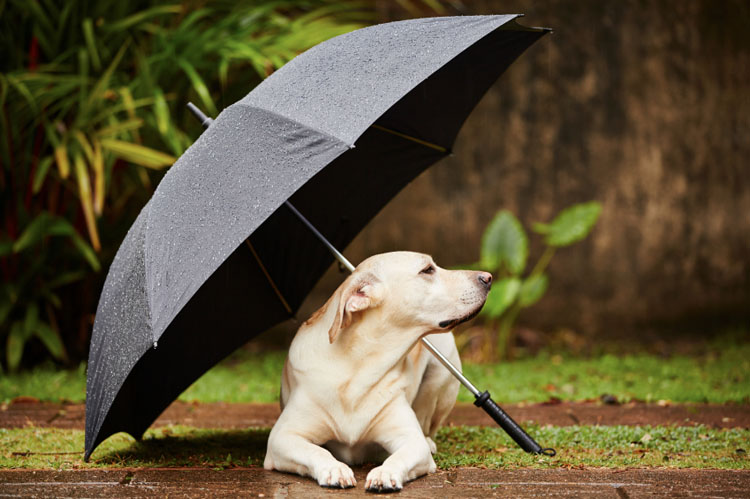
Believe it or not, dogs refusing to go outside when it rains is a pretty common issue with all types of dogs–big or small, male or female. Boy, it can be frustrating, especially when it rains for days straight. If your dog stops in her tracks the moment she steps outside on a rainy day, give these tried and true dog training tips a try. They really work. Pssst I live with a dog that hates going outside on drizzly days. He even hates stepping on wet grass. Yes, he’s a big old male Rottweiler. 🙂

Everyone Hates Getting Rained On

If you’ve ever been caught in a rainstorm, you understand sitting in wet clothes is torture. The same applies to your dog. They don’t enjoy getting wet and having to sit around with wet fur. With that said, many dogs need to potty outside, so what should you do?

Grab Your Leash and Umbrella

By far, this is the easiest way to potty your dog during the rain. When it’s potty time, attach a leash to your dog and grab your umbrella as you both head outside in the yard. For small dogs, you can most certainly pick them up and place them on the grass to potty. For larger dogs, grab several yummy treats and lure them outside.

Once you’re outside on the grass, wait patiently while keeping yourself and your dog covered with an umbrella. Ninety-percent of dogs will usually potty using this technique. They just want to get it over with, so they can go back inside. As your dog potties, slowly praise her for doing such a good job and reward with a treat once inside. Now, you can certainly give her a treat once she’s done, but most dogs would rather head inside than chew on a treat on wet grass.

After a few rainy day practice sessions, your dog will learn to run out and potty quickly, then run like mad for the door. 

For the other 10 percent of dogs that just stand there, looking up at you with pleading eyes while holding up a foot, stand still and wait outside for 10 minutes. By standing still, you’re keeping rain off you and your dog with the umbrella. Plus, it prevents your dog from pulling you toward the backdoor. If, after 10 minutes, your dog still hasn’t gone to the bathroom, maybe you need another plan.

Set Up a Covered Potty Area

It’s all about choices, and some of us are unable or unwilling to stand outside with our dogs in pouring cold rain. That’s totally fine. Instead, try pottying your dog in a covered area indoors or outdoors.

When my older dogs needed to potty while it was pouring rain outside, I placed several potty pads under our covered backyard deck. If you don’t have a covered deck, try placing some type of tarp on the corner of your house. This prevents your senior citizen from getting soaked. For smaller dogs, place potty pads in the bathroom or laundry room on rainy days.

RELATED: Housebreaking a Puppy

Dry Your Dog Afterwards

Completely dry off your dog after he potties outside. Keep large towels next to your backdoor. Don’t only dry your dog’s body, but also wipe her wet feet and tail. On cold, rainy days, I like to quickly blow-dry my dogs, which dries their coat and immediately warms them up.

Try Rain Boots

Personally, I don’t think raincoats really help, especially if your dog has never worn sweaters or clothes before. However, booties do help. I’ve seen it happen many times. Velcro waterproof booties will keep your dog’s feet from getting in direct contact with wet and muddy grass. For Sobek, my Rottweiler, putting rain booties on his feet made all the difference. He’ll actually walk out and potty after it rains. It’s definitely worth a try.

Plan Ahead

Watch your weather forecast and bring your dog outside to potty right before it starts to rain. If it’s pouring rain, wait a few minutes for it to die down before you take your dog outside to potty. It’s not fun being outside during torrential downpours. Also, if you’re heading out for a daily walk, either postpone or reschedule. Remember, you may love walking in the rain, but your dog hates it.

Keep potty sessions extremely short. If it starts to thunder and lightning strikes, bring your dog inside and dry her off.

Use Potty Pads

If your dog is terrified of thunderstorms, I highly recommend either placing potty pads inside your home for small dogs or walking your leashed larger dog out to a covered potty area. For thunder-phobic dogs, it’s not exactly the rain that’s frightening them; it’s the thunder, lightning and changes in barometric pressure that terrifies them.

If your dog hates going outside when it’s raining, she isn’t a wimp. She just doesn’t like getting wet like some people. 🙂

Filed Under: Behavior, Dogs, Training Tagged With: dog hates rain outside, dog training, Dog Training Tips, dog will not pee outside raining, dog won't go in the rain, dog won't go in the snow, dog won't pee outside in rain, dog won't potty outside when raining, dog won't walk on wet grass, getting dog to potty outside during rain, how to get a dog to pee outside in the rain, how to teach a dog, how to train a dog, teach a dog, train a dog

Training a Boxer to Calm Down

November 19, 2015 by Fanna Easter

Boxer Behavior: Training Them to Calm Down

Boxer Behavior
belchonock/Deposit Photos

Is living with a Boxer any different than living with a German Shepherd or Pug? Yes and no. All dogs have their own breed characteristics and traits that speak so loudly of that breed, but on the other hand there are certain behaviors all dogs have. The next question is: can dog behaviors that are sometimes not considered polite to humans be trained or are they just what you have to deal with owning a Boxer? All behaviors are trainable. We just need to find what works for your Boxer.

Not So Polite Boxer Behaviors

Boxers are a fun, loving, outgoing and high-spirited breed that have a lot of energy and affection to expel. That being said, some inappropriate dog behaviors can come from all this energy and desire for attention. The most common impolite behaviors I see with Boxers are excessive jumping, pawing and muzzle punching. I’m sure anyone who has a Boxer and is reading this is thinking: “Yes ma’am. I deal with this on a constant basis!” Well, let’s talk about how we can refine your Boxer a little bit.

Jumping

Jumping is common for many dogs, especially energetic and excited dogs. Boxers kind of do this wiggle jump because they can barely contain their excitement. On the positive side of this, they’re quite happy dogs and they radiate excitement. The negative end of this excitement level is they’ll jump all over you or at least right in front of you when you’re trying to get through the door.

A great way to deal with this behavior is to teach an alternate behavior like “sit.” You will want to work on the new desired behavior in a low distraction area when you’re not coming home from being away. What do you do when you come home and your Boxer is wiggling and jumping all over the place? Every Boxer I’ve ever met is food motivated, so let’s use this to our advantage.

Keep tasty treats outside the door in a jar, grab a handful of them before you walk in and toss them on the floor when you enter the house. This distracts your dog for long enough for you to get in the house without being trampled as well as breaks the jumping routine and rewards your dog for keeping all four feet on the floor. Now that you’re inside the house and things are a little calmer, you can ask your Boxer for the “sit” behavior before giving him attention.

Pawing and Muzzle Punching

These two Boxer behaviors go hand-in-hand because your Boxer is usually doing them for the same reason: attention! As we all know, Boxers are usually very affectionate and can be attention hogs, which I love, but sometimes they become a little pushy about it. I have a great exercise that can help your Boxer build some self-control and teach him that patiently waiting for attention will get him the attention he desires.

Begin in a quiet low distraction area. Place medium grade treats in your hand and make a closed fist to present to your dog. Ignore any pawing or muzzle punching from your dog. Say “Eh-Eh” if the bad behaviors become excessive. Once your dog stops pawing or muzzle punching, open your hand full of treats and use your other hand to take a treat to give to your dog. If your dog goes toward the baited hand (hand with treats) when you open it, simply close it and begin the dog training session again.

Continue working on this exercise until you can open your baited hand and reward your dog with each piece of food one at a time, waiting three seconds in between each treat. Soon, you’ll be able to carry the “Eh-Eh” cue over to when your dog is nudging you or pawing you for attention, which should make your Boxer default into the correct patiently waiting behavior.

Dog behaviors are only considered bad if you, the owner, doesn’t like them or finds them a nuisance. Sometimes, you like the behaviors in moderation, which is why working on these exercises will help you gain a little more control in these situations.

READ NEXT: How to Choose a Sport for Your Dog

Filed Under: Behavior, Breeds, Dogs, Training Tagged With: boxer dog training, dog training, Dog Training Tips, how to teach a dog, how to train a dog, teach a dog, train a dog, training a boxer

  • « Previous Page
  • 1
  • …
  • 22
  • 23
  • 24
  • 25
  • 26
  • …
  • 37
  • Next Page »

About

Dog Training Nation is a community of dog trainers, dog owners and dog lovers. Our mission is to provide trainers and owners valuable information to enrich dogs' lives. We cover a range of topics, from socializing puppies to dealing with aggressive dog behavior to selecting the best dog products. It is our hope you share our content to make the dog and owner world a better place.

​

Facebook

Video

Dog Training Nation is a dog training blog for pet owners and dog lovers. We cover a range of topics from puppy socialization tips to dog aggression to dog health. It is our hope you share our content to make the world a better place for dogs.

Dog Training Nation

Quick Links

Dog Training
Dog Behavior
Dog Training Videos
Become a Dog Trainer
About
Contact Us

Copyright © 2026 · Lifestyle Pro Theme on Genesis Framework · WordPress · Log in