Dog Training Nation

In Dogs We Trust

  • Home
  • Training
    • Dogs
    • Puppies
    • Clients
  • Behavior
    • Breeds
  • Health
  • Safety
  • Resources
    • Equipment
    • Books
  • Dog Training Videos
  • About
You are here: Home / Archives for puppy training tips

Should Your Dog Chew Pig Ears?

April 7, 2017 by Fanna Easter

Pros and Cons of Pig Ears for Dogs

Pig Ears for Dogs
klaventure1976/Adobe Stock

Dogs love and need to chew. Chewing provides mental stimulation and exercise, keeps teeth clean, is fun and super relaxing. If dogs aren’t given plenty of chewing opportunities, they’ll likely create their own, which is never a good thing. So, should your dog chew pig ears? It depends. Learn the pros and cons of pig ear chews for dogs.

Pros of Pig Ear Dog Treats

The most appealing advantage about pig ear chews is dogs find them simply delicious! In my 20-plus years as a dog trainer, I’ve never witnessed a dog turning his or her nose up at a smoked pig ear dog treat.

Their thick hide and density make pig ears easy to chew for small, delicate chewers and senior dogs. Another huge plus is pig ear chews keep your dog’s teeth clean and gums healthy, which means fresh breath. Pig ear chews are also odorless even while your dog chews them.

Due to their popularity, pig ear dog treats are readily available at pet retailers and online, and are relatively inexpensive compared to other dog chews.

RELATED: Are Antler Chews for Dogs Safe?

Cons of Pig Ear Dog Treats

Pig ear dog treats are high in fat. When consumed daily, pig ear chews can cause vomiting and diarrhea. Overzealous chewing dogs (power chewers) may choke or swallow large chunks, causing GI obstruction hazards.

Another pro about pig ear chews is power chewers can literally consume a pig ear chew within seconds, which can get very expensive. Most pig ear dog treats are also covered in chemicals, additives and preservatives, so choose chews made in the USA only.

Since pig ear chews for dogs taste so delicious, some dogs may exhibit resource guarding behavior and protect these treats from other dogs, people and children.

Pig Ear Chew Safety

If your dog is prone to obesity, has pancreatitis, is currently eating a bland diet or consumes chews too quickly, then it’s best to provide a different type of dog chew.

Pig ear chews are best for small dogs, delicate chewers and seniors in moderation (one chew per week). For power chewing dogs, bully sticks are a better option. Remember, supervision is vital while dogs chew. It’s the best preventative for choking or digestive obstructions.
Filed Under: Health, Puppies, Training Tagged With: best treats for dogs, best treats for puppies, chew stick dogs, chew sticks puppy, dog training, Dog Training Tips, how many pig ears can I give my dog, my dog ate a whole pig ear, pig ear chews, pig ear chews for dogs, pig ears vs bully sticks, pig ears vs rawhide, puppy training, puppy training tips

Capturing Dog Behavior

May 15, 2015 by Fanna Easter

Capturing a Dog Behavior: That’s It!

Dog Behavior
suemack/iStock

A teacher uses basic teaching fundamentals for humans, dogs, cats, fish and snails so let’s discuss capturing a behavior. This is a powerful way to teach your dog a new behavior.

What is Capturing?

Think about using a camera. When taking a picture, you’re capturing a moment in time. When capturing dog behavior, it’s the same process, except you’re using a clicker to capture a moment in time. And then giving your dog a treat so that moment in time continues.

Imagine you and I standing in a room. Then, after a few minutes of chatting, I move a chair in the middle of the room and you moved toward it to sit. As your behind touched the chair, I clicked and gave you $100. What did you just learn? Ha, that it pays to sit in that chair, right? This is capturing.


 Capturing works best for naturally occurring behaviors.


When encouraging participation during a business meeting, reward questions with small bits of chocolate or mints. At first, participants will giggle, but after 10-20 minutes, you’ll have an actively engaging meeting. For introverts, I reward with two pieces of candy. These folks are tough to engage.

If you find need to slow down participation, withhold rewards a bit and reward every third question. Capture and reward know-it-all attendees every third time because constant rewards will ensure their hand is always raised. At first, they’ll become a little perplexed, but they will learn to control their behavior and hand. 🙂

How to Capture Dog Behavior

When using a clicker to mark behaviors you like and then giving your dog a treat, you’re saying, “That’s what I want so keep doing it.”

Capturing is very powerful so be careful of what you capture. 🙂  When dogs bark at us, we look at them–you just captured that behavior. Your dog jumps up on you so you push them down. You just captured that behavior. That’s why, as dog trainers, we ask you to choose good behaviors to replace naughty ones. If your dog jumps up, wait for all four feet to touch the ground and click/treat. When your dog barks, click and treat when she’s quiet.

Naturally occurring examples are:

  • Sitting.
  • Lying down.
  • Calming down.
  • Loose leash walking.
  • Stretching.
  • Barking.
  • Not barking.
  • Picking up a paw.
  • Looking at you.
  • Whining.
  • Licking.
  • Standing.
  • Yawning.
  • Keeping four feet on the floor (not jumping up).

Capture Often

If you attend my group classes, you’ll hear this phrase often. The more you capture good behavior, the faster your dog will keep offering it. Even if you must click and treat 10 times in a row when your dog stops pulling on the leash, you’ve taught your dog that keeping the leash loose pays!

Check out these videos to watch capturing in action.

VIDEO: How to Teach a Dog to Sit

VIDEO: Teaching Your Dog to “Touch”

You really can’t give too many treats. Just make sure your dog has earned them for good behavior. 🙂

READ MORE: Shaping Dog Behavior

Filed Under: Behavior, Resources, Training Tagged With: capturing behavior, clicker training capturing behavior, dog trainer tips, dog trainer tips for puppies, Dog Training Tips, help for naughty dogs, how to reward good dog behavior, puppy training tips, rewarding good dog behavior

How to Train a Puppy to Give Items Back

February 4, 2015 by Fanna Easter

Teach a Puppy to Give

Puppy Trade Game

Train a Puppy to Give Items Back
Teach your puppy to trade the sock for a yummy treat. willeecole/Deposit Photos

Puppies were not born with nor read, the pet owner’s guide to polite manners so it’s important to teach them the trade game. Would you give up the $100 bill you found at the park? Probably not. 🙂

Trade Game

When puppies or dogs find something, they intend to keep it. Guarding resources is a natural instinct. The more you have, the more likely you’ll survive. Plus, puppies and dogs will pick up items, such as socks, to instigate play like chase. Oh, it’s tempting to chase a puppy with your sock. We panic and think, “Oh my god, they will swallow it!” and we continue chasing. Not fun huh?!

Instead, teach your puppy or dog how to trade instead. And say goodbye to crazy chases around the dining room table. 🙂

RELATED: Resource Guarding

How to Teach Your Dog to Give Items Back

Whenever your puppy or dog picks up a sock, shoe or a child’s toy, instead of chasing him, try:

  • Stop moving. Your puppy will probably stop moving too.  He’s not sure what’s going on.
  • Walk to the refrigerator and select a yummy treat. These treats must be yummy. They should behoove your puppy to trade the smelly sock for something better.
  • Approach your puppy. If she runs away, stand still.
  • Say “trade” and show her the yummy treat. She probably smells it already, but thinks the treat is for you and not her.
  • Remain still and wait for your puppy to drop the sock. If she continues running with the sock, your treat needs to be yummier. She’s saying, “Nah, I would rather keep my stinky sock instead.”
  • As she drops the sock, say yes and toss the yummy treat in the opposite direction of the sock.
  • When she runs for the treat, pick up the sock.

Now, you’re not rewarding your dog for stealing socks. You’re rewarding her for giving it up.  

VIDEO: Teach Your Dog the Trade Game

Taking Items From a Puppy’s Mouth?

On rare occasions, such as a puppy snatching up a cooked chicken bone or medication, I would remove it from her mouth. Now, as I explain to my puppy people, don’t make this a habit. If you do, your puppy will learn to swallow an item quickly, usually as you approach. She knows you’re going to take it away!

You may also like: Free Games for Dogs

Filed Under: Puppies, Training Tagged With: dog trainer tips for puppies, how to train a puppy, how to train your puppy, polite puppy manners, preventing resource guarding, puppy guards toys, puppy trade game, puppy trade me game, puppy training, puppy training tips

Help! My Dog Refuses to Walk

February 4, 2015 by Fanna Easter

What to Do When Your Dog Refuses to Walk

Dog Refuses to Walk
Learn tips to un-pancake your dog!

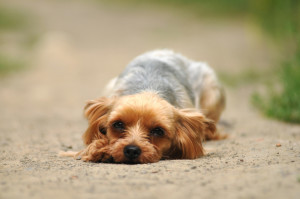
Most likely, you’ve had this happen during walks. When you’re heading home after a fun walk in the park, your healthy dog flattens himself to the ground, refusing to walk any farther. I call this “pancake dog,” meaning a dog will splat himself against the ground and refuse to walk.

Now, if your dog is limping, ill or injured, this doesn’t apply. Bring your dog to the vet ASAP.

Why Dogs Refuse to Walk

Below are a few reasons why a dog refuses to walk and flatten himself onto the ground.

Fearful

About 50% of the time, I notice puppies and dogs refuse to move forward due to fear. Usually, their bodies are lying backwards away from whatever is frightening them. This happens because a puppy or dog is scared of whatever he is approaching at the time. This could be another dog, person, narrow space, barrier or she has not learned how to walk on a leash. Honestly, it could be anything.

Never force or drag a dog past a scary object. Instead, stop to give your dog some time to process the situation. If she’s still scared, use the Hansel and Gretel technique described below. For smaller dogs, it may be easier to pick them up and walk past the scary thing. At home, practice confidence building games, such as Touch the Goblin.

RELATED: How to Train Fearful Dogs

Don’t Let the Fun End

Dog Training Tips
Learn tips to get your dog happily moving forward!

And this is the other 50%. 🙂 Puppies and dogs are smart. They’ve learned that splatting against the ground and holding firm keeps them in their favorite environment longer. Dogs will refuse to move usually once you turn to head home. I’ve had puppies splat after class. They don’t want to leave. 🙂

The Hansel and Gretel technique will get them moving. Also, practice randomly walking away from the park and then rewarding good behavior (non-splatting) by walking back to the park for another game of fetch. No one wants the fun to end, but by making the act of going home fun, you don’t have to worry about pancaking along the way.

Un-Pancaking Your Dog

The goal of this dog training exercise is to get your dog up and willingly move forward, which builds confidence. Studies have shown giving dogs choices and allowing them to choose is just as reinforcing as treats—something to ponder!

Hansel and Gretel

Unlike the children’s fable, you’re moving your dog away from the monster not toward it. Sprinkle yummy treats in a trail past the scary thing. Using super yummy treats will really help. Your dog (or puppy) will eat the treats while keeping an eye on the monster. But he’s moved himself, which is a big step forward!

Plus, pairing yummy treats with something scary, well, makes things less scary. If you were stuck in an elevator, you would probably freak out. But what if you were stuck in an elevator with a dozen delicious cupcakes or a six-pack of your favorite beer? Not so bad, huh? You’ll indulge while waiting for someone to rescue you. 🙂

Touch the Goblin

During this game, you’ll need a clicker and lots of yummy treats. Introduce something odd in your home, such as the vacuum or folding step stool (both usually freak dogs out). Practice each step 10 times and then move onto the next one. If your dog becomes frightened, take 1 to 2 steps back.

Never move, wiggle or touch the scary thing during training sessions. This just makes the scary thing even more terrifying to your dog.

  1. Click and treat when your dog looks at the scary object.
  2. Now, click and treat when your dog walks over to the scary thing.
  3. Usually, after a few sessions, dogs will try to touch the scary thing with craned necks, wide eyes and splayed out back legs. Click and treat this behavior. They are being pretty darn brave right now.
  4. Say “touch the goblin” as they lean forward, trying to touch it with their muzzle.
  5. After a few touches, your dog will exude confidence. He successfully slayed the dragon so be proud! We call this building confidence. 🙂

After a few “touch the goblin” sessions with different scary things, you’ll notice your dog will likely march right up and touch the next scary thing. He’s learning that scary things will not harm him.

WATCH: How to Get a Dog Moving When He Refuses to Walk

You may also like: Humping Dogs

Filed Under: Behavior, Dogs, Puppies, Training Tagged With: dog refused to move, dog refuses to get out of water, dog refuses to go outside, dog refuses to leave, dog refuses to leave dog park, dog refuses to walk during walks, dog training, Dog Training Tips, dog training videos, fearful dogs, how to train a puppy, my dog refuses to walk on leash, my dogs stops moving on leash, positive reinforcement dog videos, professional dog training tips, puppy is scared of moving cars, puppy training tips

Complete New Puppy Checklist

January 25, 2015 by Fanna Easter

Bringing Home a New Puppy

Bringing Home a New Puppy
I want all this stuff! Woof!

You’ve reached the ultimate puppy or older dog checklist! Here, you’ll find tons of information all rolled up on one page.

How to Use the Checklist

Before bringing your new puppy or older dog home, it’s important to shop for essential items and brush up on skills. Below is a complete new puppy checklist, which I recommend printing for reference. Click on the links within the list to explore brand names, pros and cons of products, dog trainer-approved products and product instructions.

Complete New Puppy Checklist

  • Crate
  • Bedding (Old Towels or Blankets)
  • Toys (Rubber Balls and Tugs)
  • Chewies (Bully Sticks and Nylabones)
  • Water Dish
  • Dinner Toy (Kong Toys, Kong Wobbler or Puzzle Toys)
  • Collar (Flat Buckle or Martingale)
  • Leash
  • ID Tags
  • Poop Bags
  • Good Quality Food (Kibble, Raw or Cooked)
  • Treats
  • Enroll in Group Class (Puppy or Adult Dog Class)
  • Brush Depending on Fur Type
  • Pet First Aid Kit
  • Download Pet First Aid App
  • Seat Belt for Car Rides
  • Toothbrush and Dog-Specific Toothpaste
  • Puppy or Dog Training Books

New Puppy Links

Once shopping is complete, it’s time to brush up on new puppy training skills. Don’t worry, we have you covered! Each link redirects you to tips and tricks on preventing, cleaning or using recommended products. Feel free to print these articles for further reference.

  • Crate Training
  • House Training Using Paper or Pads
  • Importance of Enrolling in Puppy or Adult Dog Class
  • Teething – What to Expect
  • Surviving the First Night Home
  • Pet Insurance – A Must-Have
  • Prevent Puppy Nipping
  • Best Products for Removing Urine

Enroll in a Dog Training Class

Yes, it was mentioned earlier, but it’s worth repeating you should enroll in a dog training class within 1 to 2 weeks. You’re beginning to build an extremely strong bond, which is invaluable. Plus, you have an expert available for any questions!

You may also like: Multiple Dog Household Tips

Filed Under: Behavior, Puppies, Training Tagged With: before adopting a dog, before buying a dog, best puppy checklist, best puppy training tips, bringing home a puppy checklist, new puppy checklist, puppy checklist, puppy checklist what do I need, puppy supply checklist, puppy training tips, ultimate puppy checklist

  • 1
  • 2
  • 3
  • …
  • 5
  • Next Page »

About

Dog Training Nation is a community of dog trainers, dog owners and dog lovers. Our mission is to provide trainers and owners valuable information to enrich dogs' lives. We cover a range of topics, from socializing puppies to dealing with aggressive dog behavior to selecting the best dog products. It is our hope you share our content to make the dog and owner world a better place.

​

Facebook

Video

Dog Training Nation is a dog training blog for pet owners and dog lovers. We cover a range of topics from puppy socialization tips to dog aggression to dog health. It is our hope you share our content to make the world a better place for dogs.

Dog Training Nation

Quick Links

Dog Training
Dog Behavior
Dog Training Videos
Become a Dog Trainer
About
Contact Us

Copyright © 2026 · Lifestyle Pro Theme on Genesis Framework · WordPress · Log in